




Most service businesses in the UAE are already running on WhatsApp whether they planned to or not. Inquiries come in on WhatsApp. Quotes go out on WhatsApp. Booking confirmations, follow-ups, complaints, referrals: all on WhatsApp.
WhatsApp was never meant to be a business system. But it became one because customers expect instant replies and that's where they are. The real problem isn't the app. It's what happens next: someone reads the message, figures out what it is, finds the answer, writes back, and maybe logs it somewhere. Do this two hundred times a day and you're not running a business. You're running an expensive inbox.
This is what AI agents solve for service businesses in hospitality, events, real estate, and professional services across the UAE. Not replacing people. Replacing the work that should never have needed a person in the first place. This is WhatsApp automation in its real sense: the agents run on the WhatsApp Business API, which lets them read, answer, and log every message automatically instead of a person doing it by hand.
In short
- A WhatsApp AI agent reads real messages, pulls from your actual business data, hands off to humans when needed, and updates your CRM. A scripted chatbot can't do any of this.
- For a business handling ~300 conversations/month, a fully running system typically costs $300–$800/month versus AED 5,000–12,000/month for one person on one shift.
- The bigger win is revenue: in high-consideration categories, the business goes to whoever responds first with something useful.
- It is the right move when message volume is straining your team, your services and pricing are consistent enough to represent accurately, and you have (or are building) a CRM.
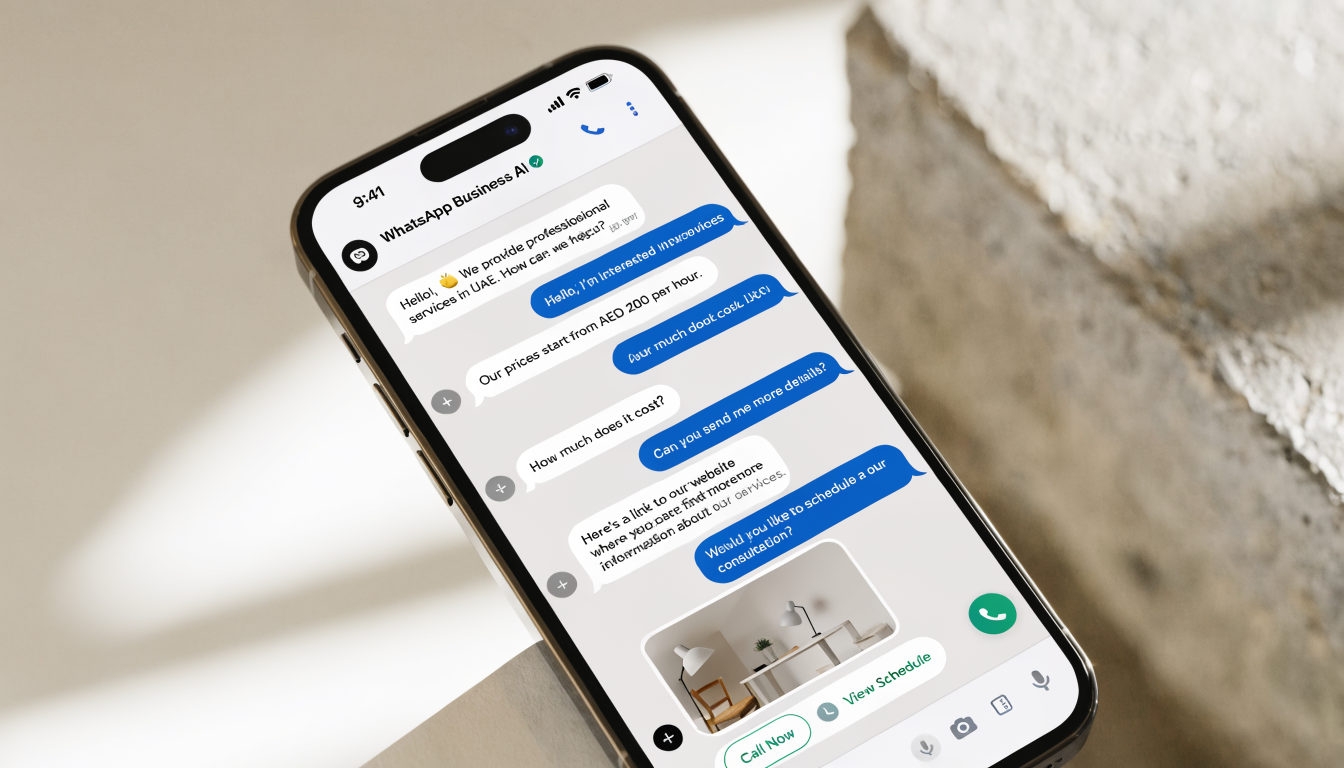
What a WhatsApp AI agent (automated chatbot) actually does
The word "chatbot" has been around for fifteen years and most people have met a bad one. An AI agent is not a decision tree with canned responses, and it is not the "press 1 for billing" experience dressed up differently. A properly built WhatsApp AI agent does four things a traditional chatbot cannot:
| Capability | What it means in practice |
|---|---|
| Understands unstructured language | A customer types "hi I want something for 200 people in November outdoor maybe pool area not sure yet" and the agent reads an event inquiry with real parameters, not unmatched keywords. |
| Pulls from your actual business data | Uses real pricing, availability, services, FAQs, and past client conversations. Your team's actual information, not an old script. |
| Knows when to stop | If a message is complex, emotional, or outside its scope, it hands off to a human right away with full context. No guessing. |
| Connects to the rest of your stack | A message that qualifies a lead can create a CRM record, notify a salesperson, schedule a follow-up, and send a confirmation in the same flow. |
That's the key difference: workflow tools vs reasoning engines. Read our breakdown of n8n vs Claude agentic AI to understand what each does.
WhatsApp chatbot for Dubai businesses
A WhatsApp chatbot for a Dubai business is an automated assistant that runs on the official WhatsApp Business API and answers customer messages on your business number. The scripted kind follows a fixed menu. The AI kind, the agent described above, reads the message, answers from your real pricing and availability, qualifies the enquiry and hands anything complex to a person. For most Dubai service businesses the practical setup is the official API on your existing number, the agent trained on your services and FAQs in Arabic and English, a CRM connection so every conversation is logged, and a handover rule so a human joins the moment the bot is out of its depth. Setup is typically 4 to 6 weeks and the running cost sits in the $300–800 a month range covered below. If you want one provider to handle the API, the CRM and the agent, see our WhatsApp Business API and automation service in Dubai.
The real cost of not having this
A team member handling WhatsApp full-time in the UAE costs AED 5,000–12,000 per month depending on the role. That covers one person, one shift, one language, one conversation at a time. An AI agent costs a fraction of that, handles unlimited concurrent conversations, is available at 3am, responds in Arabic or English or both, and does not have a bad day.
| Human (one seat) | WhatsApp AI agent | |
|---|---|---|
| Monthly cost | AED 5,000–12,000 | ~$300–800 to run |
| Availability | One shift | 24/7 |
| Concurrent chats | One at a time | Unlimited |
| Languages | Usually one | Arabic + English |
| Response time | Minutes to hours | Under 30 seconds |
But money saved isn't the real win. The bigger win is the revenue you keep when you respond fast. In events, weddings, real estate, and hospitality, the deal goes to whoever responds first with a real answer. An agent that replies in under 30 seconds, qualifies the lead, and asks smart follow-ups does more than save money. It keeps the deals you'd otherwise lose. See how this works in real estate, or how event organisers use it for ticketing and reservations.
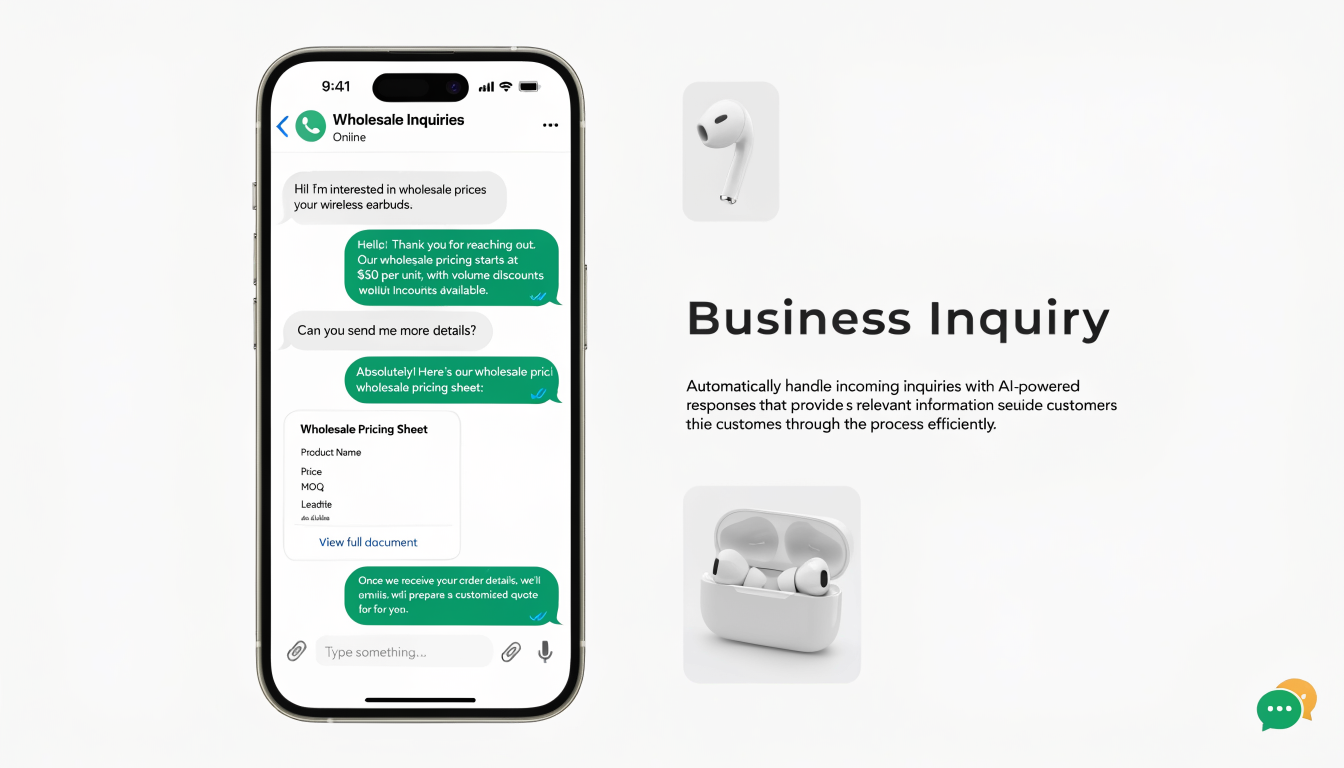
How a multi-department setup actually works
For businesses with sales, operations, admin, and support teams, one WhatsApp agent is just the front door. What comes after it matters more.
- A customer sends a message on WhatsApp.
- The agent figures out who they are (new prospect, existing client, team member) and what they need.
- It routes to the relevant department agent: sales for a new booking, operations for a logistics question, support for a complaint.
- Each department agent has its own knowledge base, escalation rules, and connection to the tools that team actually uses.
The customer has one smooth conversation. Your team gets every message handled, logged, and actioned without manual inbox sorting. For a busy business handling 80-100 deals per month, the manual work of reading, sorting, forwarding, waiting, and relaying takes up huge chunks of every day. It feels important until you automate it and realize it added zero value. See how we built this for a UAE events platform.
What it costs to run
This is the question worth asking before any build starts. AI agents use language model APIs to process each message, and those costs add up in ways that are not always obvious upfront.
| Item | Typical range (300 conversations/month) |
|---|---|
| API cost per complete conversation (5–15 messages) | $0.05–$0.30 |
| Monthly model/API cost | $15–$90 |
| WhatsApp Business API access | Platform-dependent |
| Automation infrastructure + CRM connectivity | Included in build |
| Fully running system, this scale | $300–$800/month |
The key variable isn't cost per message. It's building the system so it doesn't waste tokens on every message: tight prompts, smart routing, and clear escalation rules. The choices you make at the start decide if the system runs cheap or burns money on wasted API calls. This is where n8n fits in: as the reliable plumbing around the reasoning. For the full cost breakdown, Meta's per-message charges, platform fees, and setup, see WhatsApp Business API pricing in the UAE.
Not sure you even need the API yet, or whether the free app still covers you? Start with WhatsApp Business API vs WhatsApp Business App.
Running a service business in the UAE with lots of WhatsApp messages? We map your real message volume, find what can be automated, and build around your existing tools. Not a template. Book a 30-minute discovery call →
The limitations worth knowing before you build
Any agency that tells you an AI agent handles everything without caveats is selling you something you will regret buying. The real limitations:
| Limitation | Why it matters |
|---|---|
| It needs good source material | The agent is only as good as the information you feed it. Vague services and inconsistent pricing show up in customer replies. The build will find these gaps. You'll need to fix them. |
| It is not a replacement for relationship-led sales | A client spending AED 200,000 on an event does not want to close with a chatbot. The agent qualifies, gathers information, and hands off at the right moment. |
| Escalation design matters enormously | The most common failure mode is an agent that tries to handle things it should not. Knowing when, how, and to whom to hand off is a business-process problem, not a technical one. |
| It needs to be maintained | Services, pricing, and policies change. An agent accurate on day one gives wrong answers if nobody updates it. This is not a build-and-forget system. |
What the build process looks like
Build starts before any code is written. First, understand what messages you actually get (not what you think you get). Look at real conversations. Most businesses find that 60-70% of messages are versions of the same 10-15 questions. That's your automation opportunity.
From there:
- Define what the agent handles autonomously, what it escalates immediately, and what falls in between.
- Build the knowledge base, and give the agent a tone of voice taken from your brand guidelines rather than a generic assistant voice.
- Choose the right model and infrastructure for the volume and complexity.
- Integrate with your existing CRM and communication tools.
- Test with real message scenarios, not curated examples.
- Measure what matters.
A mid-complexity setup (one to two departments, WhatsApp, CRM integration) takes about 4 to 6 weeks from start to live. See our full AI automation service.

The industries where this is already working
This is not theoretical. Businesses across the UAE are already running AI agent infrastructure on WhatsApp:
| Industry | What the agent handles |
|---|---|
| Events & hospitality | Inquiry qualification, package information, availability checks, booking confirmations across venues running dozens of events a month. |
| Real estate | Qualifying portal and direct leads, routing to the right broker, sending property information, following up on cold leads automatically. |
| Professional services | Law firms, accounting practices, and consultancies handling FAQs, document request intake, and appointment scheduling without tying up senior staff. |
| Food & beverage | Reservation requests, dietary queries, and event catering inquiries across channels with zero phone dependency. |
The common thread is not the industry. It is the operational pattern: high message volume, repetitive inquiry types, revenue sensitive to response speed, and a team spending significant time on communication a system could handle better.
Is this the right move for your business right now?
Not every business is ready. The ones that get real value share a few characteristics:
- Volume is creating strain: response times are getting slower, your team spends more time on admin than sales, or you lose inquiries when no one's around.
- Services and pricing stay the same: If every deal is totally custom with no repeating patterns, the agent has nothing to work with. You need enough consistency for it to represent you.
- You have or are building a CRM: Without a place to send the data the agent collects, it's just an expensive auto-reply. Real value comes when it feeds your pipeline.
- You invest in building it right: A $200 off-the-shelf chatbot won't do what we're talking about here.
Frequently asked questions
What is the difference between a WhatsApp AI agent and a chatbot?
A traditional chatbot follows a fixed menu with scripted answers. A WhatsApp AI agent understands real language, pulls answers from your live business data, decides when to hand off to a human, and connects to your CRM to take action. Not just reply.
How much does a WhatsApp AI agent cost to run in the UAE?
For about 300 conversations per month, API costs run roughly $15-$90. A complete system with WhatsApp API, automation, and CRM costs $300-$800 per month. Compare that to AED 5,000-12,000 for one person on one shift.
Model choices underneath those numbers involve real trade-offs. Here is how to think through them →
Will an AI agent replace my sales or support team?
No. It removes the repetitive stuff: 60-70% of messages that are versions of the same questions. Your team handles the complex, high-value, and emotional conversations with full context. Big deals still close with a human.
Does a WhatsApp AI agent support Arabic and English?
Yes. A built agent replies in Arabic, English, or both. That's a huge advantage over one human stuck on one language and one shift.
How long does it take to build a WhatsApp AI agent?
A mid-complexity setup (one to two departments, WhatsApp, CRM integration) typically takes 4 to 6 weeks from start to live. That includes discovery, building the knowledge base, integration, and testing with real messages.
Can the AI agent connect to my CRM?
Yes, and it should. Connecting to your CRM turns it from just an auto-reply into a real revenue tool. It creates records, notifies salespeople, schedules follow-ups, and fills your pipeline automatically.
Talk to us about your WhatsApp operation
Share what you are handling today and we will come back with a clear picture of what can be automated, what it would cost to run, and what a realistic build looks like for your business.
A note on the tooling questions we get asked
GoHighLevel: WhatsApp automation in GoHighLevel works, and for agencies already running GHL as their client platform it is often the pragmatic choice. The limits show up in conversation design: the flows are marketing-shaped rather than support-shaped, so anything needing real branching or a knowledge base usually gets built alongside it rather than inside it.
Bulk senders: a WhatsApp message sender and automation tool that drives WhatsApp Web from a browser is not the same category as the API. It works until the number is restricted, has no delivery reporting, and cannot receive webhooks. Every serious build here sits on the official API.
Real estate lead management: for a Dubai real estate agency, the pattern that works is lead management and WhatsApp on the same record: portal enquiries create the deal, the AI agent qualifies on WhatsApp within a minute, and the transcript lands on the CRM contact before an agent picks up. We cover that build in detail in real estate CRM and WhatsApp automation.