




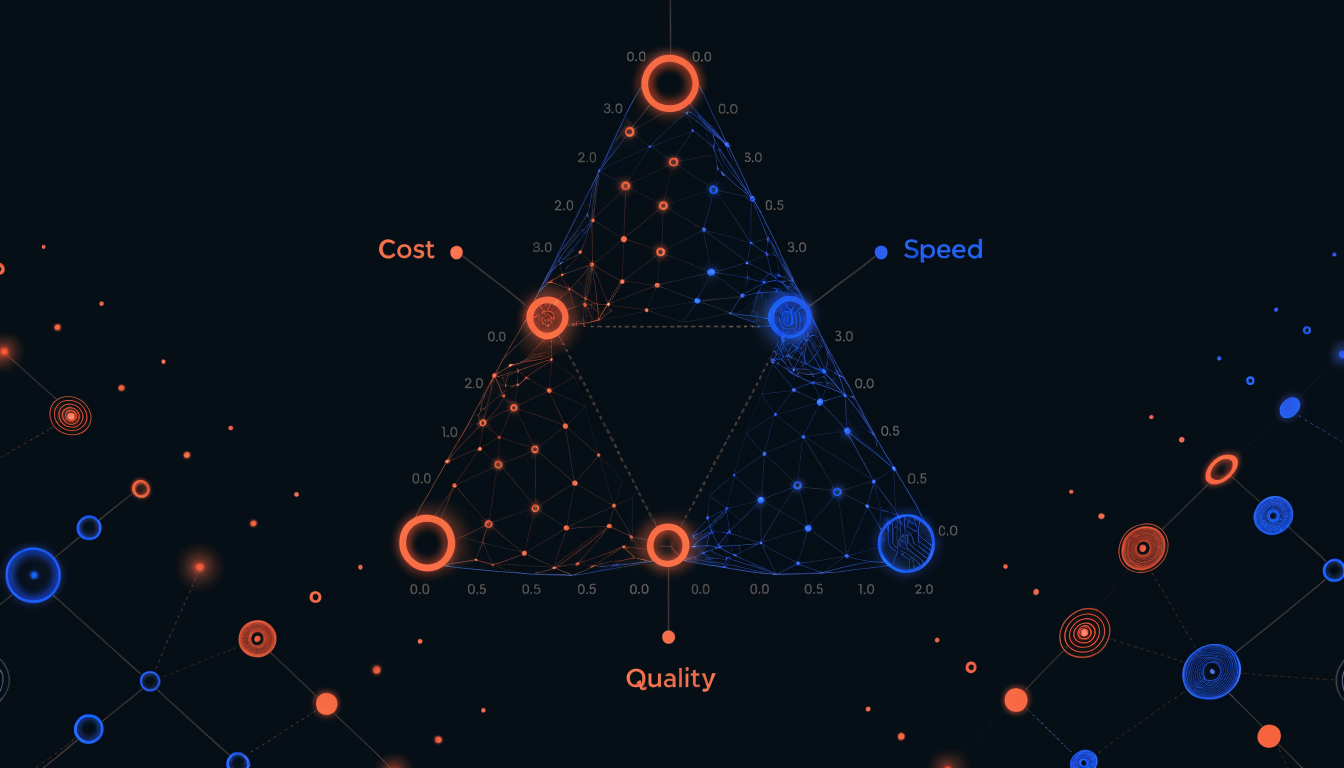
Constraint every AI engineer who built something in production understands but almost nobody talks about in public. Has three corners: cost, latency, quality. Can optimize hard for two. Third moves against you.
Not limitation of any specific tool or model. Structural property of how these systems work. Businesses ending up with AI agents actually running well in production (under real load, real users, months not days) understood this constraint before starting. Ones that did not discover it expensively after launch.
What follows: breakdown of this triangle with real numbers, why decision differs for different system components, and how to think through which corner to optimize before writing code.
What the three corners actually mean
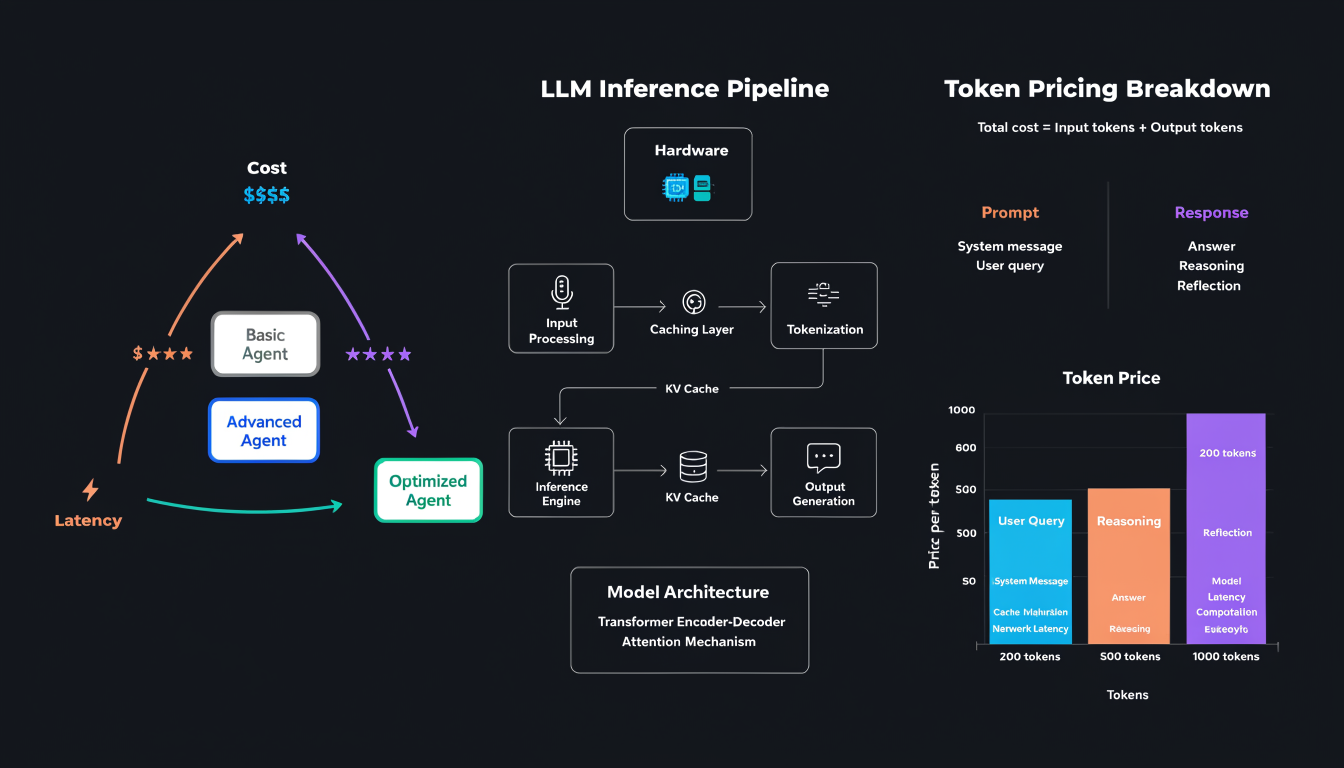
Cost has two components most conflate. First: inference cost (what you pay every time agent processes query). Second: infrastructure cost (underlying compute model runs on). Separate decisions that interact in non-obvious ways.
Latency is time between user sending message and agent responding. Customer on WhatsApp: two seconds feels acceptable. Three seconds starts slow. Five seconds and significant users disengage or resend. Voice call tolerance even tighter: anything above 1.5 seconds response generation breaks conversational flow.
Quality is accuracy, relevance, coherence of output. Customer-facing agent handling bookings: quality means correct information confidently. Sales coaching agent reviewing calls: quality means useful insights not generic observations. Content generation: quality means output needing minimal editing.
Cannot have all three simultaneously because decisions improving one typically degrade at least one other. Larger models produce higher quality but cost more per query, respond slower. Aggressive speed optimization usually means smaller, cheaper model handling straightforward queries well but struggling with complexity. Cutting costs through infrastructure introduces reliability trade-offs showing up as latency spikes under load.
See how this affects workflow tools vs AI agents →
The real cost numbers
Most discussions stay abstract. Here is 2026 actual numbers.
Cloud API route:
| Model | Input Cost | Output Cost | Per-Conversation |
|---|---|---|---|
| Haiku 4.5 | $1/M tokens | $5/M tokens | ~$0.006 |
| Sonnet 4.6 | $3/M tokens | $15/M tokens | ~$0.018 |
| Opus 4.7 | $5/M tokens | $25/M tokens | ~$0.030 |
Typical WhatsApp exchange (inquiry, 3-4 back-and-forth messages, qualification or escalation): roughly 2,000 input tokens, 800 output tokens per full conversation.
At 1,500 conversations per month:
- Haiku: ~$9/month API cost
- Sonnet: ~$27/month API cost
- Opus: ~$45/month API cost
Numbers look manageable until adding system prompt, retrieval context, memory layer passed with every query. Well-architected agent with full context window: 8,000-15,000 input tokens per exchange depending on background information needs.
Same 1,500 monthly conversations on Sonnet moves from $27 to $120-$200/month before output tokens for longer responses.
Prompt design and retrieval architecture directly affect operating cost. Not marginal consideration. Difference between sustainable system and second-largest software expense.
Open source infrastructure route:
| Hardware | Spot Price | On-Demand | 24/7 Monthly |
|---|---|---|---|
| A40 GPU | $0.29/hr | ~$0.60/hr | $210-400 |
| A100 GPU | $1.79/hr | $2.50/hr | $1,290-1,800 |
| H100 GPU | $2.99/hr | $4.20/hr | $2,154-3,024 |
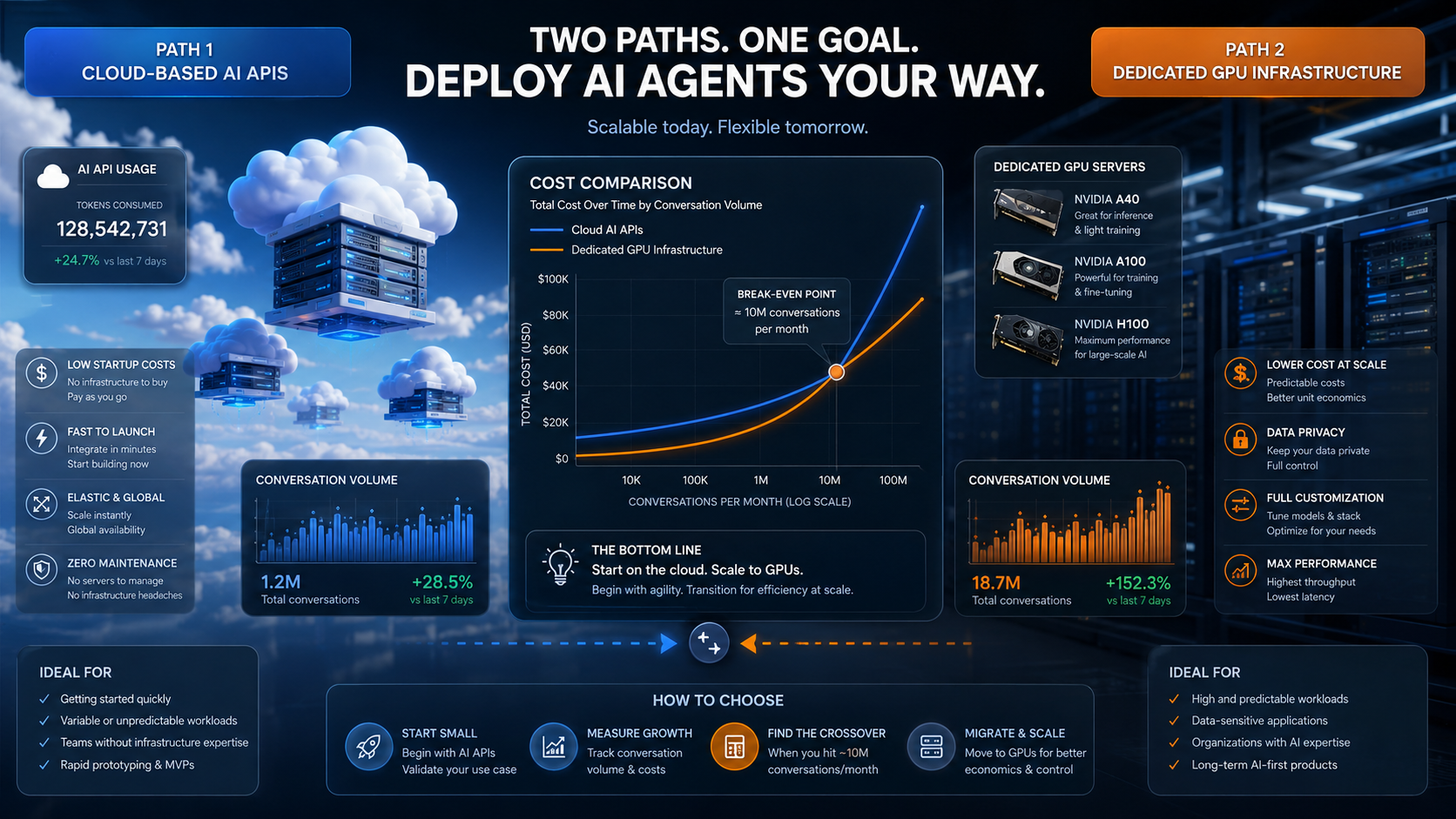
A40 running 24/7 costs roughly $210 spot or $400 reliable. Can run 8B parameter model (Llama 3.1, Mistral 8B) with 2-3 second latency under normal load. Zero per-token cost beyond server.
At 1,500 monthly conversations: API route clearly cheaper. Infrastructure route makes economic sense above 15,000-20,000 monthly conversations where fixed GPU cost beats per-token accumulation.
Less obvious cost of infrastructure route: engineering overhead. Managing deployment, monitoring, updates, quality gap between frontier model and open source. Gap is real and matters differently depending on what agent does.
Building AI agent, unsure which infrastructure path for your volume? We run numbers for actual use case: conversations per day, context window requirements, quality tolerance. Before recommending anything. Talk to us →
Latency is not one number
Mistake: treating latency as single variable across whole system. Not.
Per-task decision per component:
| Task | Latency Ceiling | Why | Optimization |
|---|---|---|---|
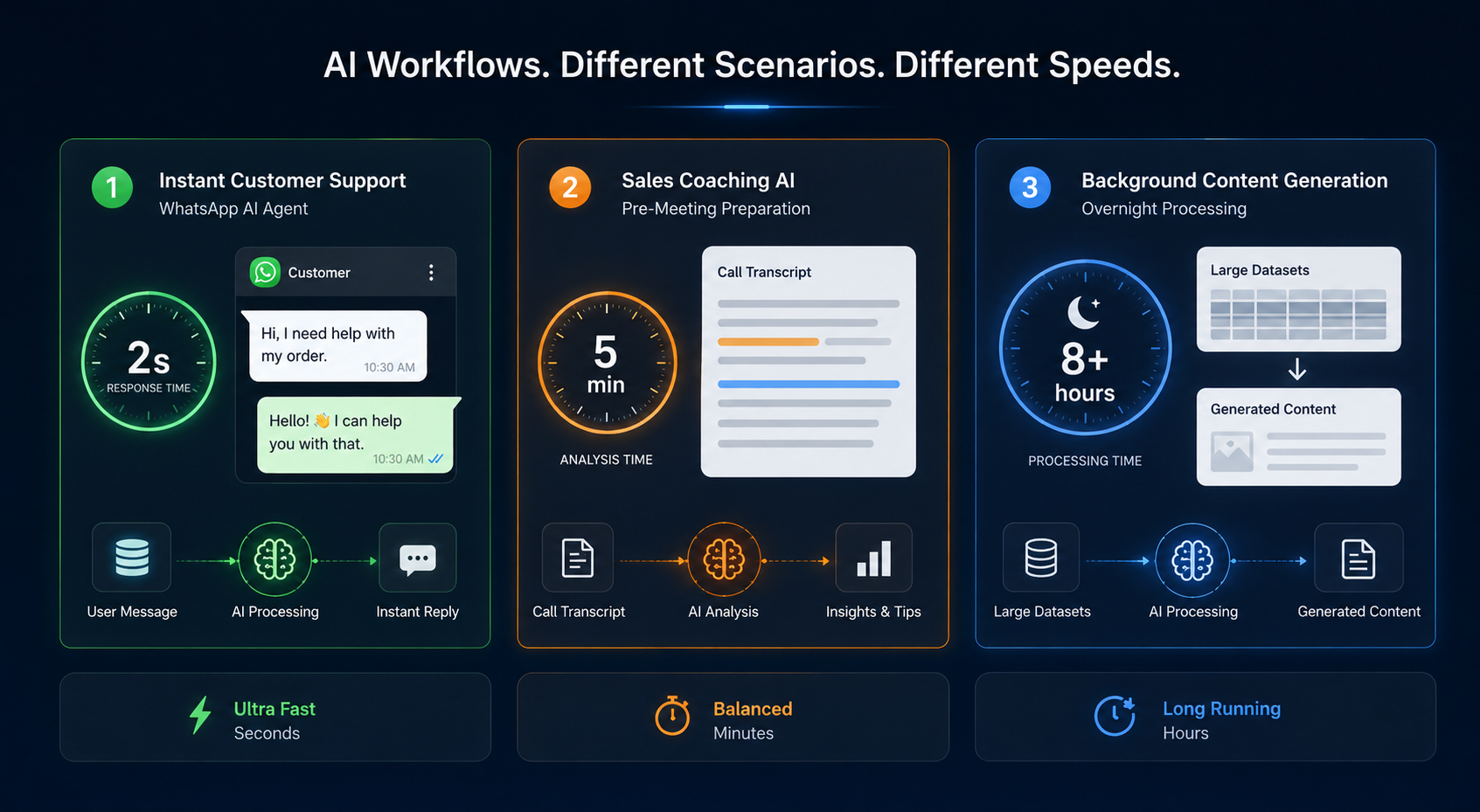
| Customer WhatsApp | <2 seconds | Users don't wait. Slow = perceived low quality | Small model, tight retrieval |
| Sales coaching pre-call | 10-15 seconds | Fits pre-call routine | Larger model, more context |
| Background content brief | No ceiling | Runs overnight | Maximum quality, Batch API |
Customer-facing WhatsApp agent: hard ceiling around two seconds. Non-negotiable. Messaging users don't wait.
Background content generation agent turning inquiry patterns into draft briefs: no latency requirement. Can take twenty minutes.
Sales coaching tool human opens before client call: ten to fifteen second window.
Same business, same system, three different latency budgets. Running all three at WhatsApp standard would degrade sales coaching quality. Optimizing all three for maximum quality would break customer-facing agent.
Right architecture assigns latency budget per task type, selects model and infrastructure accordingly. Design decision, not default.
Open source models: what benchmarks don't tell you
2026 marketing around open source models suggests near-parity with frontier models. Partially true. Caveats matter.
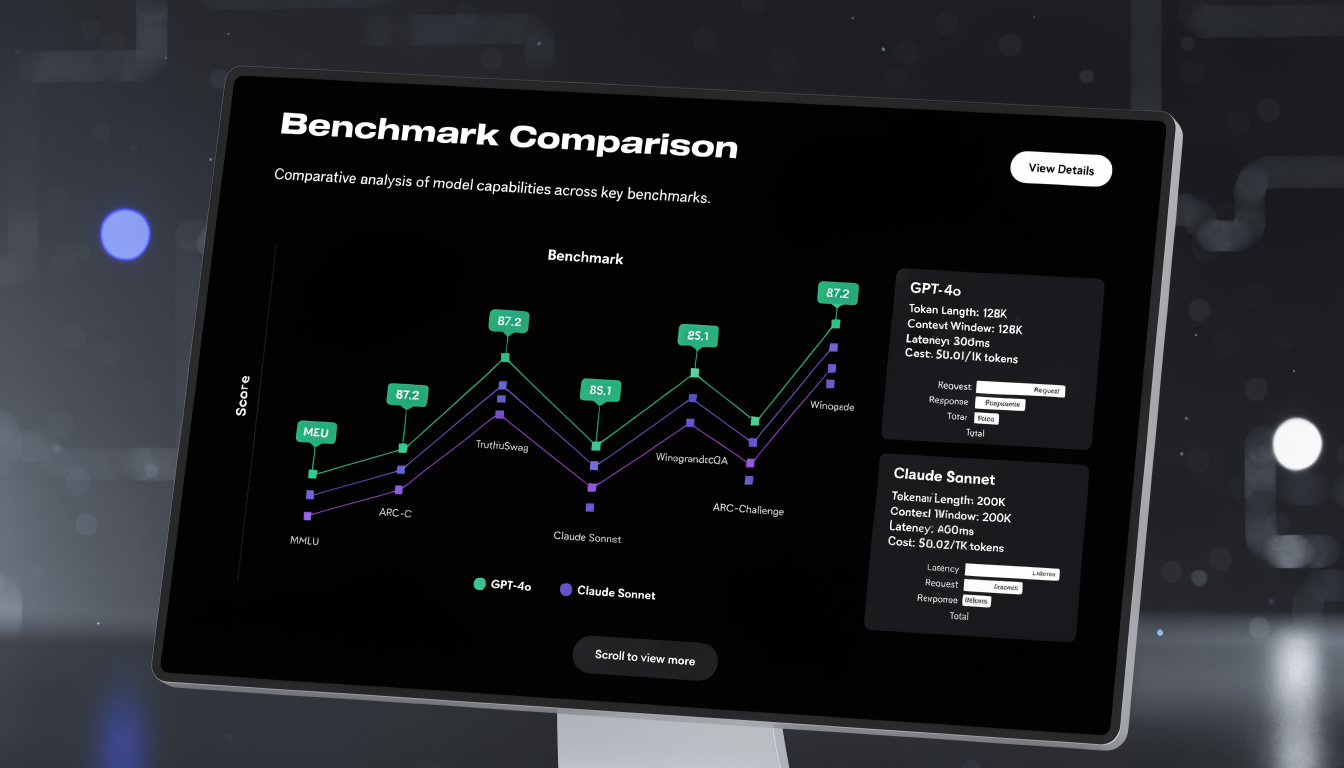
On structured, well-defined tasks (classification, extraction, routing, knowledge base Q&A), well-prompted 8 billion parameter open source model performs genuinely well. Gap with frontier model small enough irrelevant for most production uses.
Gap opens on reasoning under ambiguity. Customer sends hard-to-interpret message (emotional context, mixed intent, implicit references to past conversation): smaller model makes more mistakes. Not always. Not dramatically. But consistently enough that in customer-facing system handling hundreds daily, mistakes accumulate into pattern damaging trust.
Parameter size matters concretely:
| Model Size | Speed | Cost | Reasoning | Use Case |
|---|---|---|---|---|
| <3B | Very fast | Very cheap | Weak | Routing, classification |
| 3-20B | 2-3s latency | Low | Good | Most business tasks |
| 70B+ | Slower | High | Excellent | Complex reasoning |
Production decision not "open source versus API." Per-component question: which tasks need frontier reasoning, which well-served by smaller model, what cost and latency profile at actual volume.
Same system needs different answers for different agents
Multi-agent system (orchestrator routing to sales, operations, support, marketing agents) not single optimization problem. Four or five separate ones sharing infrastructure.
Example: high-volume service business, 50 daily leads:
Customer intake agent: Low latency above all else. Sub-two second response on Haiku 4.5, tightly scoped knowledge base, handles 90+% correctly. Escalates rest to human. Negligible cost at volume.
Sales coaching agent: Completely different problem. Reading transcript, pulling CRM history, cross-referencing deal stage and objections, producing structured brief. Reasoning task. Haiku produces something. Sonnet produces significantly more useful. Latency irrelevant (human opens three minutes before call). Optimizing for cost over quality wrong trade-off.
Marketing agent: Generates content from aggregated inquiry patterns. Runs overnight. No latency budget. Uses Batch API at 50% discount on tokens. Sonnet quality at Haiku pricing for non-time-sensitive output.
Building all three on same model at same settings: architecturally simple, economically and qualitatively suboptimal. Better architecture makes explicit per-component decision and documents why.
See WhatsApp-first businesses handle this →
Caching lever most builds ignore
Prompt caching cuts cached input cost by 90% across all Claude models. Not minor optimization. Agents passing same system prompt and knowledge base context with every query: cache static portions means majority of input tokens cost tenth of normal.
Sonnet agent with 10,000-token system prompt and knowledge base, 1,500 monthly conversations: pays full price once per cache period. Every call within cache window: 10% of input cost. At scale, single architectural decision cuts monthly API spend 40-60% without model change, quality change, or latency change.
Batch API provides 50% discount across all models for non-time-sensitive tasks (content generation, report compilation, analysis runs not needing real-time response).
Combined with prompt caching: effective cost of non-real-time agent tasks drops 95% from headline per-token rate.
Most teams implement neither on first build. Shows up later as cost optimization project after spend visible. Building in from start straightforward if you know exists.
The decision framework
Before any AI agent build starts, three questions answered explicitly per agent in system:
Latency tolerance for this specific task? Hard ceiling? Ceiling determines model tier and infrastructure. Work backwards.
What does wrong answer cost? Customer-facing agent giving incorrect pricing/availability: broken trust event. Internal research agent summarizing news: few minutes editing. Different quality thresholds, different model choices.
Expected volume at twelve months, not launch? System costing $50/month at launch with 500 conversations may cost $800 at 8,000 conversations if architecture not designed for scale. Early infrastructure and caching decisions either scale cleanly or create rebuild project.
Answering these before building not complicated. Working session, not research project. Prevents pattern: system working month one, strain month three, rearchitecting month six when volume grows and cost/latency problems simultaneous.
Our approach to AI automation builds →
No universally right answer to cost-latency-quality triangle. Only right answer for specific system, specific volume, specific error tolerance per component. Businesses getting this right treat as first-principles design question rather than default setting.
That conversation worth having before single line code written.
Scoping AI agent build, want clear picture of cost/latency/quality trade-offs for specific volume and use case? Map architecture before build starts: model selection, infrastructure, caching strategy, cost projections at actual scale. Start conversation →