





WhatsApp support for a UAE online store means answering order, payment and product questions on the channel your customers already use, fast enough that they still want to buy. For most stores the questions are the same few hundred, phrased a thousand ways: where is my order, has my payment gone through, is this in stock in a medium, can I pay cash on delivery, how do I return this. We build WhatsApp customer support systems that answer those questions in seconds from your own data, in Arabic and English, and pass everything that needs judgement to a person who sees the whole conversation and the order behind it.
This piece is for UAE ecommerce brands that have outgrown one phone and a spreadsheet. It covers what the message mix actually looks like, why the manual inbox stops scaling, what we put in its place, what stays human, and what decides your quote.
What WhatsApp support looks like for a UAE online store
For a UAE online store, WhatsApp support is mostly order operations dressed up as conversation. Product questions and pre-sales chat matter, but the bulk of volume is customers checking on something they have already bought or are about to pay for, and every one of those answers lives in your store or courier system, not in anyone's head.

Here is the mix we see when we audit a store's WhatsApp history before a build:
- Order status and tracking. "Where is my order?" in every variation, including the customer who pastes a screenshot of their confirmation email and nothing else.
- Payment and COD confirmation. Did the card payment go through, why did the payment link fail, can I switch to cash on delivery, please confirm my COD order before the courier calls. In the UAE, a COD order nobody confirms is a parcel that may come back.
- Product, price and availability. Sizes, colours, stock, ingredients, compatibility, whether the price on the Instagram post is still valid, whether a bundle can be split.
- How-to and after-sales questions. How to use the product, how to set it up, what to do when it does not work as expected.
- Returns, exchanges and complaints. The conversations where tone matters most and a scripted answer does the most damage.
Layer two UAE realities on top. Customers write in Arabic, English and a mix of both, sometimes in the same message. And traffic is lumpy: a click-to-WhatsApp ad on Instagram or Facebook can turn a quiet afternoon into a queue of several hundred unread chats, most of them asking the same three questions about the product in the ad.
Why the one-phone model breaks
The manual model breaks because it ties every reply to a person, a shift and a device, and none of the three scale with a campaign. It is also the model almost everyone starts with, and the briefs we receive describe it with remarkable consistency.
A business hires one or two people to sit in the WhatsApp Business app or WhatsApp Web during fixed hours. They are handed an FAQ document, a price list, a few reply templates and a tone guide, and asked to sound personal while staying on script. They are expected to reply within two to five minutes, confirm payments by checking an internal order panel, and log every conversation by hand into a Google Sheet or a small CRM: name, reason, outcome, follow-up. At the end of the shift, they write a summary of what was resolved, what is pending and which chats were escalated to the owner. Volumes in these briefs commonly run from fifty to two hundred conversations a day, seven days a week.
Each part of that is reasonable. Together they fail in predictable places:
- Shift gaps. Shoppers browse in the evening and at weekends, which is exactly when the support desk is thinnest. Messages that arrive overnight are answered after the customer has bought elsewhere or refused the COD parcel.
- One phone, one queue. The WhatsApp Business app was built for a small business owner, not a team. There is no clean way to assign a chat, transfer it to a colleague or see who is already replying, so customers get answered twice or not at all.
- Copy-paste everything. Every order lookup means leaving WhatsApp, searching the store admin, copying the status back. Every log entry is typed twice. The slowest part of each reply is not thinking, it is tab-switching.
- Handovers lose context. When a chat goes to the owner or a supervisor, they get a forwarded screenshot and start the conversation again. The customer repeats themselves and the store looks disorganised.
- No real reporting. A hand-written daily summary tells you roughly how busy it was. It does not tell you how long people actually waited, which products generate the most questions, or how many conversations turned into orders.
Hiring more agents moves these limits; it does not remove them. The answer for a growing store is to change what the agents work inside. If you are still on the free app, our comparison of the WhatsApp Business API vs the Business app explains exactly where its ceiling is.
The WhatsApp customer support system we build
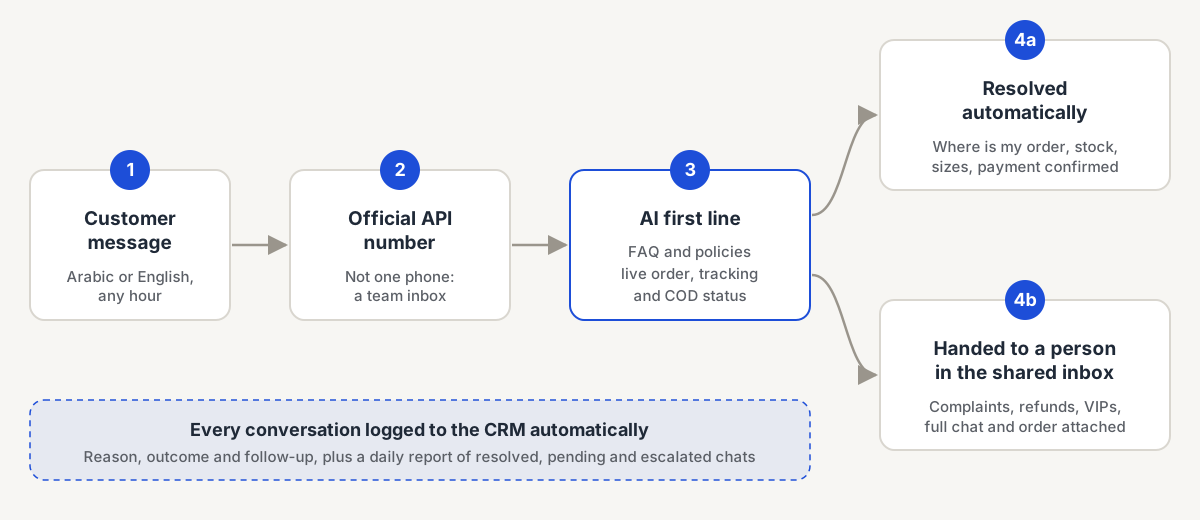
We replace the one-phone desk with a WhatsApp support system that answers routine questions automatically, routes the rest to the right person, and records everything without anybody typing it twice. It runs on the official WhatsApp Business API in Dubai, connected to your store, and it is built around how your team already works rather than a vendor's default template.
- An official WhatsApp Business API number. Verified under your business in Meta Business Manager, with your brand name and profile, usable by the whole team at once rather than tied to a phone in someone's drawer.
- A shared team inbox. Your agents pick up, assign, transfer and close conversations from a browser, see who is handling what, add internal notes and use saved replies. Most of the inbox platforms we deploy can bring Instagram DMs and website chat into the same queue, so your team works one list instead of three apps.
- An AI first line trained on your own material. Your FAQ, policies, product catalogue, delivery zones and tone guide become the knowledge the assistant answers from. It replies in Arabic or English to match the customer, handles the questions that already have a fixed answer, and says plainly that it is an assistant, with a route to a person at every step.
- Live order and payment lookup. This is the part that removes most of the manual work. The assistant reads order status, tracking and payment state from Shopify, WooCommerce or your order system, so "where is my order" gets a real answer with the courier status, and a COD confirmation can be captured in the chat and written back to the order.
- Human handover with context. Complaints, refund exceptions, VIP customers, anything off-script or emotionally charged goes to a person in the inbox, with the transcript, the customer's order history and the reason for escalation already attached. Nobody starts again.
- Automatic logging and reporting. Every conversation is written to your CRM with its reason, outcome and follow-up. The daily summary of resolved, pending and escalated chats, and the list of hot pre-sales leads, is generated rather than written.
- Proactive order updates. Order confirmations, COD confirmation requests, dispatch and delivery notices sent as approved WhatsApp templates, which cuts the "where is my order" volume before it starts. Replies inside the 24-hour customer service window are free under Meta's pricing; how templates outside it are charged is covered in our guide to WhatsApp Business API pricing in the UAE.
Customer data in the inbox and CRM is personal data under the UAE's Personal Data Protection Law (Federal Decree-Law No. 45 of 2021), so we set access by role and keep conversations off personal phones as part of the build, not as an afterthought.
Is your WhatsApp inbox already at its limit? Send us a rough count of daily conversations, the languages your customers write in and the platforms your store runs on. We will come back with how we would set up your WhatsApp support and a scoped price. Request a custom quote → or message us on WhatsApp.
What stays human in WhatsApp support
People stay on every conversation that needs judgement, and the system is designed to get those conversations to them faster, not to keep customers away from them. The point of automating the first line is to give your agents back the time they currently spend on lookups and logging.
In practice, the split looks like this. The assistant handles order status, tracking, payment confirmation, stock and size questions, delivery areas and timings, return policy explanations and simple product how-tos. A person handles complaints, damaged or wrong items, refunds outside policy, anything involving a goodwill gesture, wholesale or bulk enquiries, and any customer who asks for a human. We set escalation rules with you during the build - by topic, by keyword, by order value, by customer tag - and tune them on real conversations in the first weeks after launch.
The one thing we will not build is a bot that loops. If the assistant does not understand, it says so and hands over. A WhatsApp helpdesk that traps customers in a menu converts worse than a slow human, and it damages the brand in a channel where people are used to talking to their friends. Our piece on what a WhatsApp chatbot in Dubai actually does goes deeper on where AI agents earn their place and where they should stop.
Meta ad spikes, evenings and the weekend gap
The two moments the manual desk fails worst are campaign spikes and out-of-hours traffic, and both are where an automated first line pays for itself. Neither can be fixed by scheduling more people, because nobody can staff for a spike they cannot predict.
When a click-to-WhatsApp ad lands, most of the incoming chats ask about the advertised product: price, sizes, delivery time, whether COD is available. The assistant answers those instantly from the catalogue, captures the order intent, and lifts the handful of conversations that need a person to the top of the queue. Your team works a short list of real decisions instead of scrolling past three hundred copies of "price?".
Out of hours, the same assistant keeps answering, so the shopper browsing at midnight from Abu Dhabi or Sharjah gets their stock and delivery answer while they still have the product in their basket. Anything that needs a person waits in a sorted queue with its context, so the morning shift starts with the important chats, not a wall of unread messages in random order.

Where we have built WhatsApp support before
We have built WhatsApp automation for retail and service brands in the Gulf and beyond, and the pattern - official API, automated first line, CRM behind it, people for the exceptions - is the same one we bring to UAE ecommerce.
- Lusso Lifestyle, a premium vegan-leather footwear brand with a flagship showroom in Mumbai: WhatsApp API automation and a chatbot handling order and customer-query conversations for their online store. The closest match to the ecommerce setup described above.
- T72, a UAE events management company: WhatsApp API automation and a chatbot, including a launch microsite where WhatsApp was the primary channel for leads and enquiries.
- Easy Wedding, the flagship site in a multi-country wedding-planning network: Zoho CRM implementation, SEO, web development, campaigns and WhatsApp API chatbot automation, with every enquiry landing in the CRM rather than on someone's phone.
"great communication very clear good job done and even after finishing the project they still give support"
— Abdulkarim, United Arab Emirates, via Freelancer
That last point matters more for support systems than for most projects. A WhatsApp support setup is never finished on launch day: product ranges change, policies change, a new campaign brings new questions. We stay on after go-live to tune the assistant, adjust routing and add the answers your customers are actually asking for. More from clients on our reviews page.
Outsource WhatsApp customer service or automate it?
Most stores that search for someone to outsource WhatsApp customer service to are really asking for more capacity. Outsourcing adds hands; automation removes the work that did not need hands in the first place. For a UAE online store the strongest setup is usually both: a system that resolves the routine majority, and people - your own team or an outsourced team you already trust - working inside it on the conversations that need them.
| Outsourced agents on the free app | WhatsApp support system on the API | |
|---|---|---|
| Response at 2am or during an ad spike | Only if someone is on shift and the queue is short | Routine questions answered instantly, the rest queued and sorted |
| Order and payment lookups | Manual, in another tab | Read live from your store or order system |
| Logging and daily reports | Typed by hand | Automatic, in your CRM |
| Handover to your team | Forwarded screenshots | Full transcript and order history attached |
| Arabic and English | Depends on who is hired | Built into the assistant and the routing |
| Scales with volume | By hiring | By configuration |
We build and run the WhatsApp business support system; we do not supply call-centre staff. If you already work with an outsourced team, they log in to the same inbox and get faster from day one.
What decides the quote for WhatsApp support
We do not publish a price list, because two stores with the same order volume can need very different builds. We scope against your actual conversations and quote a fixed price in AED, so you know the number before we start. Meta's own messaging fees are separate and billed by usage. The variables that move the build quote most:
- Conversation volume and peaks - steady daily traffic or heavy campaign spikes, and how many agents need seats in the inbox.
- Languages - English only, or Arabic and English with routing by language.
- Systems to connect - Shopify, WooCommerce or a custom store, your courier, your payment gateway, your CRM. Each live lookup or write-back is its own piece of integration work; our note on ecommerce integration mistakes UAE stores keep making explains why we test each one properly.
- Where you are starting from - a number already on the API, a number to migrate from the Business app, or a new number to verify.
- AI scope - an assistant for FAQs only, or one that confirms COD orders, captures returns and qualifies pre-sales leads.
- Reporting - a daily summary, or dashboards by agent, topic and product.
Our ecommerce agency in Dubai page covers the rest of what we do for online stores, from store builds to post-purchase flows.
Ready to take WhatsApp support off one phone?
Your customers have already chosen WhatsApp. What is missing is a support desk that answers them at the speed they expect, in their language, at the hour they are shopping, without your team copying order numbers between tabs all day. That is what we build.
"amazing work, I will continue working with GoDesign"
— Awatif, Kuwait, via Freelancer
Request a custom quote → - tell us roughly how many WhatsApp conversations you handle a day, the languages your customers use and the platforms your store runs on. Or message us on WhatsApp and we will book a 20-minute scoping call.
Frequently asked questions
Can the system answer customers in both Arabic and English? Yes. The assistant replies in the language the customer writes in, including messages that mix the two, and conversations can be routed to Arabic- or English-speaking agents when they need a person. We build and test the Arabic answers as their own content rather than as a machine translation of the English ones.
Can WhatsApp support connect to our Shopify or WooCommerce orders and our CRM? Yes, and that connection is what makes it useful. The assistant reads order status, tracking and payment state from your store or order system, can capture a COD confirmation and write it back to the order, and logs every conversation to your CRM with its reason, outcome and follow-up. We confirm exactly what your platforms allow during scoping, before we quote.
Will our customers get generic bot answers? No. The assistant answers from your own FAQ, policies, catalogue and tone guide, not from a stock script, and it says clearly that it is an assistant. Anything off-script, emotional or high-value goes to a person with the full conversation and order history attached, and any customer can ask for a human at any point.
What hours does WhatsApp support cover? The automated first line runs around the clock, including evenings, weekends and public holidays, and absorbs the spike when a Meta ad campaign lands. Your agents work their normal shifts and pick up a sorted queue of conversations that need judgement, with context, instead of a pile of unread messages.
Can it handle Instagram DMs as well as WhatsApp? Usually, yes. Most of the inbox platforms we deploy can bring Instagram DMs and website chat into the same queue as WhatsApp, so your team works one list. We recommend the platform after scoping, based on your channels, volume and the systems it needs to connect to.