




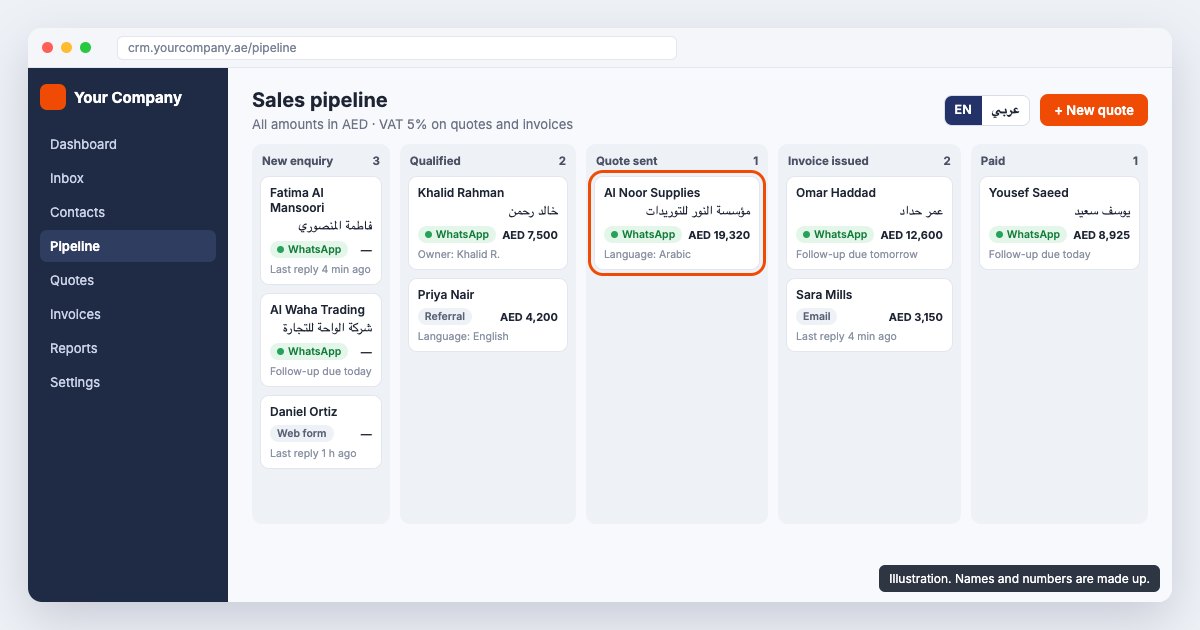
Custom CRM development in Dubai, and across the UAE, means building the parts a generic CRM leaves out. Customer records in Arabic and English. WhatsApp inside the pipeline instead of on a salesperson's phone. Quotes and tax invoices in AED with 5% VAT, ready for finance. And a clear answer to where the data is stored. As a CRM development company working with UAE businesses, we see these four requirements shape every build.
This post covers the UAE-specific side. For the wider question of when a custom CRM is worth building and how a build runs, our sister team's guide to custom CRM development covers it in full.
What makes CRM development in the UAE different?
The pipeline itself is not very different. A lead comes in, gets qualified, receives a quote, and becomes a customer. What changes in the UAE is the material moving through it.
Your customers write in Arabic, English or both in one message. They reach you on WhatsApp before they fill in a form. Your quotes need VAT on its own line and your invoices need your tax registration number. And sooner or later someone asks where the customer data is stored. A CRM that was designed for another market treats each of these as an add-on. We design them in from the first workshop.
Should a UAE business build a custom CRM or configure Zoho or HubSpot?
Configure an existing platform when your sales process is close to standard. Zoho and HubSpot both work in the UAE, and our CRM implementation service sets them up with WhatsApp, migration and training.
Build custom when the standard tools need workarounds for what makes your business different. Typical cases we see: pricing rules that no quote builder handles, a client portal where customers upload documents or approve quotes, several companies or brands under one owner, approval chains between sales and finance, or a team that needs full Arabic records rather than a translated menu. Often the answer is a hybrid: a configured CRM at the core with custom pieces around it.
If your business runs on bookings, our post on CRM for events and venues in Dubai walks through that pipeline stage by stage.
Which CRM development services do UAE businesses ask us for?
Most projects combine a few of the same pieces. What UAE companies ask us for most:
- Custom CRM builds for sales processes, portals and approval chains that standard tools cannot hold.
- Zoho and HubSpot implementation with the pipeline, fields and user roles set up for your team.
- CRM integration with WhatsApp, your website forms and your accounting system, so nothing is entered twice.
- Customisation of an existing CRM: new modules, quote templates, automations and Arabic records.
- Data migration from spreadsheets or an old CRM, cleaned and tested before go-live.
- Training in English or Arabic for the people who will use it every day.
The sections below cover the UAE-specific parts that run through all of these.
Can a custom CRM work in Arabic and English?
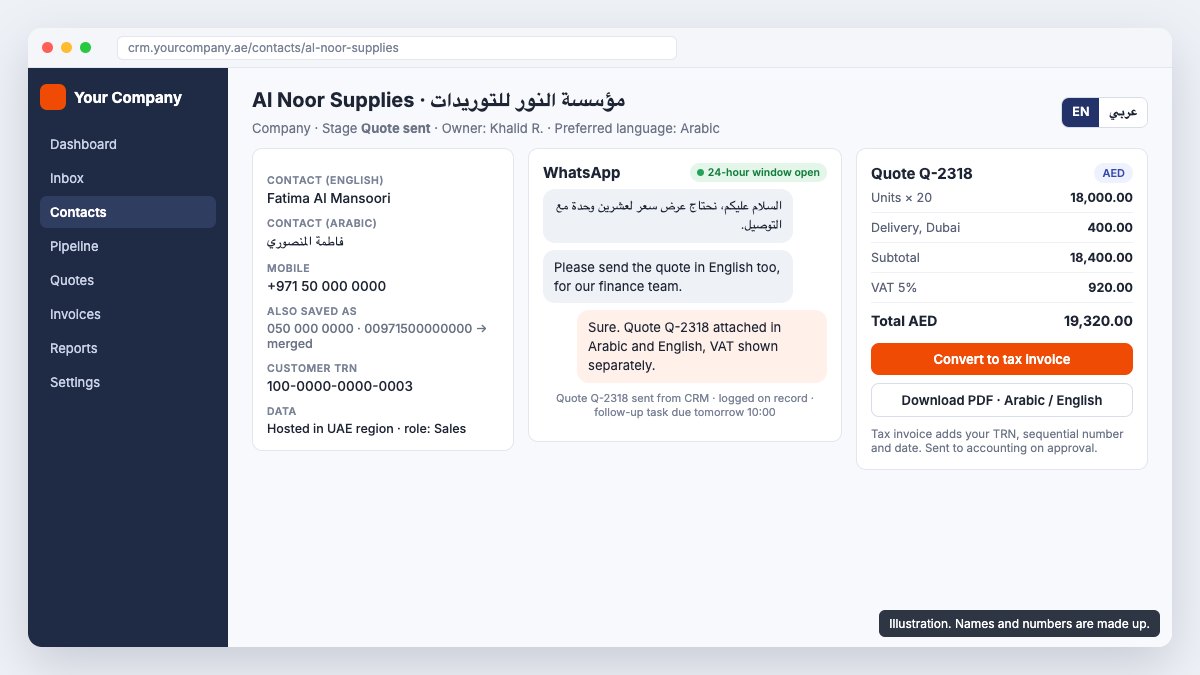
Yes, as long as Arabic is handled as data, not just as a translated interface. Switching the menu to Arabic is the easy part. The harder parts are in the records themselves:
- Names in both scripts. A customer may be saved as محمد by one rep and Mohammed, Muhammad or Mohamed by another. We store an Arabic and an English name where needed and make search find all of them.
- Duplicate detection that matches on a normalised phone number, not on a name spelt three ways.
- Right-to-left screens that are designed as layouts of their own, so tables, forms and timelines read correctly in Arabic.
- Templates in both languages: quotes, emails and WhatsApp messages, chosen by the customer's preferred language on the record.
- Mixed text in one field, such as an Arabic company name with an English trade licence number.
Why build a CRM with WhatsApp inside it?
Because in the UAE that is where most conversations start and where deals are agreed. If the chat lives on one person's phone, the CRM only holds what that person remembers to type in.
We connect the CRM to the official WhatsApp Business API. Each inbound message creates or updates a contact and lands in a shared inbox. Replies are logged on the record, so a manager can see what was promised. The platform's rules are built into the workflow: free-form replies are allowed within 24 hours of the customer's last message, after that only Meta-approved templates can be sent, and marketing messages go only to people who opted in. Our page on WhatsApp Business API setup in Dubai explains the verification side.
We have done this work in the UAE market. For T72, an events company, we set up WhatsApp API automation and a chatbot, with WhatsApp as the main enquiry channel for a launch microsite. For Easy Wedding, part of a multi-country wedding planning network, we implemented Zoho CRM with WhatsApp chatbot automation alongside web development and SEO.
Can a custom CRM issue UAE VAT tax invoices?
Yes, and it should. The UAE has charged VAT at 5% since January 2018, and a tax invoice has to carry set details: the words "Tax Invoice", your Tax Registration Number (TRN), the customer's TRN where they are registered, a sequential invoice number, the date, and the VAT amount in AED. When the quote is built in the CRM, the approved quote can become that invoice without anyone retyping it.
What we build for this:
- Quotes in AED with VAT on its own line, built from your products, services and pricing rules.
- Approval steps for discounts above a limit, before the quote goes out.
- Invoice and credit note numbering that follows your finance team's sequence.
- A link to your accounting system, so invoices and payments are not entered twice.
The UAE is also phasing in mandatory e-invoicing through accredited providers, starting with larger businesses. If you are building a CRM now, we design the invoice data so it can be passed to that provider later. Your accountant or tax adviser confirms what applies to your company.
Not sure whether your quotes and invoices fit in the CRM or should stay in accounting? Request a quote or message us on WhatsApp and we will look at how they move today.
Can CRM data be hosted in the UAE?
Yes, and for some businesses it matters, depending on your sector and your clients. The UAE's federal personal data protection law (Federal Decree-Law No. 45 of 2021) sets rules for how customer data is collected and used. Companies in the DIFC or ADGM fall under those free zones' own data protection regimes. Health data has its own federal rules, which generally keep it inside the UAE. And some government or enterprise clients ask in their contracts where your data sits.
A custom CRM gives you the choice. Microsoft Azure and Amazon Web Services both run cloud regions in the UAE, so the database can be hosted in the country when that is required. When it is not, we host where cost and speed make sense. Either way we build:
- Role-based access, so a junior rep or a freelancer sees only their own leads.
- An audit log of who viewed, changed or exported records.
- Collection of only what you need. If you do not need a customer's Emirates ID, the CRM does not ask for it.
- Backups and export, so the data is yours and can leave with you.
This is general guidance, not legal advice. For your specific obligations, ask your own legal counsel.
How does custom CRM development work with us?
We start by mapping how a lead becomes revenue in your business today, including the WhatsApp chats, the spreadsheets and the invoice template. Then we agree the data model, the user roles and the screens, and show you a clickable version before development starts. The build runs in stages you approve, with your real data migrated and tested before go-live, and training in English or Arabic.
When we built the platform for Claim Cash Now, the process had run on spreadsheets and email. We replaced it with a web app that has separate admin and client portals, application tracking, automated document generation and reporting. Most custom CRMs we build follow the same route: move the work out of inboxes and into one system with clear owners.
"Great and reliable collaboration — the work was completed professionally, cleanly, and exactly as agreed. I'm very satisfied with the result and can absolutely recommend working with him."
Jens, Germany, Freelancer
How much does custom CRM development cost in Dubai?
A configured Zoho or HubSpot CRM with a pipeline and WhatsApp lead capture starts from AED 2,900 and is usually live in 2 to 3 weeks. Custom CRM builds with portals, Arabic records, invoicing or accounting integration start from AED 11,000 and usually take 8 to 12 weeks. We give a fixed quote once we have mapped your process. Our breakdown of CRM implementation cost in Dubai shows where the money goes, including licences.
Talk to us about your CRM
Tell us how leads reach you today, which languages your customers use and how a quote turns into an invoice. We will tell you whether a configured CRM will do or what a custom one would need. Get a quote or message us on WhatsApp to book a call.
"Working with Kaiser was a great experience. He was responsive, detail-oriented, and truly understood the vision. The final result is clean and modern. I would highly recommend them."
Majdeline, United States, Freelancer
Frequently asked questions
Can a custom CRM be fully bilingual in Arabic and English?
Yes. Beyond translating the menus, we store Arabic and English names where needed, make search find a customer however the name was spelt, design right-to-left screens as layouts of their own, and pick quote, email and WhatsApp templates by the language on the customer record.
Can a CRM integrate with WhatsApp in the UAE?
Through the official WhatsApp Business API. Inbound messages create or update a contact in a shared inbox, replies are logged on the record, and the workflow follows the platform rules: free-form replies within 24 hours of the customer's last message, approved templates after that, and marketing only to people who opted in.
Can the CRM issue UAE VAT tax invoices?
Yes. Approved quotes in AED become tax invoices with the words "Tax Invoice", your TRN, the customer's TRN where they are registered, a sequential number, the date and 5% VAT on its own line, and can be passed to your accounting system. Your accountant confirms what applies to your company.
Can our CRM data be hosted in the UAE?
Yes. Microsoft Azure and Amazon Web Services both run cloud regions in the UAE, so a custom CRM can be hosted in the country when your sector, free zone or clients require it. We also build role-based access, an audit log and full data export.
How much does custom CRM development cost in Dubai?
A configured Zoho or HubSpot CRM with a pipeline and WhatsApp lead capture starts from AED 2,900. Custom CRM builds with portals, Arabic records, invoicing or accounting integration start from AED 11,000. We give a fixed quote once we have mapped your process.
How long does it take to build a custom CRM?
A configured Zoho or HubSpot CRM is usually live in 2 to 3 weeks. A custom CRM build usually takes 8 to 12 weeks, run in stages you approve, with a clickable version shown before development and your real data migrated and tested before go-live.