




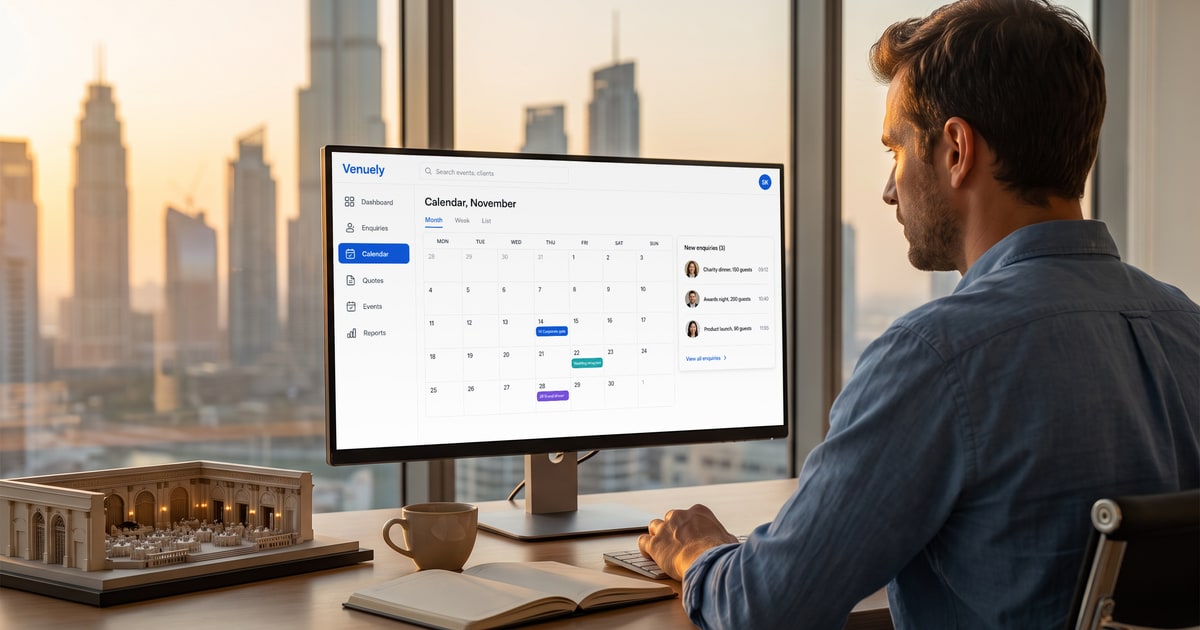
A venue or events business in Dubai rarely has a CRM problem on paper. It has a WhatsApp problem: enquiries arrive on a phone at 11pm, availability lives in someone's head or a shared calendar, the quote is a PDF in a personal inbox, and the deposit is confirmed by a screenshot. CRM development fixes that by building one system around how your bookings actually move, instead of asking your team to bend to a template.
In short
- A CRM for venues and events is a booking pipeline, not a contact list. The stages that matter are enquiry, availability, date and extras, viewing, quote, approval, contract and invoice, payment, and event preparation.
- WhatsApp has to be a first-class channel. In the UAE many enquiries start there, so the CRM should capture and answer them, not sit beside them.
- Off-the-shelf tools get you part of the way. Custom CRM development is for the gaps: the availability rules, the add-ons, the approvals and the handover to the events team.
- Plan the build before the code. The stages, fields and automations are mapped first, so everyone knows what is being built.
Custom CRM development: what it means for a venue or events team
Custom CRM development means building the system around your sales and delivery process, with your fields, your stages and your rules, rather than adapting your process to a generic tool. For a venue that usually means a pipeline where every enquiry becomes a record with a date, a guest count, an event type and a status, and where each status change triggers the next job automatically.
Here is the booking flow venues and planners typically run, and the one a CRM for them should follow:
- Enquiry arrives from WhatsApp, the website, Instagram or a call, and is logged with its source.
- Availability reply goes out in minutes, checked against a live calendar rather than someone's memory.
- Date and extras are confirmed by the client: catering tier, AV, decor, seating layout.
- Viewing is booked and the owner of the enquiry is reminded.
- Quote is generated in AED with UAE VAT shown separately, from the same extras the client chose.
- Approval, contract and invoice follow from the approved quote, with no retyping.
- Payment is tracked against the invoice, deposit and balance.
- Event preparation turns the booking into a task list for operations, suppliers and on-site staff.
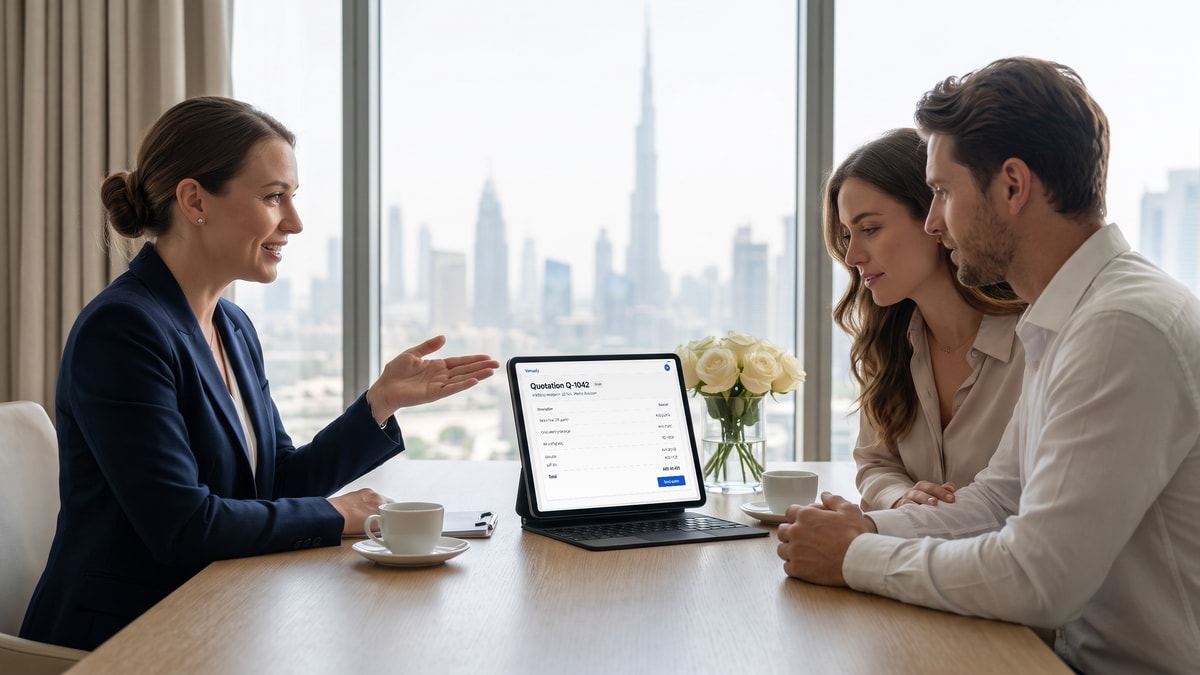
The detail that separates a useful build from a database is what happens between those steps. A date that is held for a viewing should block that date for other enquiries, and release it if no deposit arrives. An extra that is added after the quote should update the invoice, not a separate spreadsheet.
"Great and reliable collaboration — the work was completed professionally, cleanly, and exactly as agreed. I’m very satisfied with the result and can absolutely recommend working with him."
Jens, Germany, Freelancer, on a search platform data collection tool we developed
That is the kind of feedback we work towards on every project. If your current process looks like the list above but lives in chats and spreadsheets, get a custom quote and we will map it with you.
CRM development in Dubai: what is specific to the UAE
The UAE adds a few details a generic CRM ignores. Quotes and invoices are in AED, and a booking system should show UAE VAT (currently 5%) as its own line so finance does not rebuild it later. Clients often speak Arabic and English in the same thread, and many corporate and wedding clients would rather message than fill in a web form.
That is why we treat WhatsApp Business API as part of the CRM build rather than an add-on. Inbound messages can create or update records, replies and templates can be logged against the booking, and staff can see the whole conversation without hunting through a personal phone. The platform and messaging costs of the API are a separate budget line, which we break down in our guide to WhatsApp Business API pricing in the UAE.
On data, the UAE has a federal personal data protection law that can apply to businesses that handle customer information. In general terms that means collecting only what you need, being clear why you hold it, and controlling who inside the business can see it. A custom CRM lets you build that in with role-based access, so a freelancer on a wedding does not see every client in your pipeline. For anything specific to your business, take advice from your own legal counsel.
We have worked on this in the market. For T72, a UAE events management company, we implemented WhatsApp API automation and chatbot flows and built the JINo Debut launch microsite, with a countdown timer and WhatsApp as the main enquiry channel for the event. For Easy Wedding, the flagship site of a multi-country wedding planning network, we delivered a Zoho CRM implementation alongside web development, SEO and a WhatsApp chatbot. You can see that engagement in the Easy Wedding case study and on easywedding.me.
In-house CRM development or a specialist team?
An in-house build gives you control, but it also makes you the owner of every decision a CRM needs: data model, integrations, WhatsApp compliance, hosting, security and the ongoing fixes. For a venue or an events company, whose real work is running events, that usually means a developer who is pulled between the CRM and everything else, and a system that depends on one person remembering how it works.
A specialist team takes on that load. We build the booking pipeline, the WhatsApp layer and the hand-off to your operations team, so your people can focus on running events. The honest case for in-house is a business large enough to employ a full product team. For most Dubai venues and planners, the better use of an internal hire is running the system, not building it.
Build a custom CRM or configure an existing one?
Both are legitimate, and we do both. If your process is close to standard, configuring a platform such as Zoho CRM is faster, and it is what we did for Easy Wedding. Our CRM implementation service covers that route, including data migration and automation.
Custom development earns its place when a standard tool would need workarounds for the things that make your business different: calendar holds across several halls, packages with many add-ons, multi-stage approvals, or a client portal where customers confirm their date and extras themselves. Often the right answer is a mix, with a configured CRM at the core and custom pieces around it. We will tell you which one fits when we have seen your process.
What the finished system gives your team
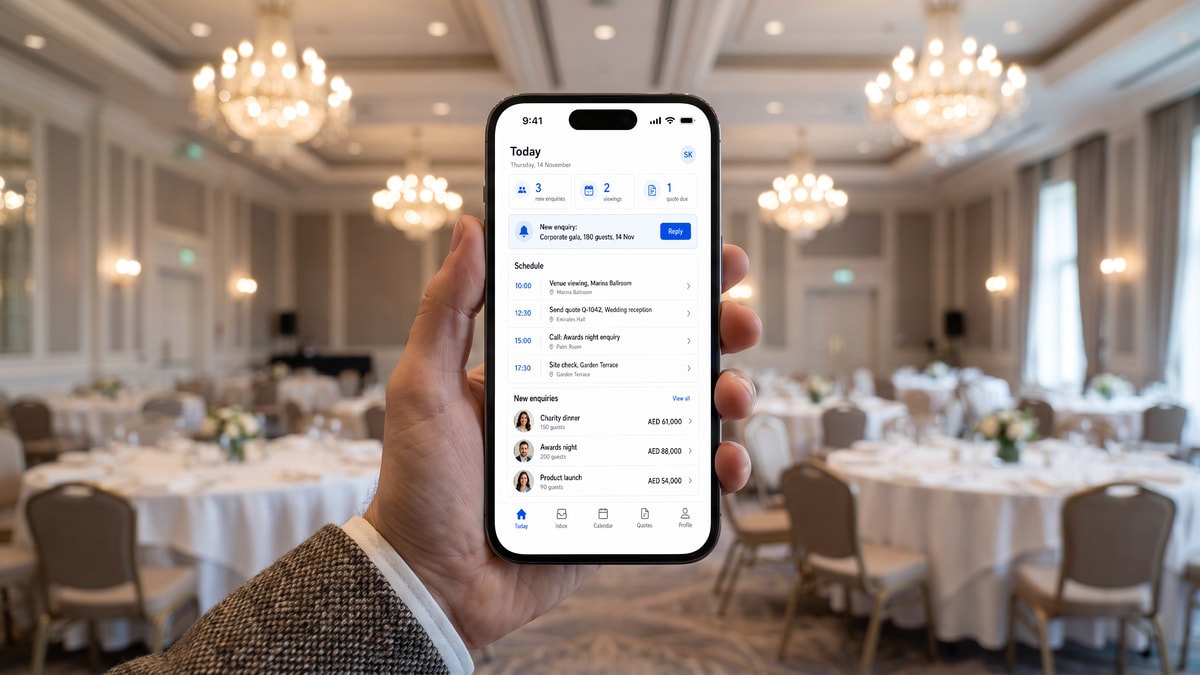
The aim is not a prettier database. It is a team that answers enquiries quickly, knows which dates are held, sends accurate quotes from one source, and starts event preparation the moment payment lands. Speed of reply is the part clients notice first; our write-up on the first hour after an enquiry explains why that window matters. For the sourcing side of larger events, see how we approach RFQ automation for event companies.
If you want AI to draft first replies or qualify enquiries, that sits on top of the same records. We cover it in WhatsApp AI agents for UAE businesses, and it works far better once the data underneath is clean.
"Working with Kaiser was a great experience. He was responsive, detail-oriented, and truly understood the vision. The final result is clean and modern. I would highly recommend them."
Majdeline, United States, Freelancer, on a trade show landing page we developed
You can read more feedback on our reviews page. If you run a venue, a planning company or a hospitality group, our hospitality page covers venue and event enquiries.
Talk to us about your CRM build
Tell us how an enquiry reaches you today and where it gets stuck, and we will come back with a plan: the stages, the records, the WhatsApp flows and the integrations. Request a custom quote or message us on WhatsApp to book a call.
Frequently asked questions
What is CRM development for an events or venue business? It is building a system around your booking process: enquiry, availability, quote, contract, invoice, payment and event preparation. Unlike a generic contact database, it holds dates, packages and add-ons, and it moves each booking to the next step automatically.
Can the CRM work with WhatsApp? Yes. Using the WhatsApp Business API, incoming messages can create or update booking records, and replies and templates are logged against the client. Your team sees the full conversation in one place instead of on personal phones.
Should we build in-house or hire a specialist team? In-house gives control but makes you responsible for design, integrations, security and maintenance. A specialist team builds and maintains the system while your people focus on running events. Most venues and planners are better placed running the system than building it.
Do we need a custom CRM, or will Zoho or HubSpot do? If your process is close to standard, configuring an existing platform is faster. Custom development is worth it for what a standard tool cannot handle cleanly, such as calendar holds, many add-ons or client self-confirmation. We assess which fits before recommending anything.
How do we get a price for a CRM build? Each build depends on your stages, integrations and channels, so we do not publish fixed prices. Send us your current process and we will come back with a custom quote.