




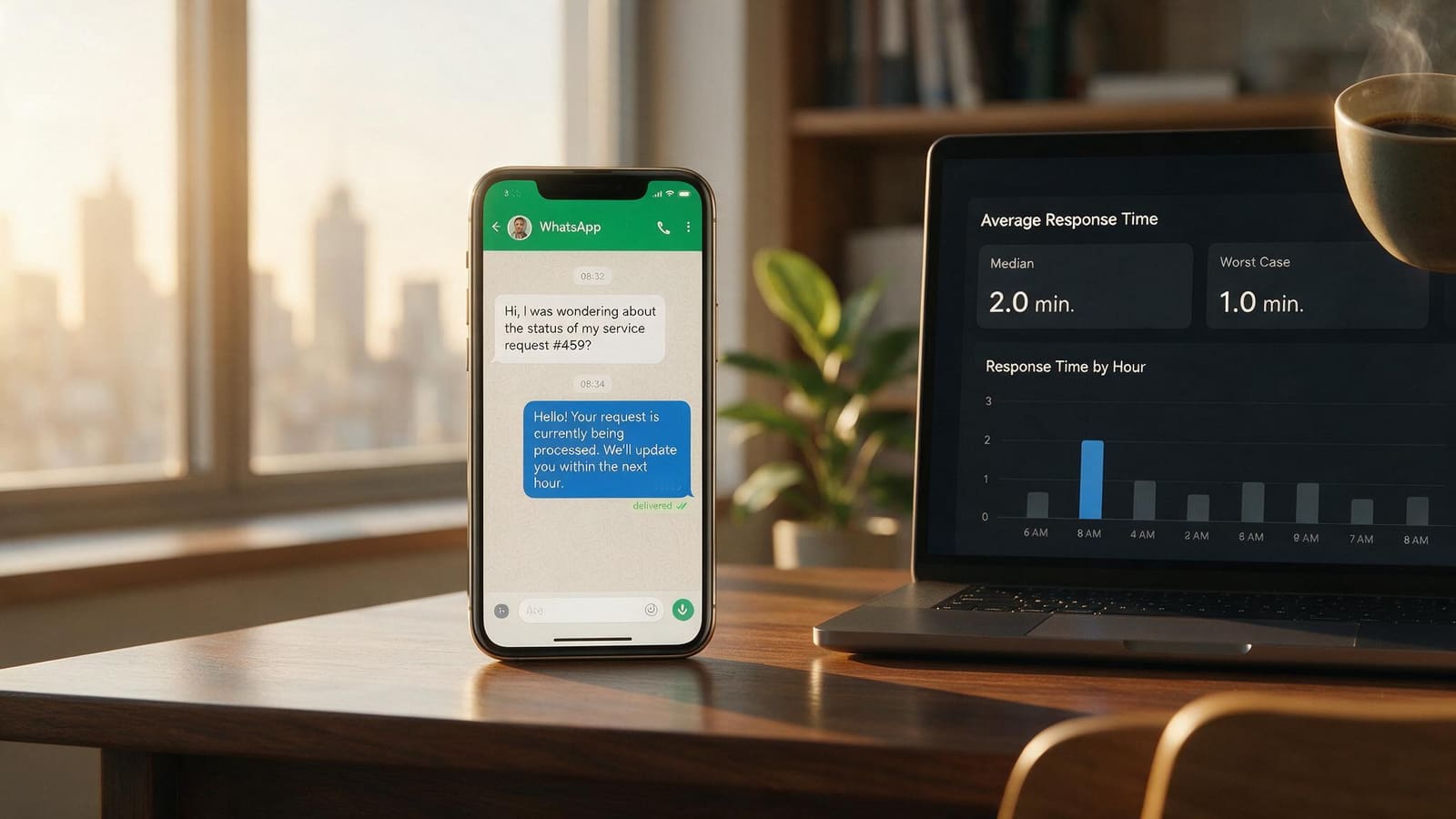
Two messages from our archive, sent by different people, about the same sixty minutes.
"I've received over 150 proposals already, but yours caught my eye."
"I haven't heard back from you so I will have to award the project to another freelancer. I wanted to start working on this tonight my time."
Nothing in the second is about price, portfolio or capability. The work went elsewhere because of a gap in a calendar, in a different timezone, on an evening somebody wanted to begin.
Lead response time: why the first reply beats the best reply
When somebody sends four enquiries in one sitting, they have no way to compare the four businesses. They cannot assess your engineering, your judgement or whether you will still be around in a year. What they can assess instantly, and at no effort, is whether anybody replied.
Answering first does three things, and they stack:
- It sets the questions. Whatever you ask becomes the framework used to evaluate everyone who replies after you, because it is the first structure anyone has offered.
- It catches intent while it is warm. Somebody who has just sent four enquiries is engaged for perhaps an hour. After that they are back at work and your reply is an inbox chore.
- It makes you the reference point. Everyone else gets compared to you, rather than you being one of four compared to each other.
This is why the difference between five minutes and one hour is so much larger than the difference between one hour and one day. The first crosses the boundary between in the moment and later. The second is two kinds of later.
In this market, the channel decides the clock
The expectation attached to a channel is not the same everywhere, and in the UAE a large share of first contact arrives on WhatsApp. People who message a business on WhatsApp are using a tool they otherwise use to talk to friends, and they carry that pace with them.
| Channel | What "prompt" means to the sender |
|---|---|
| Minutes | |
| Web form | Same working day |
| Same working day, next morning tolerated | |
| Phone, missed | A call back within the hour |
A business that answers everything within four hours looks responsive on email and unresponsive on WhatsApp, using the same effort. That is worth knowing before you decide the target.
Slow replies are structural, not lazy
Almost nobody decides to be slow. What happens is one of a short list of routing failures, each with a cheap fix.
| What is actually happening | The fix |
|---|---|
| Enquiries land in an inbox nobody owns | One named person, and a named backup |
| They arrive only by email, checked hourly at best | Route to something that interrupts |
| The replier waits until they can write a full answer | Separate acknowledging from answering |
| Nobody covers evenings or the weekend | An honest auto-reply with a real commitment |
| The only route is a form on page four | Offer the channel the buyer already prefers |
The third row is the most common and the most self-inflicted. People delay because they want the reply to be good, and a good reply takes time nobody has right now. At minute five the buyer is not waiting for a proposal — they are waiting to find out whether anyone is there.
Acknowledge fast, answer properly
These are two different messages, and treating them as one is what makes people slow.
The first is short, human, sent within minutes, and does three things: confirms a person has read it, asks one clarifying question, and says when the real answer arrives.
The clarifying question is doing the work. It turns a broadcast enquiry into a conversation, which is much harder for a competitor to displace, and it usually surfaces something that makes the eventual proposal better anyway. "Happy to help — is this for the Dubai branch or all three?" costs nothing and changes the relationship.
The second message, the actual answer, can then take the time it deserves, because the position is already held.
What to automate, and what not to
Automate the acknowledgement, the routing and the reminder. Do not automate the answer.
- Acknowledgement: instant, on the channel it arrived on, saying who will reply and when.
- Routing: to a named person by service, sector or language, with a backup if they do not open it.
- Reminder: if nothing has happened in thirty minutes, tell somebody. This single rule catches most of the damage.
- Escalation: if nothing has happened in two hours, tell somebody more senior.
What must stay human is the reply itself. An automated answer that misses the point is worse than a slower one that lands, because it spends the goodwill the fast acknowledgement just bought.
Measure lead response time, not lead follow up time you imagine
Every business we have asked believes it replies faster than it does. The mean is not the useful figure either — one four-day reply drags it around while telling you nothing about the normal case.
Track the median and the worst case over a month. The median tells you what usually happens. The worst case tells you what happens when whoever normally handles enquiries is on leave, which is the scenario that costs the most and is planned for the least.
Then do the thing almost nobody does: send your own business an enquiry, from an address it does not recognise, on a Friday afternoon. Whatever comes back, or does not, is your real answer.