




Blog website design is the design and build of the blog itself: the templates every article sits in, how posts are grouped, who is shown as the author, how fast the pages load and the structured data behind them. Our blog website design work in Dubai is mostly for professional services firms whose partners and advisers have plenty to say and need a place that turns reading into enquiries.
This post is about the blog as a piece of design. If you are still deciding what a business blog needs overall (the CMS, the content plan, the SEO basics), our team's guide to building a blog website covers that first.
What does blog website design cover?
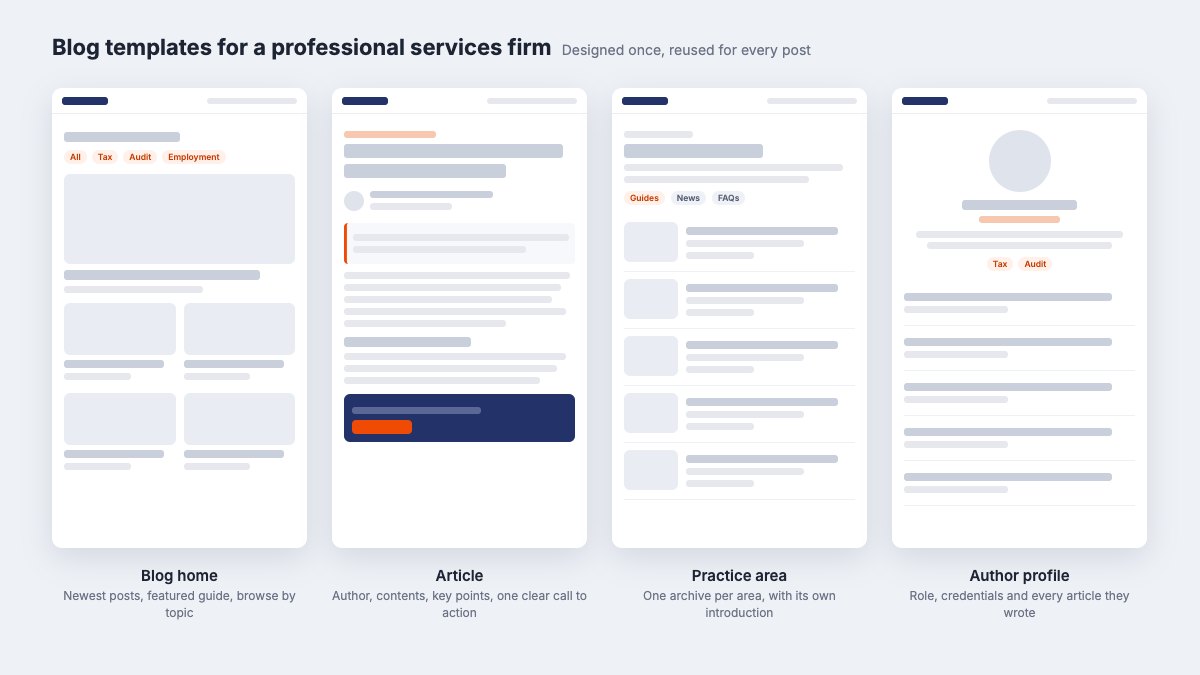
It covers every page type a reader touches between finding an article and contacting you. For a professional services firm, that is five templates and the parts shared between them:
- The blog home or listing: the newest posts, featured pieces and a way to browse by topic.
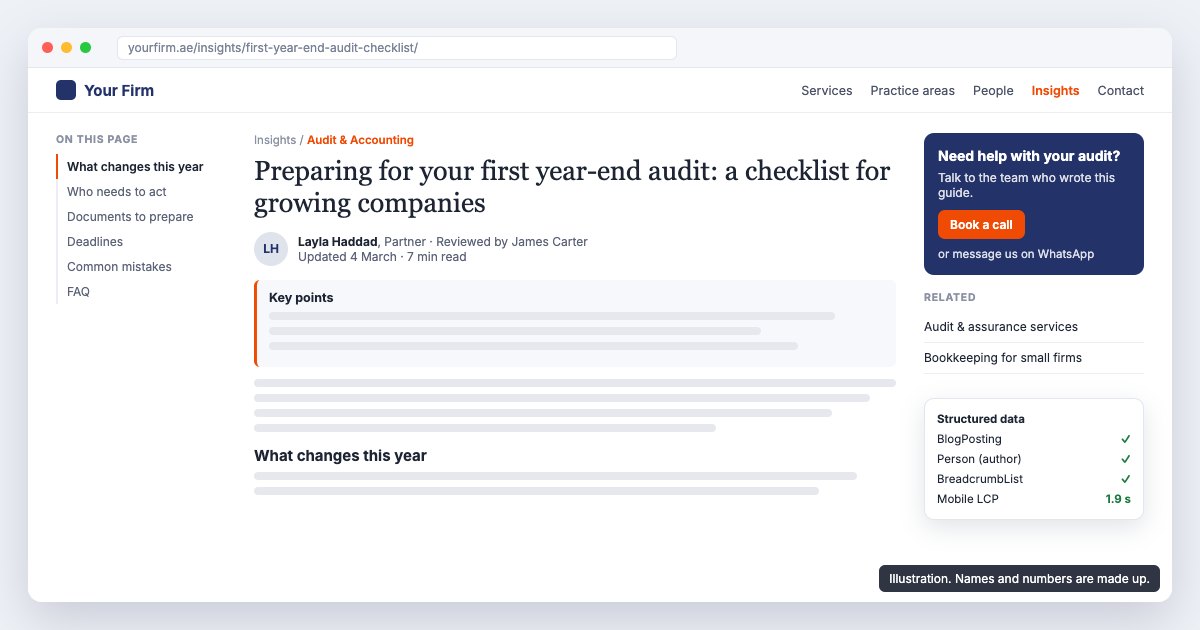
- The article template: title, author, date, reading time, the body, a table of contents for long pieces, related services and a call to action.
- Category archives: one page per practice area or topic, with its own short introduction.
- Author pages: a profile for each person who writes, with their role, credentials and articles.
- Search: for firms with years of content, so a reader can find the piece on the topic they came for.
Underneath sit the shared parts: type styles that stay readable at length, image sizes, pull quotes, tables, callout boxes and the lead capture blocks. These are designed once and reused, so a post written next year looks as considered as the launch posts.
What should a blog post template include?
Reading comfort, attribution and the next step. The article page is where readers spend their time, so we design it first and in the most detail.
- Line length and type size that a reader can follow for 2,000 words on a phone without zooming.
- A visible author and date near the title, linked to the author's page. Updated posts show the update date.
- A contents list for long guides, so a reader can jump to the section they need.
- Tables, checklists and callouts that hold up on a small screen. Regulatory and tax posts in the UAE lean on these.
- Related services at natural points, not a banner every two paragraphs.
- One clear call to action in the body and one at the end, matched to what the reader was reading.
How should a law firm or consultancy blog be organised?
Categories should mirror how clients think about their problem, which usually means your practice areas: corporate structuring, employment, tax, disputes, licensing, and so on. Keep the list short. Ten categories with three posts each look abandoned; five with fifteen each look like expertise. Tags can carry the finer detail.
Authors matter more for advisory firms than for almost any other business. A reader deciding whether to trust an article on a legal or financial question wants to know who wrote it. We give every author a profile page with their role, qualifications, the areas they advise on and their articles, and we show them on every post. Where a piece is drafted by marketing and checked by a partner, the template can show both "written by" and "reviewed by".
Should a Dubai business blog be in Arabic and English?
If your clients read in both, yes, but plan it as two sets of pages, not one with a translation layer. Each language gets its own URL, its own metadata and a right-to-left template designed as a layout of its own. Search engines are told which pages are translations of each other, so the right version shows for each reader.
Not every post needs both languages. Many firms publish everything in English and translate the pieces aimed at clients who prefer Arabic, such as guides on local regulations. The design should allow that without leaving gaps, so an English-only post does not link to an Arabic page that does not exist.
Thinking of a new blog or a redesign of the one you have? Request a quote or message us on WhatsApp and send us the link.
Which CMS is best for a business blog: WordPress or headless?
For most firms, WordPress. Your team can publish without a developer, and Arabic is well supported. A headless or Next.js blog suits firms that want the fastest possible pages and have a developer on hand to look after it. Wix or Webflow is enough for a small blog on a simple site.
The choice changes how the templates are built, not what they need to do. Whichever CMS you use, we design the same five templates, keep the build lean and hand over a short guide, so the person posting next month does not need to call anyone.
How fast should blog pages load?
Fast enough to pass Google's Core Web Vitals on a phone: the main content visible within 2.5 seconds (Largest Contentful Paint), a response to taps within 200 milliseconds (Interaction to Next Paint) and no layout jumping as the page loads (Cumulative Layout Shift under 0.1). Blogs fail these for predictable reasons, and most of them are design decisions:
- Oversized images. Every image is exported at the size it is shown, in a modern format, with its dimensions set so nothing shifts.
- Too many fonts. Two families with a few weights are enough, including the Arabic set.
- Third-party scripts. Chat widgets, social embeds and tracking tags are loaded only where they are used.
- Heavy page builders. On WordPress we build lean templates rather than stacking plugins.
Our post on responsive website design in Dubai covers how we test on real phones.
Which schema should a blog carry?
Structured data tells search engines and AI tools what each page is and who is behind it. A business blog should carry:
- Article or BlogPosting on every post, with the headline, dates, image and author.
- Person markup for each author, linked to their profile page.
- Organization for the firm, consistent across the site.
- BreadcrumbList, so the path from blog to category to article is clear.
FAQ markup no longer earns rich results for most sites in Google, but it still describes the questions a page answers, and we add it where a post has a real FAQ. Schema only helps when it matches what is on the page, so we generate it from the same fields the templates show. Our SEO services team checks it after launch.
How does a business blog bring in enquiries?
By linking reading to the next step at the point a reader is ready. On a professional services blog, that usually means a short line under the relevant section pointing to the service, a contact form or WhatsApp button for readers who want to talk, and a newsletter sign-up for those who are not ready yet. The design decides where these sit so they help rather than interrupt.
The other half is volume and consistency. A well designed blog with four posts will not bring in leads. Our article on why most business websites get no organic leads explains how content volume and AI search change that. The templates should make publishing the next post easy for your team, without a developer.
Blogs we have designed and built
For Dash & Pinch, a founder's recipe blog, we built the brand identity, a custom recipe management system and a performance-focused WordPress build. For Infusion, an agency in Uruguay, we built a WordPress company site with a content section for articles and updates. For Flaralit, we built a company, services and blog site on Laravel. Each started from the same question: what does a reader need to see on the article page, and what should they do next?
"Kausar has been fantastic! She delivered a new website look for me that was beautiful and organized. She self drew the art work and logo and animation. She also delivered ahead of schedule. I will be working with her again! She is highly recommended if you are in search of a talented web designer who is creative and draws beautifully."
Vanetria, United States, Freelancer
A blog is a small product in its own right. Our post on UX/UI design in Dubai explains how we design templates and components before anything is built.
Can you add a blog to an existing website?
Yes. Many firms already have a site they are happy with and only need the blog. We design the blog templates to match your current site, so the articles do not look bolted on. We set up the categories and author pages, move any articles you already have, and connect the calls to action to your contact form, WhatsApp or CRM.
We start by looking at the CMS behind your site, because that decides how the templates are built. Adding a blog to a site you already have is quoted from your brief.
How much does blog website design cost in Dubai?
A business website with a blog starts from AED 4,900. Larger custom-designed sites with Arabic, several author profiles and CRM-connected forms take longer and are quoted from your brief, as is adding a blog to a site you already have. What moves the price is the number of templates, whether the blog is bilingual, the CMS, and how much existing content needs moving across. Our web development service page covers what is included.
Talk to us about your blog
Send us your current site, the practice areas you want to write about and the languages your clients read in. We will tell you which templates you need and what the build involves. Get a quote or message us on WhatsApp to book a call.
"I loved her work. Perfect communication, beautiful work. If I need, I will hire her again."
Szilard, Slovakia, Freelancer
Frequently asked questions
Which CMS is best for a business blog in Dubai, WordPress or headless?
For most firms WordPress, because the team can publish without a developer and Arabic is well supported. A headless or Next.js blog suits firms that want the fastest pages and have a developer on hand, and Wix or Webflow suits a small blog on a simple site. We design the templates for the one your team will use.
Can you add a blog to an existing website?
Yes. We design the blog templates to match your current site, set up categories and author pages, move any existing articles across and connect the calls to action to your contact form, WhatsApp or CRM. It is quoted from your brief.
Do we need separate Arabic and English blog posts?
Only for the posts your Arabic-reading clients need. Each language gets its own URL and a right-to-left template, and search engines are told which pages are translations of each other. Many firms publish everything in English and translate selected guides.
Can our team publish posts without a developer?
Yes. The templates handle layout, author boxes, contents lists, schema and calls to action, so your team writes, adds images and publishes. We hand over a short guide and train whoever will be posting.
How much does blog website design cost in Dubai?
A business website with a blog starts from AED 4,900. Bilingual sites, several author profiles, CRM-connected forms or a blog added to an existing site are quoted from your brief.