



What is business automation? Business automation is the use of software systems to replace manual, repetitive business tasks-such as data entry, email routing, invoice follow-ups, and status updates-with rules-based workflows that execute automatically. This frees humans to focus on decisions requiring judgment and relationships.
There is a version of automation that gets talked about in conference rooms and LinkedIn posts. It involves dashboards, AI transformation roadmaps, and phrases like "end-to-end digital enablement." It sounds expensive, complicated, and built for companies much larger than yours.
Then there is the version that actually matters to a service business running 20 to 50 active clients, a lean team, and a founder who is simultaneously the best salesperson, the most senior delivery person, and the only one who really knows where everything stands.
That version looks like this. A client submits a booking request. It lands in your CRM already tagged, already assigned, already with a follow-up scheduled. Nobody typed anything. Nobody forwarded an email. The coffee you made while the form was being submitted is still warm.
That is what automation actually is. Not a transformation. A replacement of the manual step that was never worth a human doing in the first place.
The Honest Problem
The average small business owner loses 1.5 hours daily to wasted time, according to Slack's 2024 Small Business Productivity Survey. That is not relaxation. It is status chasing, copy-pasting between tools, re-entering information that already exists somewhere else, and waiting for updates that should have been automatic.
94% of workers say they perform repetitive, time-consuming tasks in their role, according to Zapier's research. In a service business, those tasks tend to cluster around three areas: client communication, project tracking, and the internal handoffs that happen between the two.
The irony is that none of this feels like waste while you are doing it. It feels like work. Responding to the same inquiry for the fifteenth time this month feels productive. Updating a spreadsheet that three people need to check before anything moves forward feels necessary. It is only when you stop and calculate what that activity actually cost, in time, in attention, in the hours not spent on the work that actually requires human judgment, that the number becomes uncomfortable.
Over 40% of workers spend at least a quarter of their working week on manual, repetitive tasks, according to Smartsheet research. For a business with five people, that is effectively one full-time role consumed entirely by work a system could handle.
What Gets Automated First
The businesses that see the fastest return from automation are not the ones who try to automate everything at once. They are the ones who identify the three or four processes that happen most frequently, consume the most time per occurrence, and require the least human judgment to complete correctly. In a UAE service business, those processes are almost always the same.
Inquiry Handling
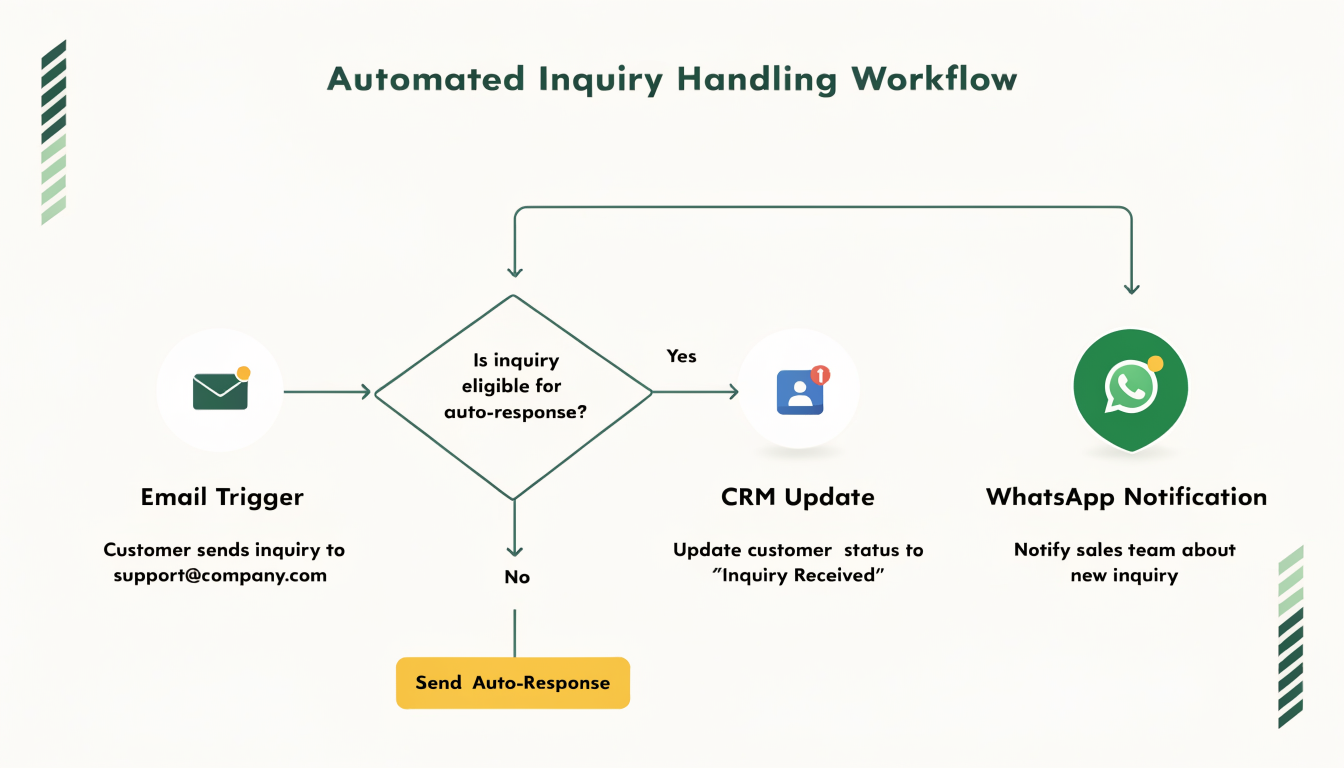
A potential client reaches out on WhatsApp, through the website contact form, through Instagram DM, or through a referral. In a manual operation, someone reads it, decides what it is, figures out who should respond, writes something, and logs it somewhere, maybe. In an automated operation, the message routes to the right person, triggers a personalized acknowledgement, creates a CRM record, and schedules a follow-up before anyone has picked up their phone.
Onboarding
Once a project is confirmed, the same sequence of tasks happens every time. A welcome message goes out. A brief needs to be filled. Access needs to be granted. A kickoff needs to be scheduled. Every one of these steps can be triggered automatically from a single status change in the CRM. The project manager's job becomes reviewing what happened, not making it happen.
Follow-up and Payment
Chasing outstanding invoices and following up on proposals that have gone quiet are tasks that consistently fall through the gaps in a manual operation not because anyone is negligent, but because they require someone to remember to do them at the right moment. Automation does not forget. A payment overdue by three days triggers a message. A proposal not opened after 48 hours triggers a nudge. These are not aggressive actions. They are consistent ones, and consistency is what a person cannot always guarantee when they are managing 15 other things.

What Automation Is Not
Automation does not replace judgment. The decision about whether to take on a client, how to handle a complaint, or how to scope a complex project still requires a person. What automation does is remove the administrative scaffolding around those decisions so the person making them has more time and better information when they do.
Automation does not fix a broken process. If your onboarding process is inconsistent and poorly documented, automating it produces inconsistency at higher speed. The clarity has to come first. This is actually the most useful thing about building an automation: it forces you to answer the question of what the process is actually supposed to be, which many businesses have never properly done.
Automation does not work without a data layer. A CRM that nobody updates, a calendar that is not connected to anything, a WhatsApp group where decisions get made but never recorded, none of these can be automated because there is nothing structured to work with. The automation is only as useful as the information flowing into it.
why the data layer has to come first
The Replacement Calculation Nobody Does
Here is a calculation most service business owners have never run.
Take one process that happens every day in your business. Something a team member does manually that takes 15 minutes. Client status update, invoice follow-up, lead qualification, booking confirmation: pick one.
If it happens once per working day, that is five hours per month. Across a year, that is 60 hours. If the person doing it earns AED 10,000 per month, you are paying roughly AED 3,500 per year for that single task. If three people each have a version of it, the number triples.
| Annual cost | ROI impact | |
|---|---|---|
| One 15-min daily task (1 person) | ~AED 3,500 | 60 hours/year freed |
| Same task across 3 people | ~AED 10,500 | 180 hours/year freed |
| 5 tasks automated (5 people) | ~AED 17,500+ | 300+ hours/year freed |
SMEs using AI and automation achieve an average of 23% savings on operational costs, primarily through automation of repetitive tasks and process optimization, according to McKinsey's 2025 report on AI and small businesses.
The average cost of integrating an AI solution for an SME dropped from $15,000 to $3,000 between 2023 and 2026, a drop that has made these tools genuinely accessible to businesses that could not have considered them two years ago.
The calculation is not about replacing people. It is about redirecting them. The five hours per month recovered from manual follow-up is five hours a salesperson can spend on actual sales. The two hours a week recovered from status updates is two hours a project manager can spend on delivery quality. The value is not in the task eliminated. It is in what becomes possible when the task is gone.

Where AI Fits Into This
Automation and AI are not the same thing, and the distinction matters practically.
How Automation Works (Fixed Logic)
Automation handles processes where the logic is fixed. If a client submits a form, send this message, create this record, assign this task. The path is predetermined. The system follows it.
How AI Works (Judgment-Based)
AI handles processes where judgment is needed but the judgment is predictable enough to be learned. Qualifying a lead based on what they wrote in an inquiry. Drafting a response to a common client question using information from your CRM and previous conversations. Flagging a project that is running behind based on milestone data. Identifying which proposals are most likely to close based on historical patterns.
The Combination Effect
The combination is what produces the result that genuinely changes how a service business operates. The routine gets automated. The judgment-adjacent work gets AI-assisted. The people in the business focus on the work that requires relationships, creativity, and accountability, which is what they should have been doing the whole time.
Customer service automation delivers a 40 to 60% reduction in support costs with ROI achieved in two to four months, while administrative automation saves 15 to 25 hours per week per employee with ROI in one to three months, based on observed outcomes across SME deployments.
how WhatsApp automation fits into this our AI automation services
The Right Starting Point
The businesses that get this wrong start with the technology. They choose a CRM, an automation platform, an AI tool and then try to fit their processes around it.
The businesses that get it right start with one question: what is the single most time-consuming manual process in this business right now, and what would it look like if it happened automatically?
Answer that question honestly and the technology choice becomes straightforward. Build one automation that works. Measure what it saves. Then build the next one. The compounding effect of five well-built automations running reliably is more valuable than twenty half-built ones that require maintenance and workarounds.
The goal is not a fully automated business. The goal is a business where the people in it are spending their time on the work that actually requires them, and a set of systems handling everything that does not.
Press a button. Make a coffee. Come back and it is done.
That is not a fantasy about AI replacing your team. It is a practical description of what a well-built automation actually delivers. The question is just which process you start with.
how n8n powers this kind of workflow automation
About the Author
Usman is an AI automation specialist at GoDesign, a UAE-based consultancy focused on workflow automation, CRM implementation, and AI agent development for service businesses. He has designed automation systems for 50+ consulting firms, agencies, and professional services companies across the region.
Want to know which processes in your business are worth automating first?
We map your current manual workflows, identify the highest-ROI automations, and build them around the tools you already use.