
Most real estate brokers in Dubai don’t have a technology problem. They have a clarity problem. Before we set up a single CRM workflow or automate a single message, we sit down and map the business — and what we find almost always changes the plan.
We recently sat down with a broker operating independently in Dubai. They came to us wanting to automate their outreach, get organised with a CRM, and use AI to move faster. It’s a brief we hear often in this industry. And if we had jumped straight into building, we would have built the wrong thing.
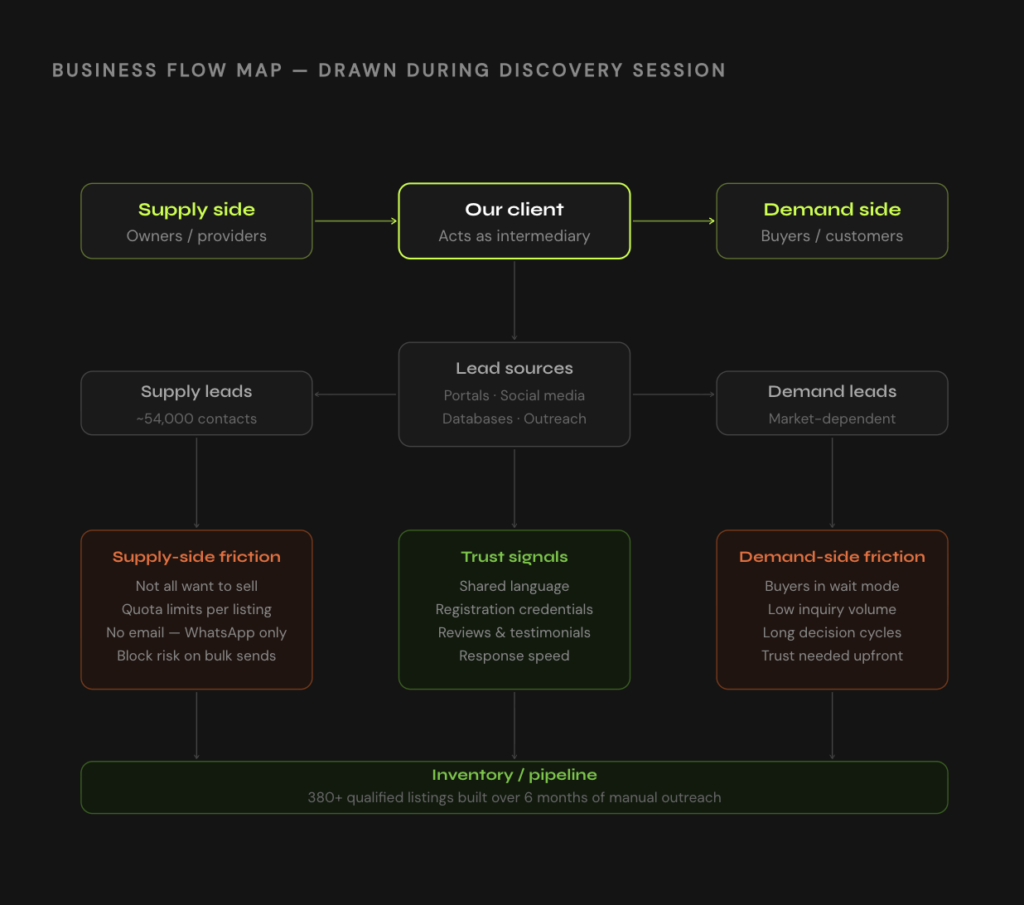
Instead, we opened a blank page and mapped their entire operation together. Forty minutes later, we had a diagram that changed the conversation completely.
The problem wasn’t that they lacked tools. The problem was that their biggest constraint — the one blocking revenue — had nothing to do with technology at all.
How a Dubai real estate operation actually works
To understand where automation helps, you first need to understand the structure of the business. A Dubai broker sits between two groups of people: property owners on one side, and buyers or tenants on the other. Their entire job is to connect the two — and take a commission when they do.
On the supply side, they are constantly reaching out to property owners — people who may want to sell or rent. These contacts typically come from property portals, broker networks, social media, and purchased databases. In Dubai’s market, a single property can only be listed by up to three registered brokers at a time, which means competition for listings is real and constant.
On the demand side, they are trying to attract buyers and tenants — people actively looking for a property. These leads come through portals like Property Finder and Bayut, social media, referrals, and inbound enquiries from marketing campaigns.
In the middle sits the broker: manually messaging property owners, manually updating a spreadsheet, manually following up on leads, manually scheduling viewings. For an independent broker without a large team, this is the daily reality.
What the mapping session revealed
When we drew this out, three things became immediately clear.
The bottleneck was not on the supply side
The broker had built a strong inventory over several months of consistent outreach — hundreds of qualified listings across multiple communities. The bottleneck was on the demand side. Buyer activity in the current market is subdued, with investors taking a wait-and-see approach. No CRM in the world fixes that. Recognising this early is the difference between smart investment and wasted spend.
Manual outreach was consuming hours every day
The broker was sending 50 to 100 WhatsApp messages per day — manually, from their personal number, carefully spacing them to avoid getting blocked. Every reply was handled one by one. Every lead was tracked in a Google Sheet updated by hand. Across a contact database in the tens of thousands, this was two or more hours every single day spent on tasks that could be systematised.
Trust had no system behind it
Every outreach message started from zero. There was no automated follow-up sequence, no way to warm up a cold contact over time, and no centralised place to track where a lead was in the relationship. When someone replied positively, the broker had to remember to follow up — and when they were busy, they sometimes didn’t. That’s revenue left on the table, not from lack of effort, but from lack of system.
What good automation actually solves for a broker
There is a version of this engagement where we simply build an outreach tool and send more messages to more people faster. Volume for the sake of volume. That is not what we recommended — and it is not what the business needed.
What CRM and automation genuinely solve for a broker is the administrative weight that sits around every real conversation. The goal is not to replace human judgment or human relationships — both of which are essential in real estate. The goal is to make sure the broker is spending their time on viewings, negotiations, and closings rather than on copy-pasting messages and updating spreadsheets.
Automation should compress the distance between a lead arriving and a human being engaged. It should never try to replace that engagement.
The three-layer system we recommended
Once the map was clear, the right solution became obvious. Not simple to build — but logical in its structure.
Layer 1 — CRM as the single source of truth
Every property owner contact, every buyer lead, every conversation, every viewing — all routed into one CRM. Status visible at a glance. Nothing tracked in memory or scattered across spreadsheets. For a broker managing hundreds of contacts and dozens of active conversations, this alone is transformative. Tools like Zoho CRM (which Dubai free zone licence holders often receive free with renewal) are more than capable of handling this without any additional cost.
Layer 2 — Compliant WhatsApp outreach via API
Instead of sending messages manually from a personal number and risking being blocked, the broker can run outreach through the official WhatsApp Business API via platforms like Bot Space. Messages go out on a schedule — ten per hour, timed to avoid flagging — without the broker needing to touch anything. Reply detection flags hot leads immediately for manual follow-up. The broker is freed from the daily ritual of sitting at their phone spacing out messages.
Layer 3 — AI-assisted qualification and follow-up
When a lead does respond, an AI workflow handles the first layer: answering basic questions, capturing key details (what are they looking for, what is their budget, what areas), and routing them to the right follow-up sequence. The broker only enters the conversation when there is a genuine opportunity — not when someone asks whether a studio in JBR is still available. Over time, the system also builds a warm-up sequence for cold contacts, so that when a property owner is ready to list, the broker is the name they remember.
The part technology cannot fix
We always say this, because we would rather be honest than win a project we cannot deliver on: there are things a CRM cannot do for a real estate broker.
It cannot generate buyer demand that is not there. It cannot make an investor move faster than they are comfortable moving. It cannot replace the trust that comes from years of closings, good reviews, and referrals. And it cannot turn a weak listing into a strong one.
What it can do is make sure that when demand does arrive — when the market turns, when an inbound enquiry comes in, when a referral lands — you are ready. Your pipeline is clean. Your follow-ups are automated. Your response time is minutes, not hours. Your time is spent on closings, not admin.
The best time to build your system is when you are not drowning in leads. Because when the leads come, you will not have time to build anything.
Dubai’s real estate market moves in cycles. The brokers who use quieter periods to get organised — to implement a CRM, to set up their outreach sequences, to build their inventory and their trust signals — are the ones who are ready to move fast when the cycle turns. The ones who wait until they are busy find themselves still doing everything manually, just with more pressure.
What a mapping session with GoDesign looks like
Every engagement we take starts with a session like the one described above. We map your operation: where your leads come from, how you manage them, where the friction is, and where you are losing time or losing deals. We tell you honestly what CRM can fix, what automation is appropriate, and where AI adds genuine value versus where it adds unnecessary complexity.
We work with brokers, independent agents, and real estate agencies across Dubai. We are not a software company trying to sell you a subscription. We are a tech team that maps first and builds second — and only builds what the business actually needs.
If you are a broker or agency in Dubai looking to get your systems in order, we would be glad to start with a free 45-minute mapping session. No pitch. No proposal. Just a clear picture of where you are and what would actually help.