
If you're running a business in Dubai, you're not just aiming to get by—you're here to lead. That's where smart Search Engine Optimization (SEO) comes in. It’s not just another line item on a marketing budget; it’s the fundamental engine for getting seen and winning customers in the UAE's hyper-competitive market.
Why SEO Is Your Biggest Growth Lever in Dubai
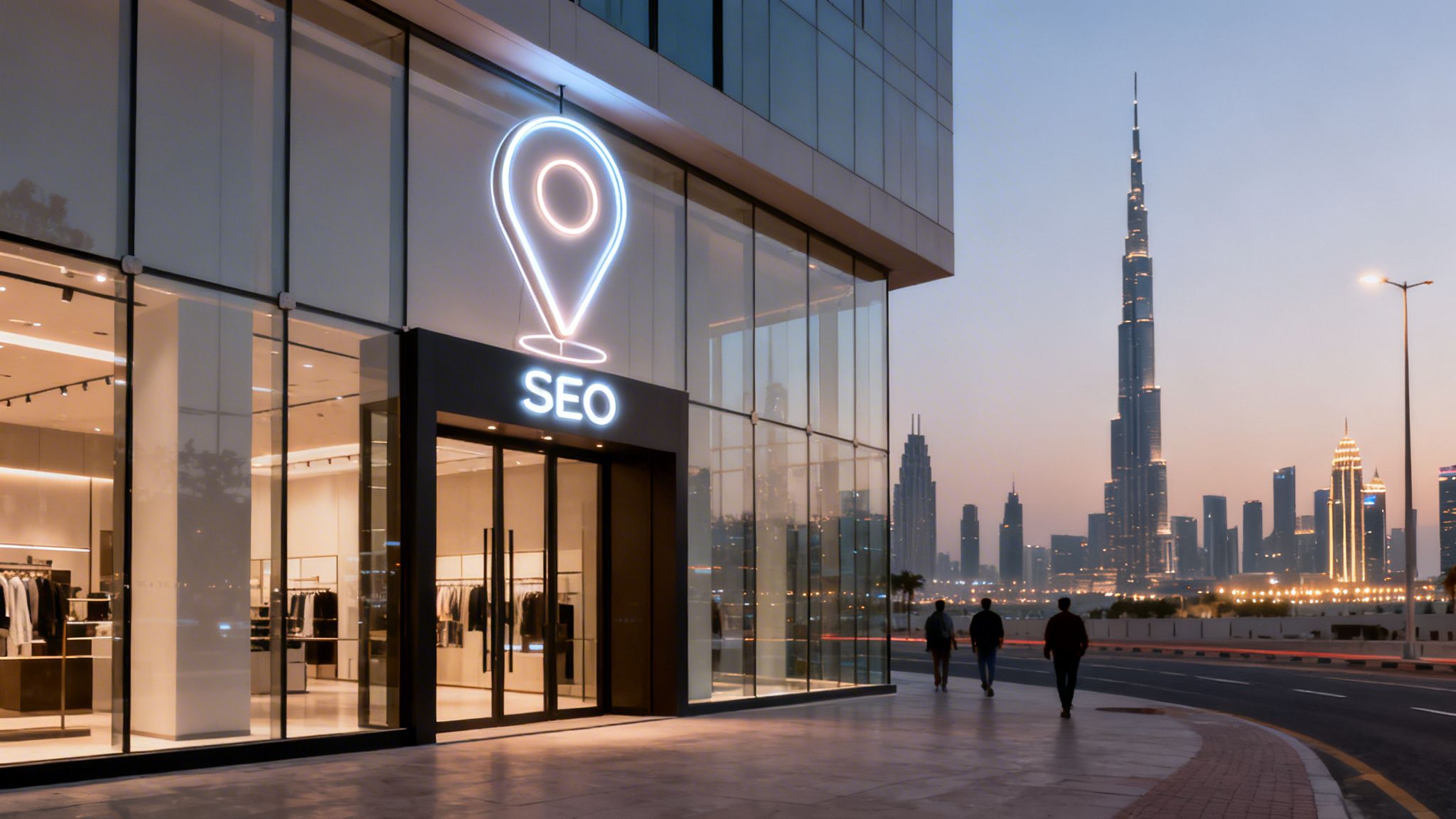
Think of your website like a physical shop. Without search engine optimization in Dubai, you’ve essentially built a stunning boutique in a back alley nobody walks down. SEO is what moves you to the main entrance of the Dubai Mall, complete with bright signs and people lining up at the door.
In a market where Google dominates over 95% of all search activity, being invisible on their platform means you’re basically invisible everywhere else.
This guide is built to help you claim that prime digital real estate. Whether you're launching a local startup, scaling an e-commerce empire, or landing B2B clients, getting your SEO right is how you build lasting momentum and leave your competitors behind.
The Unmatched Value of Organic Visibility
Sure, paid ads get you traffic fast, but that fire hose of visitors shuts off the second you stop paying. SEO is different. The organic traffic you earn is a genuine asset, one that grows in value over time.
Every optimized blog post, every service page, and every quality backlink you secure adds to your website's authority. This creates a powerful snowball effect, pulling in qualified leads and customers for months, sometimes even years, without you paying for every single click.
"A top position in Google's organic results is like owning property in a prime location. You build equity over time, attracting continuous traffic without paying rent for every visitor."
This sustained visibility does more than just bring traffic; it builds rock-solid credibility. People inherently trust organic search results far more than they trust ads. That trust translates directly into higher conversion rates and a brand that people respect. The ultimate prize is becoming the automatic, go-to name in your industry, and a sharp SEO strategy is the only path to get there.
The Dubai SEO Performance Snapshot
The competition in Dubai is intense, but the data gives us a clear picture of what it takes to win. The metrics below aren't just numbers; they represent the bar for entry and the opportunity for those willing to invest strategically.
| Metric | Statistic | Why It Matters for Your Business |
|---|---|---|
| Top-Ranking Site Authority | Average DA of 51 for 'digital marketing Dubai' | This is a high benchmark, proving that Google rewards established, authoritative sites. You need a long-term plan to build this level of trust. |
| Authority vs. Abu Dhabi | 30% higher DA in Dubai | The competition in Dubai is significantly tougher. What works in other emirates often isn't enough to make a dent here. |
| Authority vs. Sharjah | 64% higher DA in Dubai | This massive gap shows that Dubai is the epicenter of digital competition. A superior SEO strategy is your most powerful competitive advantage. |
| Google Market Share | Over 95% in the UAE | With nearly all of your potential customers using Google, being absent from its search results is a major business risk. |
As these stats show, a casual approach to SEO simply won’t cut it in this market. For a deeper dive, check out the latest digital marketing statistics from Global Media Insight.
Ultimately, a well-executed strategy for search engine optimization in Dubai is the single biggest factor that separates the businesses that just have a website from those that truly dominate their market online.
Mastering Local Search to Win Over the Emirates
In a city like Dubai, your closest customers are often your best customers. While thinking globally is great for long-term ambition, your immediate success hinges on winning your own neighbourhood. This is where mastering local search engine optimization in Dubai becomes your most powerful tool, driving real people to your storefront and catching high-intent customers searching for solutions "near me."
Think of it this way: someone is walking through JBR or driving around Business Bay. They pull out their phone and search for "best karak chai" or "laptop repair near me." You absolutely have to be the first, most convincing answer they see. If you aren't, your competitor just down the street will be.
And this isn't just a hunch; the numbers are striking. In the UAE, local SEO is a massive opportunity because a huge 46% of all Google searches have local intent. This isn't just casual browsing—it leads directly to action. An incredible 76% of people who make a local search visit a physical location within 24 hours, and 28% of those visits end in a purchase. Getting pushed to the second page of Google search results? That's commercial invisibility. It gets a measly 0.63% of all clicks. You can dive deeper into these powerful local SEO statistics on Titan Digital UAE.
Your Google Business Profile Is Your Digital Front Door
Your Google Business Profile (GBP) is the absolute cornerstone of your local strategy. It’s not just a boring business listing anymore; it's a dynamic, interactive storefront that customers check out long before they even think about clicking through to your website.
A neglected profile is a huge missed opportunity. A fully built-out profile, on the other hand, is a customer magnet. To get your GBP working for you, concentrate on these areas:
- Optimized Descriptions: Write a sharp, compelling description of your business. Make sure it’s packed with your main keywords and tells people exactly what you do.
- Services and Products: Don't be shy. List every single service or product you offer. This is how you start ranking for more specific, high-value searches like "men's haircut and beard trim in Downtown Dubai."
- Frequent Posts: Use Google Posts to share updates, flash sales, and company news. It shows both customers and Google that you're active and open for business.
- Glowing Reviews: Actively ask for and respond to every customer review. Nothing builds trust faster, and positive reviews are one of the most powerful local ranking signals.
Build Trust with Rock-Solid Local Citations
It doesn't stop with your GBP. Google is always looking for other signals across the web to confirm your business is legitimate and trustworthy. This is where your NAP (Name, Address, Phone number) consistency is critical. Think of it as creating a web of trust around your brand.
Every time your business details appear on a site like Zomato, Yellow Pages UAE, or a niche industry portal, it’s called a "citation." If your NAP information is perfectly identical across all of them, Google sees this as a strong sign of reliability and will reward you with better rankings. Even a tiny difference can cause confusion and weaken that trust.
Your business's name, address, and phone number need to be a perfect match everywhere online. Something as simple as "St." versus "Street" can dilute your local authority and hurt your rankings.
Dominate on Mobile, or You've Already Lost
Here’s a hard truth about the UAE market: with over 70% of all web traffic coming from mobile devices, a clunky mobile experience is the quickest way to hand a customer to your competition. Someone searching for your services from a taxi or while walking through a mall simply won't wait for a slow-loading website. They'll just hit the back button and click on the next result.
To win on mobile, your website must be:
- Fast: Pages have to load in under three seconds. No excuses. Use tools like Google PageSpeed Insights to find and fix what's slowing you down.
- Responsive: Your site has to look and work perfectly on any screen, from the smallest iPhone to the largest tablet.
- Easy to Navigate: Your phone number, address, and a "Get Directions" button need to be front and center. Don't make people hunt for the information they need right now.
In the fast-paced world of the Emirates, your local search engine optimization in Dubai can't have any weak spots. From a powerhouse Google Business Profile to a lightning-fast mobile site, every piece has to work together to make sure that when a local customer is looking, you're the first and best answer they find.
Connecting With a Global Audience: Multilingual and Technical SEO
Dubai is a crossroads of the world. Every day, people from dozens of cultures and who speak countless languages interact here. If your business is going to capture their attention, your website needs to do more than just exist—it has to speak their language, both literally and technically.
This isn't about flashy gimmicks. It's about getting the foundational, behind-the-scenes details right. Two areas are absolutely crucial for success in the UAE: mastering multilingual SEO and nailing your site's technical performance. Get these right, and you'll create a smooth, welcoming experience for everyone, whether they’re browsing in English from London or in Arabic from Riyadh.
Bridging Languages With Hreflang Tags
Think of your website as having a smart, multilingual concierge at the front door. When a visitor from an English-speaking country arrives, the concierge instantly guides them to your English content. When an Arabic speaker shows up, they're seamlessly directed to the Arabic version. That's exactly what hreflang tags do for search engines.
These little bits of code are your way of telling Google you have different versions of a page for specific languages or regions. For any business operating in the multilingual landscape of the UAE, implementing them correctly is not optional—it's essential.
Without them, Google can get confused. It might see your English and Arabic pages as duplicates of each other, a mistake that can seriously damage your rankings. With proper hreflang tags, you ensure Arabic searchers find your Arabic site and English searchers find your English one. It’s a simple change that builds a massive amount of user trust.
Hreflang tags are your website's diplomatic passport. They prevent cultural and linguistic mix-ups, guarantee your content finds its target audience, and shield your site from duplicate content issues.
Nailing Site Performance With Core Web Vitals
Once you’ve sorted out the language, you have to focus on speed and experience. Google’s Core Web Vitals are a set of real-world performance metrics that measure how users actually feel when they interact with your site. It’s like a restaurant review, but for your website's performance.
There are three core components you have to get right:
- Largest Contentful Paint (LCP): How fast does the main content show up? This measures the time it takes for the biggest element on the page—like a hero image or video—to fully load.
- First Input Delay (FID): How quickly does the site respond to a click? This tracks the delay between a user’s first interaction (like clicking a button) and the browser’s response.
- Cumulative Layout Shift (CLS): Does the page unexpectedly jump around? This measures visual stability, making sure that buttons and text don't shift while the user is trying to read or click.
A low score on any of these sends a clear signal to Google: your website is frustrating to use. To guarantee lightning-fast load times across the GCC, using a local server in the UAE or a top-tier Content Delivery Network (CDN) is non-negotiable. This is how you make sure your site is just as fast for a user in Doha as it is for someone in Dubai.
A speedy, mobile-friendly site is a cornerstone of winning in local search, as this diagram illustrates.
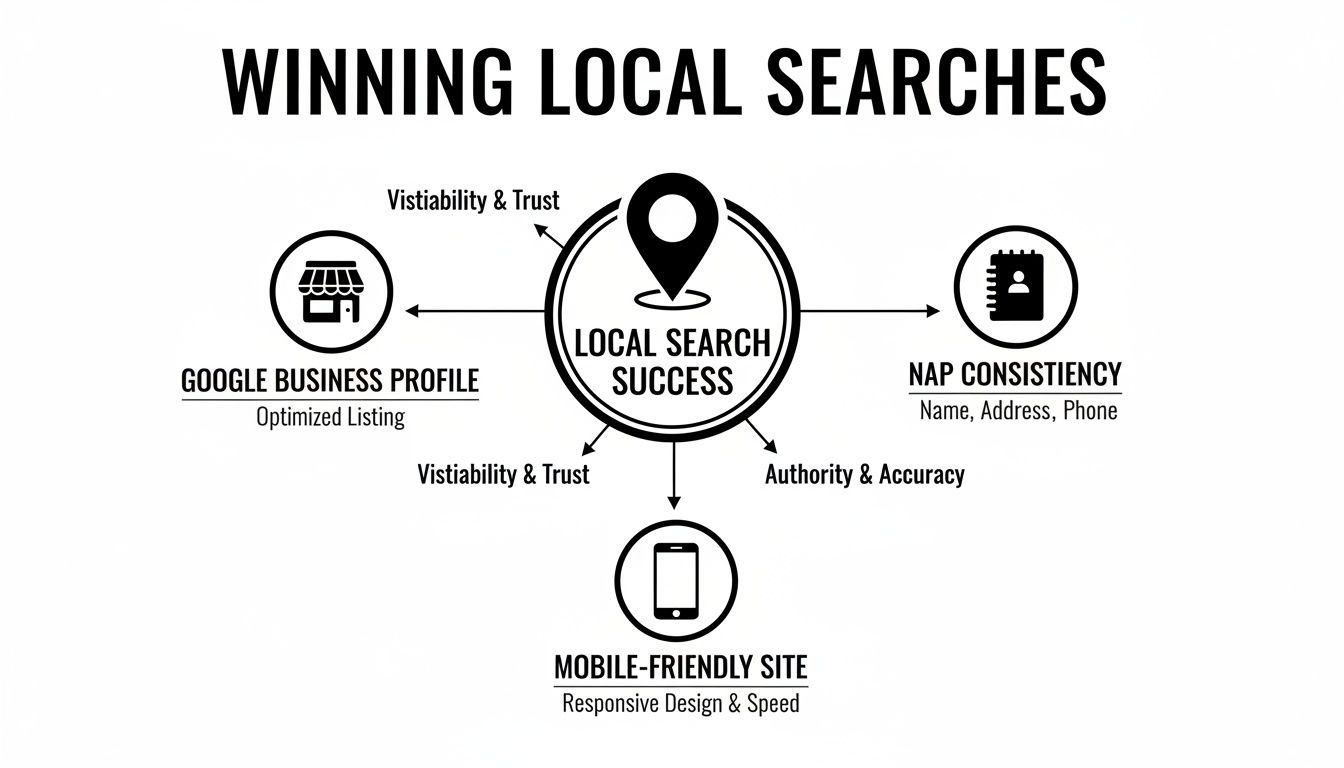
As you can see, a fast mobile experience works hand-in-hand with an optimized Google Business Profile and consistent business information to dominate local search results.
Standing Out From the Crowd With Schema Markup
Finally, if you want a true competitive advantage, you need to help Google understand not just what your content says, but what it is. Schema markup does just that. It's a vocabulary of code that you add to your site to label your content. You can explicitly tell Google, "This block of text is a product," "This is a customer review," or "This is an upcoming event."
When Google understands this context, it often rewards you with rich snippets in the search results. These are the eye-catching listings you see with star ratings, product prices, or event dates displayed right on the results page. They make your listing impossible to ignore and can dramatically boost your click-through rate, helping you stand out in a very crowded digital space.
Building a Winning Content and Backlink Strategy for the GCC
In a market as dynamic as Dubai, having a great product or service is just the ticket to entry. To truly stand out and dominate your niche online, you need a content strategy that does more than just fill a blog—it has to resonate deeply with the GCC audience and establish your brand as the go-to expert.
It all begins with thinking like your customers. This means your keyword research has to go beyond the generic. You need to uncover the exact phrases, questions, and even the slang people in the region use when they search. What are the cultural nuances and local interests that shape their queries? Getting this right is the foundation of everything that follows.
From Keywords to Topic Authority
Once you have a handle on what people are searching for, you need to organize that content in a way that Google understands and respects. The single most powerful way to do this is with the pillar page and topic cluster model. Think of it as creating a definitive digital library on a subject, with your brand as the expert curator.
Your pillar page acts as the core textbook. It’s a substantial, comprehensive guide covering a broad topic essential to your business—for instance, "A Complete Guide to Buying Property in Dubai." It touches on all the important aspects without getting lost in the weeds.
From there, you build out your topic clusters. These are shorter, highly focused articles that explore specific subtopics mentioned in the pillar page. Using our property example, clusters might include:
- Best family-friendly communities in Dubai
- Understanding Emaar vs. Nakheel developments
- How to secure a mortgage as an expat
- Legal steps for property transfer in the UAE
Each of these cluster articles links back to your main pillar page. This web of internal links sends a powerful signal to Google, proving you have a deep well of expertise on the entire subject. It's a proven method for boosting your authority and ranking for those incredibly valuable search engine optimization in dubai terms. If you're looking to dive deeper into this framework, we break it down in our guide to effective content marketing services.
The Art of Digital Networking for Backlinks
Creating exceptional content is the first step. But in a competitive space, you can't just publish and pray. You have to actively build your authority, and that's where backlinks come in. Think of a backlink as a vote of confidence or a referral from another website to yours.
But here's the catch: not all links are created equal. A single, powerful backlink from a respected source like a major UAE news outlet or a top industry blog is worth more than a hundred links from irrelevant, low-quality sites.
Think of backlinks as digital networking. A strong recommendation from a respected figure in your industry carries immense weight. Your goal is to earn those high-profile endorsements, not to collect a stack of meaningless business cards.
To build a backlink profile that truly moves the needle in the GCC, you have to treat it like relationship building, not a numbers game. Forget mass, impersonal email blasts. Instead, focus on creating genuine connections with:
- Local Publications: Get on the radar of journalists and editors at places like Gulf News, Khaleej Times, or Arabian Business. Offer them unique data, expert commentary, or a story they can't find anywhere else.
- Industry Influencers: Identify the key people shaping conversations in your niche on LinkedIn and Instagram. Find ways to collaborate or give them valuable information their audience would love.
- Business Groups and Associations: Become an active participant in local business communities. Offer to speak at an event or write a guest post for their newsletter.
When you take this approach, link building stops feeling spammy and becomes a core part of your public relations strategy. By adding real value to the regional ecosystem, you'll naturally attract the kind of powerful, authoritative backlinks that Google rewards, cementing your place as a trusted leader in the Dubai market.
E-commerce vs. B2B: How to Tailor Your SEO Strategy in Dubai
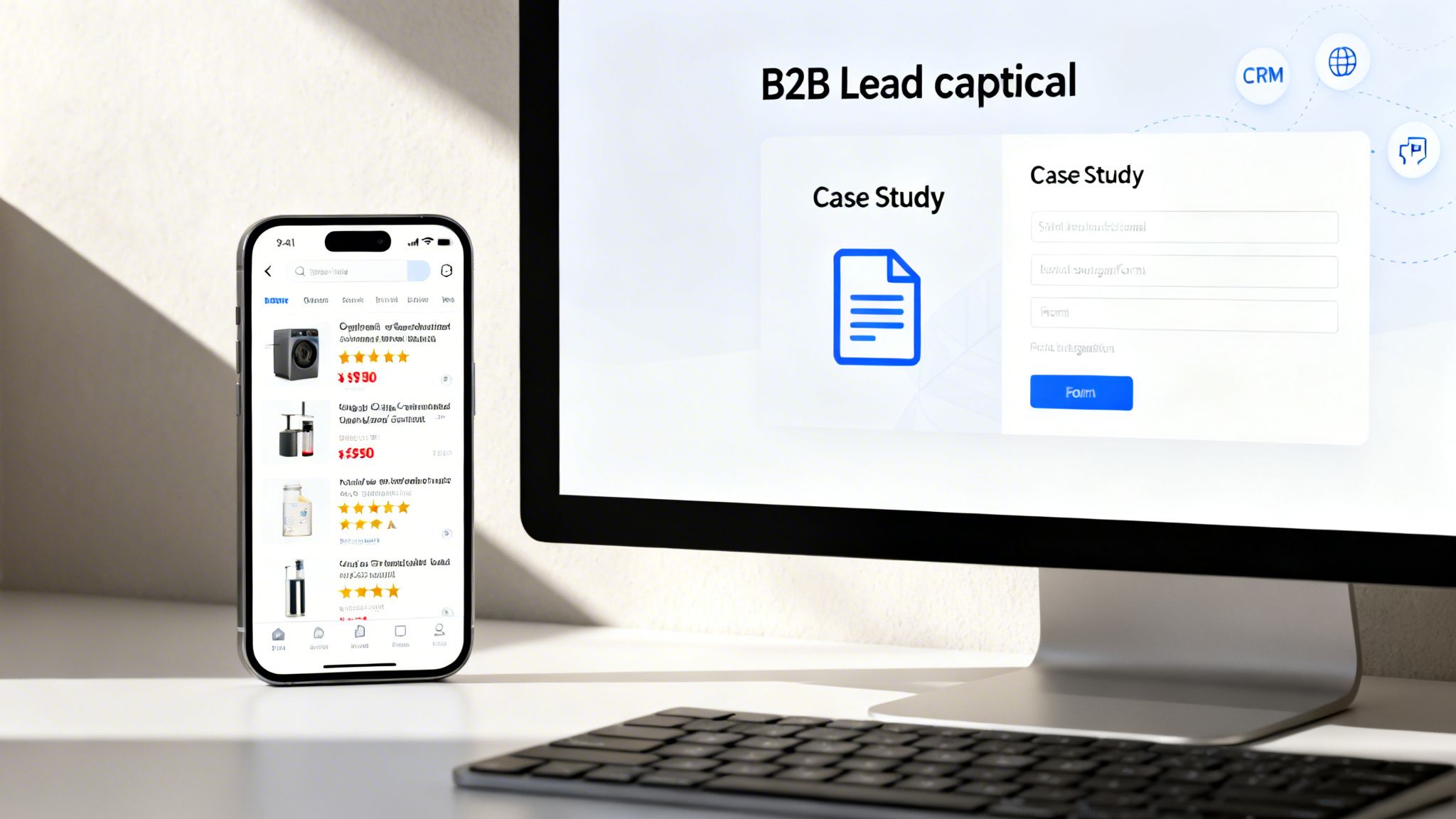
In a market as dynamic as Dubai's, there's no such thing as a one-size-fits-all SEO plan. The strategy for a B2B tech firm courting corporate clients is worlds apart from an e-commerce brand selling luxury abayas to shoppers across the GCC. Your entire approach to search engine optimization in Dubai hinges on one critical question: are you chasing direct sales or qualified leads?
E-commerce is all about the transaction. It's a fast-paced game of getting your products in front of people at the exact moment they’re ready to click "buy." On the other hand, B2B is a marathon, not a sprint. The goal is to build credibility, showcase expertise, and capture the details of decision-makers for a longer sales conversation. Let's break down how that looks in practice.
For E-commerce: Winning the Digital Shelf
When you're running an online store in Dubai, every SEO effort must push customers closer to the checkout. Your strategy is built around product-level visibility, where every single item becomes a potential front door to your brand.
Think of your product pages as your best salespeople, working 24/7. They need sharp images, persuasive descriptions, and crystal-clear calls-to-action to do their job. This is also where things can go wrong, especially during platform migrations—say, moving from WooCommerce to Shopify. A botched migration can completely wipe out your search rankings overnight. It takes a rock-solid plan of 301 redirects to guide both users and search engines to the new URLs, protecting the authority you've worked so hard to build.
Beyond that, Schema markup is your secret weapon. This snippet of code helps Google understand the specifics of your products, which can earn you rich results in search, like:
- Star Ratings: Instant social proof that builds trust at a glance.
- Price and Availability: Answering key customer questions before they even click.
- Product Images: Making your listings pop and drawing the user's eye.
These enhanced listings don't just look good; they dramatically improve click-through rates, delivering a stream of high-intent shoppers directly to your products. If you're looking to enhance your online storefront, our deeper dive into Dubai e-commerce solutions covers these tactics in more detail.
For B2B: Building a Lead Generation Engine
In the B2B world, your website's primary job is to be a lead-generating machine. You're not looking for an impulse buy; you're starting a high-value relationship. This means your SEO needs to attract and convince professionals who are researching complex, long-term solutions.
Your keyword strategy shifts to focus on service-based queries, such as "supply chain management software in UAE" or "corporate legal advisory Dubai." The content you create has to do more than just sell—it must prove your expertise. The most effective B2B content assets are:
- In-depth Case Studies: Showing potential clients you've solved their exact problem for someone else.
- Authoritative White Papers: Offering real-world solutions to industry pain points.
- Detailed Service Pages: Clearly articulating your value proposition to busy executives.
This is where your SEO efforts pay off in a big way. By integrating your website with a CRM like HubSpot or Zoho, every lead from your contact form is captured and organized instantly. You can then use targeted SEO to power automation workflows in tools like n8n or the WhatsApp Business API. Imagine a seamless journey where a prospect’s Google search turns into a scheduled meeting in your calendar—that’s the power of a well-oiled B2B SEO machine.
To clarify these differences, let's compare the two approaches side-by-side.
SEO Focus Comparison E-commerce vs B2B
This table breaks down the core differences in SEO priorities between an online store and a service-based business in the UAE.
| SEO Element | E-commerce (e.g., Shopify Store) | B2B (e.g., Service Agency) |
|---|---|---|
| Primary Goal | Direct online sales, cart conversions | Qualified lead generation, form submissions |
| Key Pages to Optimize | Product pages, category pages | Service pages, case studies, homepage, contact page |
| Keyword Intent | Transactional & commercial (e.g., "buy iPhone 15 pro Dubai") | Informational & commercial (e.g., "best corporate law firm UAE") |
| Content Strategy | Product descriptions, reviews, buying guides, sales promotions | White papers, case studies, industry reports, webinars, blog posts |
| Conversion Action | Add to Cart, Checkout | Download PDF, Request a Demo, Contact Us, Schedule a Call |
| Technical SEO Priority | Product Schema, site speed, mobile experience, crawlable filters | Service Schema, lead form optimization, CRM integration |
| Sales Cycle | Short (minutes to days) | Long (weeks to months) |
Understanding these distinctions is the first step. By aligning your SEO strategy with your business model, you're not just getting more traffic—you're getting the right kind of traffic that directly contributes to your bottom line.
Measuring Your SEO ROI and Finding the Right Partner
Let's be blunt: if you can't measure it, you can't improve it. This old saying is the absolute core of getting real value from your investment in search engine optimization in Dubai. Without solid data, your SEO efforts are just shots in the dark. This is where we stop just doing SEO and start proving its bottom-line impact, using tools like Google Analytics 4 and Google Search Console to turn raw numbers into smart business decisions.
It’s time to look past vanity metrics like raw impressions. The numbers that actually move the needle are the ones tied directly to your business goals. Are your rankings for money-making keywords climbing? Is that organic traffic actually turning into leads and sales? That's the data that tells you if your strategy is paying off.
The Metrics That Really Matter in Dubai
Tracking your performance isn't just about staring at charts; it's about seeing the story the data is telling you. In a market as fierce as Dubai, the top players aren't just counting visitors—they're obsessing over the quality of that traffic and what those users do next.
Success here boils down to a few key performance indicators: organic traffic, keyword rankings, and the quality of your backlink profile. To put that in perspective, snagging the top spot for just one competitive search term can drive an average of 502 monthly visitors. And in the mobile-first UAE, where over 70% of all traffic comes from smartphones, a slow-loading site isn't just an annoyance—it's a conversion killer that sends bounce rates soaring.
The best agencies are laser-focused on total organic traffic, click-through rates (where top positions command a massive 27.6% CTR), conversion rates, and, of course, mobile performance to constantly sharpen their approach. As you can discover more about these key SEO metrics for Dubai businesses on BMmarketing.ae, seeing how these numbers connect is the key to real growth.
How to Choose the Right SEO Agency in Dubai
Picking an SEO partner in Dubai is one of the most critical decisions you'll make for your business online. You're not just buying a monthly service; you're entrusting a team with your digital future. The right choice can put you on the fast track to success, while the wrong one can cost you months, or even years, of lost ground.
Stop shopping for SEO based on the lowest price. You're looking for a growth partner who gets your business, speaks your language, and is brutally honest about their process and results.
To tell the true experts from the pretenders, you just have to know what to ask. Any agency worth its salt will welcome tough questions and have clear, confident answers ready.
Your Vetting Checklist for a Future SEO Partner
Before you even think about signing a contract, arm yourself with this checklist. An agency's answers will tell you everything you need to know about their competence, transparency, and whether they're the right fit for you.
- How will you measure our success? Their answer has to go beyond "more traffic." You want to hear about leads, sales, cost-per-acquisition, and return on investment.
- Can I see some relevant case studies? Ask for proof of their work with businesses like yours. Dig into the results—did they just get rankings, or did they deliver tangible business growth?
- What does your reporting look like? Get a sample report. It needs to be crystal clear and focused on the metrics you both agreed matter most—not a 50-page data dump.
- What's your strategy for link building? This is a big one. You want to hear about earning high-authority links through great content and genuine outreach, not buying cheap links from spammy networks.
Red Flags That Should Make You Run:
- Guarantees of a #1 ranking. Nobody can promise this. It’s a classic sign of someone who either doesn't know what they're doing or isn't being honest.
- A "secret sauce" they can't explain. Real SEO is built on proven, transparent strategies, not magic tricks.
- A focus on getting tons of low-quality backlinks. This is a dated and dangerous tactic that can get your website penalized by Google.
By holding your team or agency accountable with real data and asking the right questions from day one, you ensure your SEO investment delivers a powerful, measurable return. Exploring our full suite of digital marketing services can give you a clearer picture of what a truly comprehensive and results-driven partnership should look like.
Frequently Asked Questions About SEO in Dubai
If you’re exploring SEO for your business in Dubai, you’ve probably got a lot of questions swirling around. It’s a competitive market, and you want to make sure you’re making the right moves. Let's cut through the noise and tackle the most common questions we hear every day.
How Much Does SEO in Dubai Cost?
This is the million-dirham question, isn't it? The truth is, there's no one-size-fits-all price tag. SEO isn't a product on a shelf; it's an ongoing service tailored to your specific situation.
A simple project with a freelancer might start at a few thousand dirhams. On the other end, a full-throttle monthly campaign with a top agency in a cut-throat industry could easily be tens of thousands.
What really drives the cost?
- How Tough is Your Niche? Breaking into saturated markets like real estate or finance demands a much more aggressive—and therefore more expensive—strategy than a small, local niche.
- What's Included in the Plan? A basic local SEO tune-up is one thing. A comprehensive strategy involving technical audits, bilingual content creation, and a serious backlink campaign is a completely different ballgame.
- Agency vs. Freelancer: Agencies bring a full team of specialists—from tech SEOs to content writers—and that comes with higher overhead. But you also get a wider safety net and a much deeper well of expertise.
How Long Until I See SEO Results?
Think of SEO as a marathon, not a 100-meter dash. In a fast-paced market like Dubai, you need to be patient. Realistically, you should expect to see significant, needle-moving results—like a steady stream of organic leads—within 6 to 12 months.
That doesn't mean you'll be flying blind for a year. Within the first 90 days, you should start seeing positive signs. We call these "early indicators": things like better rankings for some of your keywords, more visitors coming from Google, and a healthier, faster website. If anyone promises you instant, guaranteed first-page rankings, you should be very skeptical.
Is Arabic SEO Necessary in the UAE?
Without a doubt, yes. While English is the language of business, you’re leaving a massive audience—and a lot of money—on the table if you ignore Arabic.
An Arabic SEO strategy is essential for connecting with the huge segment of local and regional customers who search, shop, and live in Arabic.
But here’s the critical part: simply translating your English website won't work. True Arabic SEO means deep keyword research into local dialects, culturally sensitive content that resonates, and the right technical signals (like hreflang tags) so Google knows exactly who to show your Arabic pages to.
Can I Do SEO Myself for My Dubai Business?
Maybe, but it depends on your goals. If you're a small local shop with one location and minimal competition, you can probably handle the basics of your Google Business Profile and some on-page updates.
But the moment you step into a competitive space or want to scale, the complexity skyrockets. Trying to manage technical SEO, a content strategy, and link building without real expertise is a recipe for disaster. You can easily make mistakes that get your site penalized, setting you back months or even years.
For serious growth and a real return on your investment, partnering with a professional is not just a good idea—it's essential.
Ready to stop asking questions and start seeing results? GoDesign Technologies builds data-driven SEO strategies that deliver measurable growth for businesses in Dubai. Learn more about our SEO services and get a personalized plan today.
Enhanced by Outrank