
You’re probably in one of two situations right now. Either you’ve already run Google Ads yourself and the spend felt easy to launch but hard to justify, or you’ve held off because every agency pitch sounds polished and vague at the same time.
That hesitation is healthy. Founders don’t need more traffic reports. They need revenue they can trace, a budget they can control, and a partner who won’t hide behind jargon when lead quality drops. The best ppc advertising agencies understand that clicks are only the start. The weak ones stop reporting at the point where your sales team’s real work begins.
Table of Contents
- Why Your Next Hire Should Be a PPC Agency
- Decoding PPC Agency Services and Deliverables
- How to Vet PPC Agencies and Spot True Experts
- Understanding Pricing Models and Key Performance Indicators
- Creating a Powerful RFP and Agency Brief
- Integrating Your PPC Agency with Your Business Systems
Why Your Next Hire Should Be a PPC Agency
You launch a few campaigns, leads start coming in, and the numbers look encouraging for about two weeks. Then spend climbs, lead quality drops, and no one can say which enquiries turned into pipeline or sales. That is the point where many founders realise they do not have an ads problem alone. They have a tracking, qualification, and decision-making problem.
That gap is why a PPC agency is often the right next hire.
DIY PPC breaks down in predictable places. Search terms drift away from buyer intent. Irrelevant clicks slip through. Daily budgets disappear before your best prospects even start searching. Landing pages promise one thing while the form, sales call, or checkout delivers another. The account can stay busy while revenue stays flat.

PPC is a revenue channel when it is tied to the rest of the business
PPC can produce fast demand, but traffic and leads are only the first step. The essential question is whether paid clicks become qualified opportunities, closed deals, and repeat customers. That only happens when campaigns are connected to your CRM, call tracking, sales process, and reporting.
For a first-time buyer, that is where an agency has an edge. A good team does more than launch ads in Google or Meta. They set up conversion tracking properly, define what counts as a qualified lead, and push performance data back into the account so bidding decisions reflect revenue, not just form fills.
That matters more than the click-through rate.
I have seen founders pause PPC because the campaign looked expensive, only to learn later that paid search was producing the highest-value customers. I have also seen the opposite. Cheap leads looked great in the ad platform and turned out to be useless once the sales team followed up. Without CRM feedback, both accounts looked healthy.
What you are actually hiring an agency to do
A capable PPC agency gives you operating discipline that an early in-house hire often cannot build alone in the first 90 days.
You are paying for:
- Faster decisions based on actual account patterns, not guesswork
- Cleaner tracking across forms, calls, CRM stages, and revenue events
- Budget control so spend shifts toward terms, audiences, and locations that produce pipeline
- Commercial judgment about when to test, when to hold, and when to cut a campaign
- Cross-functional pressure on landing pages, offer clarity, lead handling, and sales follow-up
That last point gets missed in a lot of hiring advice. PPC performance is shaped by the whole customer path. If leads sit untouched in a shared inbox for two days, the media buyer cannot fix that with better keywords.
Practical rule: If your team cannot show how a lead moves from ad click to CRM record to sales outcome, do not judge PPC by platform metrics alone.
Why an agency is usually the better first move
An in-house setup can work. It makes sense if you already have strong attribution, enough budget to support testing, a clear offer, and a sales team that logs outcomes consistently.
Many SMEs are not there yet.
They need a partner who can get campaigns live, spot waste early, and connect paid media to the wider digital marketing stack instead of treating PPC as a disconnected ad account. They also need honest trade-offs. An agency costs more than doing it yourself, and some agencies hide weak performance behind busy reports. But for a founder buying PPC for the first time, the bigger risk is often wasted spend, poor tracking, and months of learning on a live budget.
The right agency shortens that learning curve and helps turn paid media into a measurable revenue channel.
Decoding PPC Agency Services and Deliverables
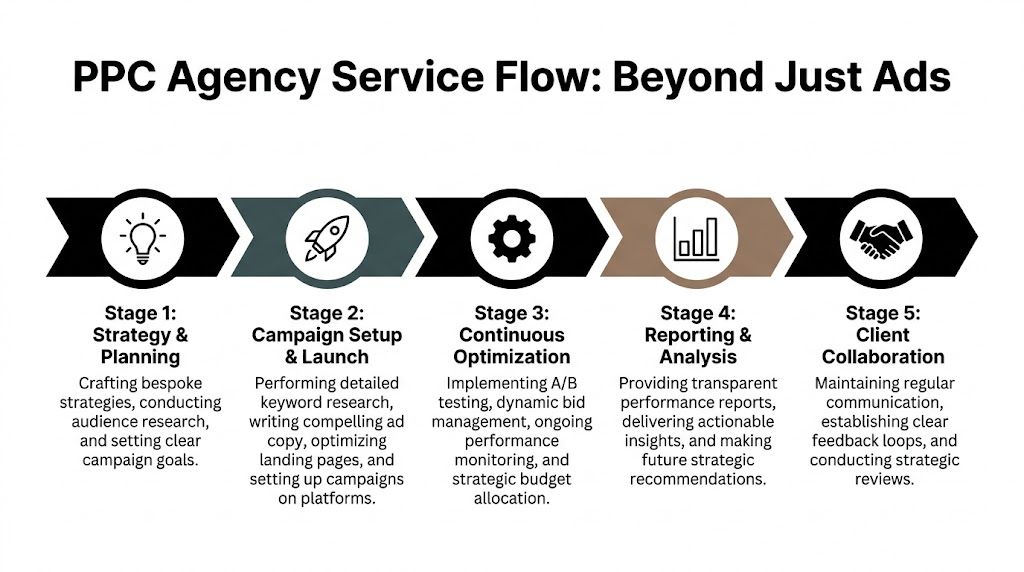
A serious PPC agency should be able to show you what happens before launch, during launch, and after launch. If all you hear is “we manage ads”, you’re hearing a sales summary, not an operating model.
The work starts before the first click
The first deliverable should be diagnosis.
A capable agency reviews your offer, margins, customer journey, conversion path, existing account structure, landing pages, and tracking. They should also challenge your assumptions. Some products don’t need more impressions. They need a better offer, stronger qualification, or a cleaner enquiry process.
After that, campaign architecture matters. Good agencies segment intentionally. Weak agencies dump too much into one campaign and let the platform sort it out.
What competent campaign management looks like
Top-tier agencies in the UAE achieve 3:1 to 4:1 ROAS by using granular segmentation by geo, device, and match type, then calculating marginal ROI at the ad group level, according to Improvado’s PPC analysis. The same source notes that bi-weekly reviews and robust negative keyword lists can increase conversions by 119% and reduce CPA by 26% month over month.
That sounds technical, but the business logic is simple. Don’t treat all clicks as equal.
A founder should expect an agency to answer questions like:
- Which geography performs better and should receive more budget
- Which devices convert worse and deserve reduced bids
- Which keywords produce pipeline versus shallow enquiries
- Which campaigns are saturated and should stop scaling
- Which search terms need excluding to stop low-intent spend
Good PPC management isn’t “launch and optimise”. It’s controlled budget reallocation based on what each segment actually contributes.
Deliverables worth asking for
Ask agencies to define deliverables in plain terms, not broad promises.
A good scope usually includes:
Audit and account review
Existing campaign structure, wasted spend areas, conversion tracking, landing page gaps, and obvious targeting issues.Strategy and media plan
Platform selection, audience logic, keyword approach, budget allocation, exclusions, and how success will be measured.Campaign build
Search structure, ad groups, creative, extensions, audience overlays, conversion events, and naming conventions.Landing page input
They don’t always build pages themselves, but they should absolutely advise on copy-message match, form friction, and offer clarity.Ongoing optimisation
Search term reviews, bid adjustments, budget pacing, ad testing, and quality control.Reporting and action notes
Not just dashboards. You want commentary, decisions made, and decisions pending.
The difference between active and passive management
Passive managers send monthly summaries. Active managers explain why spend moved, why one campaign was cut, and why another got expanded.
That difference matters if you’re also investing in content and organic visibility. Paid search works better when messaging, keyword intent, and landing page experience support each other. That’s one reason many firms pair PPC with SEO services in Dubai rather than treating each channel as a silo.
How to Vet PPC Agencies and Spot True Experts
Most agencies look competent on a website. The key difference appears when you ask them uncomfortable questions.
The first thing I’d test is whether they can speak clearly about your business model. If they jump straight into ad formats and platform features before understanding margins, lead handling, and sales cycle, they’re thinking like media buyers, not growth partners.

Start with localisation, not promises
In the UAE, generic PPC tactics often break down because the market isn’t monolingual and user intent isn’t uniform. Arabic creative testing can yield a 2.5x higher CTR, while 60% of SMEs face ad disapprovals due to poor localisation, according to Boiling Point Media’s write-up on PPC agency pitfalls.
That single point tells you a lot about vetting.
If an agency can’t explain how it handles Arabic and English creative, local search nuance, and approval risk, it may be fine at generic campaign management but weak in the actual market you’re buying into.
Questions that reveal whether the team is real
Don’t ask, “Are you experienced?”
Ask these instead:
Who will manage the account?
Sales teams often sound sharper than delivery teams. Ask for the structure.How do you build negative keyword lists?
You want a method, not a slogan.How do you decide when not to scale a campaign?
Mature operators know restraint is part of performance.How do you test localised copy for Arabic and English audiences?
If the answer is generic, that’s a warning sign.Who owns the ad account and historical data?
You should.What happens when lead volume rises but quality drops?
The right answer should involve CRM feedback, not just ad-side tweaks.
How to read case studies properly
A flashy case study can hide weak fundamentals.
Look for evidence that the agency understands the full commercial picture:
- Business context instead of isolated metrics
- Starting problem clearly described
- Trade-offs they had to make
- What changed operationally in targeting, creative, landing pages, or reporting
- How success was measured beyond traffic
If every case study only talks about impressions, clicks, and CTR, you’re looking at an agency that may still be optimising for surface metrics.
A useful outside perspective on how agencies frame expertise can be seen in this video:
Red flags founders should take seriously
If an agency guarantees outcomes before it audits your account, it’s selling certainty it doesn’t have.
Watch for these signs:
- Opaque reporting that hides search terms, conversions, or account access
- Account ownership games where you don’t control your own assets
- Overconfidence on low budgets without acknowledging trade-offs
- No questions about sales process even though they claim to focus on ROI
- One-size-fits-all proposals sent before a serious discovery call
The best ppc advertising agencies aren’t always the loudest. They’re usually the ones willing to say, “Your landing page is the issue,” or “Your team isn’t qualifying leads consistently enough for us to judge performance yet.”
Understanding Pricing Models and Key Performance Indicators
A founder usually sees one line item in a proposal and assumes it covers everything. It does not. Your ad spend goes to Google, Meta, or LinkedIn. Your management fee goes to the agency for strategy, execution, testing, reporting, and account stewardship.
If a proposal blends those numbers together, ask the agency to separate them before you discuss anything else. You need to know what media budget is buying reach and what the fee is buying in terms of skill, time, and accountability.
Comparing PPC Agency Pricing Models
| Model | How It Works | Best For | Pros | Cons |
|---|---|---|---|---|
| Percentage of ad spend | Agency fee rises or falls with monthly spend | Businesses scaling budget regularly | Simple to understand, flexible as spend changes | Incentive can drift toward spending more, not always earning more |
| Flat monthly retainer | Fixed management fee each month | SMEs with stable budgets and a clear scope | Predictable cost, easier budgeting, cleaner planning | Scope can become strained if campaign complexity grows fast |
| Performance-based | Agency fee depends on agreed outcomes | Businesses with strong tracking and clear conversion definitions | Better alignment when measurement is reliable | Hard to structure fairly if attribution is messy or sales cycles are long |
No pricing model is automatically right.
A percentage-of-spend model can work well if spend is rising and the account becomes more complex as budget grows. It becomes a problem when the agency is rewarded for increasing spend faster than it improves pipeline or revenue. A flat retainer gives better cost control, but only if the scope is defined tightly enough that the agency is not reducing attention as campaigns expand. Performance pricing sounds attractive to founders, yet it often falls apart when CRM stages are inconsistent, offline sales are not tracked, or the business has a long sales cycle.
Price should follow operational complexity
Agency fees vary because accounts vary. A single-service local lead generation campaign is lighter to manage than an account covering multiple products, several geographies, two languages, custom landing pages, call tracking, and weekly creative updates.
That is why the cheapest proposal often creates expensive problems later.
Low fees usually mean one of four trade-offs:
- less frequent optimisation
- junior staff running the account day to day
- weak creative and landing page input
- reporting limited to platform metrics rather than sales outcomes
High fees need scrutiny too. A premium retainer only makes sense if the agency is doing work that affects commercial performance, not just producing cleaner dashboards.
Budget realism matters more than bargain hunting
Small budgets are not automatically wrong. Wide campaign scope on a small budget is.
The agency should be honest about what your budget can support. With a modest spend, the answer may be one geography, one offer, one conversion action, and very tight keyword coverage. That is a disciplined test. Trying to cover search, display, remarketing, multiple audiences, and several landing pages on the same budget usually creates noise instead of learning.
The benchmark that matters is not whether the budget sounds large or small. It is whether the account can generate enough qualified data to make decisions within a reasonable time frame.
Thrive Agency notes in its PPC benchmarks and mistakes guide that underfunded campaigns often struggle because high click costs and limited conversion volume make optimisation slower and less reliable. That is the practical issue founders should focus on.
The KPIs that actually matter
Founders do not need more click data. They need evidence that paid media is producing qualified demand the sales team can close.
Use KPIs that connect ad performance to revenue:
Cost per qualified lead or customer
Start with acquisition cost after lead filtering, not raw form fills.Pipeline value from PPC
For lead generation businesses, this matters more than CTR. If paid search creates leads that never become opportunities, the account is not working.ROAS or gross profit return
Useful for e-commerce or any business with clean revenue attribution.Lead-to-opportunity rate
This shows whether traffic quality is improving, not just lead volume.Time to qualified opportunity
Helpful when deals take weeks or months to mature.Closed revenue by campaign type
Brand, non-brand, remarketing, and paid social should not all be judged the same way.
Many agencies still fall short. They report conversions from the ad platform, but they do not connect those conversions to CRM stages, sales acceptance, or won revenue. If your agency cannot tell you which campaigns produce real opportunities, it is managing traffic, not growth.
What founders should demand in reporting
A useful monthly report should help you make decisions. It should not read like a screenshot pack.
Ask the agency to show:
- What happened in the account
- What changed operationally
- What those changes did to cost, lead quality, and pipeline
- What sales feedback came back from the CRM
- What they are testing next and why
The CRM view matters. A lead that looks cheap inside Google Ads can be a bad investment if your team rejects it, cannot reach it, or closes it at half the rate of leads from another campaign.
Good agencies build reporting around that reality. They do not stop at clicks, CTR, and conversion volume. They tie paid media to the sales process so you can judge whether the agency is helping you buy revenue, not just traffic.
Creating a Powerful RFP and Agency Brief
Founders often complain that agency proposals all sound the same. That usually happens because the brief they sent gave every agency the same shallow information.
A strong RFP makes weak agencies uncomfortable and strong agencies more accurate. It forces specificity.
What your agency brief should include
Start with the basics, but don’t stop there.
Business model and offer
Tell the agency what you sell, who buys it, and what a good customer looks like.
Include practical details such as:
- core products or services
- average deal shape or buying path
- geographic focus
- whether you need calls, forms, bookings, or direct purchases
If you leave this vague, agencies fill the gaps with assumptions.
Audience and qualification rules
Many briefs define target audience too broadly. “SMEs in Dubai” isn’t enough.
A better brief explains:
- who makes the buying decision
- who influences it
- what makes a lead qualified
- which enquiries waste your team’s time
That last point matters more than most founders realise. If your sales team rejects certain lead types, say so early.
Current setup and constraints
An agency needs to know what already exists.
List things like:
- current ad accounts and platform access
- landing pages in use
- analytics and tracking tools
- CRM in place, if any
- internal approval constraints
- legal or sector-specific review requirements
The outcomes you want
Here, most briefs go soft.
Don’t ask for “more awareness” unless you can define why that matters commercially. Give agencies a concrete objective tied to the stage of the business.
For example, your brief should clarify whether you need:
- a reliable flow of qualified leads
- better performance from an existing account
- support launching a new offer
- help reducing waste from broad targeting
- reporting that connects spend to downstream sales results
A good brief doesn’t try to sound sophisticated. It tries to remove ambiguity.
Questions worth adding to your RFP
Use your RFP to force useful comparisons between agencies.
Include questions like:
- How would you structure the first 90 days of work?
- What tracking gaps would you check first?
- What risks do you see in our current setup?
- How do you handle landing page feedback if you don’t build pages yourself?
- How do you connect campaign performance to lead quality?
- What would make you advise against scaling spend?
These questions reveal judgement. That matters more than presentation polish.
What not to do in an RFP
Avoid three common mistakes:
Don’t hide the budget range
Agencies need context to scope properly.Don’t ask for free strategy in exchange for a chance to pitch
You’ll attract agencies that overpromise.Don’t make the brief purely tactical
If you never mention sales process, qualification, or CRM, you invite shallow proposals.
The best responses usually come from the clearest briefs. And clarity starts with admitting where the business has friction, not pretending everything is already organised.
Integrating Your PPC Agency with Your Business Systems
Most PPC setups break at the handoff.
An ad generates a lead. The lead enters a form. After that, visibility gets fuzzy. Sales follow-up happens somewhere else. Qualification happens in someone’s inbox. Revenue gets tracked in a different tool, if at all. Then marketing and sales argue over whether the campaign worked.
That’s the gap most hiring guides miss.
Why this is the leverage point
The integration of PPC with CRM is a major missed opportunity. In the UAE, only 15% of SMEs report integrated PPC-CRM strategies, leading to 40% wasted ad spend on unqualified leads, and closing that gap can boost ROI to $4 to $6 per $1 spent, according to PPC.co’s analysis of modern agency value.
That changes how you should evaluate ppc advertising agencies.
The right question isn’t only, “Can they lower CPC?” It’s, “Can they help us see which leads turned into revenue?”

What integration looks like in practice
At minimum, your PPC agency should work with your team to connect:
- Google Ads and GA4 for campaign and conversion visibility
- GTM for clean event tracking
- UTM parameters so source data survives the click
- CRM records in tools like HubSpot or Zoho
- Lead status updates so marketing sees what sales accepted, rejected, or closed
This doesn’t need to become a giant transformation project. It does need discipline.
If a lead from paid search becomes a qualified opportunity three weeks later, that path should be visible. If one campaign generates volume but low fit, that should be visible too.
The operating model that works
The most effective agency relationships use a shared cadence.
That usually includes:
Agreed conversion definitions
Form submission isn’t always a success event. Qualified meeting or accepted lead may be better.Shared dashboard access
Founders shouldn’t need to request screenshots to know what’s happening.Regular sales feedback
If sales says the leads are poor, the agency needs examples, not vague frustration.Landing page iteration
PPC performance often improves when forms, copy, and proof points are adjusted. If you need a practical reference point for this, review proven ideas for how to improve website conversion rate.Automation where useful
Routing paid leads, tagging sources, notifying teams, and feeding status changes back into reporting.
The agency becomes more valuable when it can see beyond the click. That’s when optimisation starts affecting pipeline, not just ad metrics.
What founders should insist on
If you’re hiring your first agency, set these rules early:
- Your business owns the accounts
- CRM stages are defined before scale
- Lead quality feedback happens routinely
- The agency reports on business outcomes, not just platform activity
- Tracking gets audited before aggressive budget increases
The upside is straightforward. Once PPC, CRM, analytics, and sales feedback are connected, you stop buying traffic in isolation. You start building an acquisition system.
That’s what separates a vendor from a revenue partner.
If you want a partner that can connect paid acquisition with web performance, CRM implementation, and automation, GoDesign FZE is built for that kind of work. The team helps businesses turn traffic into qualified pipeline by aligning campaigns, landing pages, tracking, and sales systems so marketing spend is tied to real outcomes.
Enhanced by Outrank