

In the hyper-competitive world of ecommerce, simply having great products is not enough. If your target customers can't find your store on Google, you're essentially invisible, leaving significant revenue on the table for your competitors. The critical difference between a thriving online business and one that struggles often comes down to a single, powerful discipline: Search Engine Optimization.
But here’s the problem: the rules of SEO are constantly shifting. The tactics that worked last year are often outdated today, and generic advice won't cut it. This guide is built to move beyond vague suggestions and deliver a clear, actionable roadmap. You will find the most current ecommerce SEO best practices that directly address the challenges faced by modern online retailers.
We've distilled this complex field into ten essential strategies designed to produce measurable results. You will learn how to:
- Build a technical foundation that makes search engines favor your site.
- Optimize product and category pages to attract high-intent buyers.
- Implement data-driven tactics that convert visitors into paying customers.
Whether you're running on Shopify, managing a WooCommerce store, or operating on a custom platform, these techniques are your blueprint for increasing organic traffic and boosting sales. Forget theory and guesswork; this is your step-by-step plan to transform your store into a dominant force in search results. Let's get started.
1. Technical SEO & Core Web Vitals Optimization
The foundation of any successful ecommerce SEO strategy isn't just about keywords; it's about the raw, technical performance of your site. Technical SEO ensures search engines can efficiently crawl, index, and understand your store. A core component of this is optimizing for Google's Core Web Vitals, a set of specific metrics that measure a user's real-world experience with page speed, responsiveness, and visual stability. For an online store, where a one-second delay can cause a 7% drop in conversions, mastering these signals is non-negotiable.
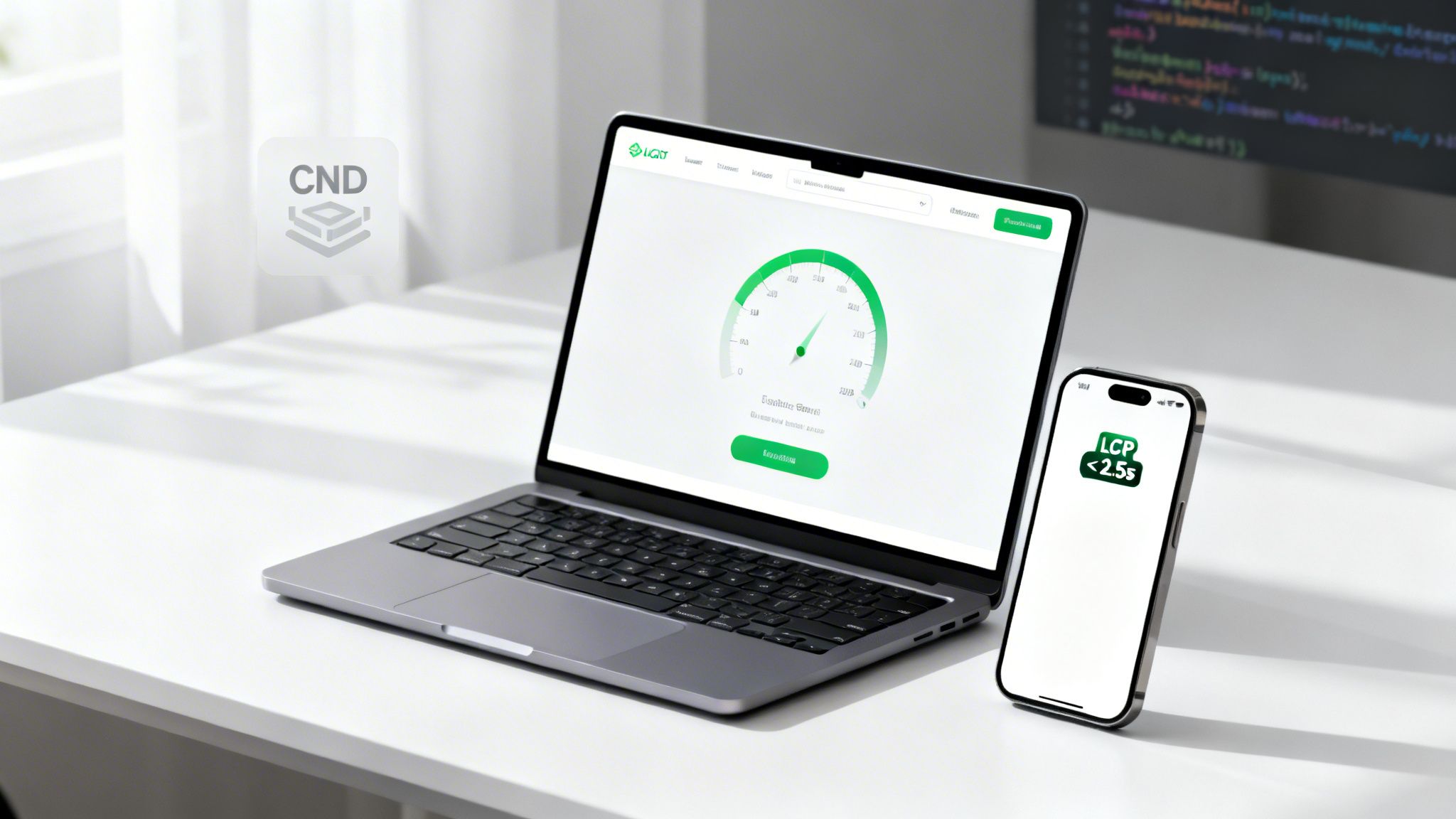
Google directly uses these vitals as a ranking factor, meaning slower, clunkier sites are actively penalized. For instance, Nike's platform achieves a sub-1.5 second Largest Contentful Paint (LCP) through aggressive optimization, directly contributing to its high search rankings and user retention. This proves that a fast, technically sound website is a powerful asset for visibility and sales.
Actionable Implementation Steps:
To improve your site's technical health, focus on these critical actions:
- Diagnose Your Speed: Start by running your key pages (homepage, category, product) through Google PageSpeed Insights and GTmetrix. These tools provide a clear report on your Core Web Vitals scores and identify specific bottlenecks, from large images to render-blocking JavaScript.
- Image & Asset Optimization: Compress all images using modern formats like WebP. Shopify apps like Image Optimizer can automate this, while WooCommerce users can use plugins like WP Rocket. This single action dramatically reduces LCP times.
- Implement a CDN: Use a Content Delivery Network (CDN) like Cloudflare or AWS CloudFront. A CDN distributes your site's assets across a global network of servers, ensuring fast load times for customers no matter where they are located.
- Code & Script Management: Defer the loading of non-critical JavaScript and CSS. This allows the main content of your page to render first, improving perceived performance and your LCP score.
Key Insight: Don't just test on a fast desktop connection. Regularly check your site's performance on real mobile devices and simulated 3G/4G networks to understand the true experience of most shoppers. Integrating this data with a professional GA4 setup can reveal how speed directly impacts your conversion rates and revenue. Getting the technical setup right from the start is crucial, which is why expert-led e-commerce solutions are invaluable for building a high-performing store.
2. Structured Data & Rich Snippets Implementation
Beyond on-page keywords, telling search engines exactly what your content is about is a critical ecommerce SEO best practice. This is achieved through structured data, a standardized code vocabulary (like schema.org) that you add to your site's HTML. It translates your page content into a format search engines can instantly understand, allowing them to display "rich snippets"—visually enhanced search results that include star ratings, pricing, and stock availability directly on the results page. For online stores, this is a powerful way to stand out from competitors and boost click-through rates.

These enhanced listings do more than just catch the eye; they pre-qualify shoppers before they even click. When a user sees a product has 5-star reviews and is in stock, they are more likely to click through with a strong intent to purchase. E-commerce giants like Amazon and Zappos dominate SERPs by using comprehensive product schema, resulting in rich snippets that build trust and drive high-quality traffic.
Actionable Implementation Steps:
To add this powerful markup to your store, focus on these key actions:
- Choose Your Format & Tool: Implement structured data using the JSON-LD format, which is Google’s preferred method and easiest to manage. Platforms like Shopify include basic schema automatically, but apps like Structured Data Pro offer more control. For WooCommerce, plugins like Yoast SEO or Rank Math are excellent for generating product schema.
- Prioritize Essential Product Schema: Ensure your product pages include Product, Offer (for price and currency), AggregateRating (for review stars), and availability (in stock/out of stock) schema. This is the minimum needed to earn a compelling rich snippet.
- Validate Your Markup: Before and after deploying, test your URLs with Google's Rich Results Test tool. This will confirm your code is error-free and eligible for rich snippets. Use the Schema.org validator for more granular debugging.
- Expand to Other Page Types: Don't stop at products. Implement BreadcrumbList schema on category and product pages to show the site hierarchy in search results. Use FAQPage schema on product pages to answer common questions and potentially capture a "Position Zero" featured snippet.
Key Insight: Data accuracy is paramount. The information in your structured data (price, stock status) must perfectly match the information visible to users on the page. Any discrepancy can lead to a manual penalty from Google and a loss of all rich results. Regularly audit your schema to ensure it remains consistent with your front-end content.
3. Keyword Strategy: Long-Tail Targeting & Content Gap Analysis
Moving beyond broad, high-competition keywords is essential for ecommerce success. A potent keyword strategy combines targeting specific, long-tail phrases with a methodical content gap analysis. This dual approach helps you capture high-intent buyers who know exactly what they want while uncovering valuable, low-competition opportunities your rivals have missed. Focusing on these informational and transactional hybrid queries is a core tenet of modern ecommerce SEO best practices.
This method allows newer or smaller stores to gain traction against established players. For example, a new fashion brand can find and rank for terms like "sustainable linen wrap dress for summer" by identifying that larger competitors are only optimized for "wrap dress." Similarly, Etsy sellers often dominate search results for hyper-specific, long-tail craft queries, proving that specificity drives sales. Best Buy successfully targets queries like "affordable gaming laptops for college students under 1000 USD," directly matching a searcher's precise need and budget.
Actionable Implementation Steps:
To refine your keyword targeting and find competitive gaps, follow these steps:
- Identify Long-Tail Variants: Use tools like Ahrefs or SEMrush to find long-tail keyword variations with decent search volume (e.g., 100-500 monthly searches). Focus on phrases that signal purchase intent, including product attributes, use cases, or locations.
- Conduct a Keyword Gap Analysis: Employ the 'Keyword Gap' or 'Content Gap' tool in Ahrefs or SEMrush. Input your domain and 2-3 top competitors to instantly see which keywords they rank for that you don't.
- Prioritize Low-Difficulty Wins: Sort the results of your gap analysis by 'Keyword Difficulty' in ascending order. Target keywords with a difficulty score between 0-20 first, as these represent the quickest opportunities to rank and attract traffic.
- Optimize On-Page Elements: Once you have your target long-tail keywords, integrate them naturally into your product and category pages. This includes the URL slug, H1 tag, the first 100 words of your description, and image alt text.
Key Insight: A content gap analysis isn't a one-time task. Perform this audit quarterly to stay ahead of competitor strategies and adapt to new search trends. By analyzing the top-ranking pages for your target keywords, you can create content that is 10% more thorough or helpful, giving you a distinct advantage. This consistent analysis is a cornerstone of an effective content marketing program that drives both rankings and revenue.
4. Category & Faceted Navigation SEO (Avoid Duplicate Content)
While product pages get the spotlight, your category pages and faceted navigation (filters for size, color, brand) are the true workhorses of ecommerce SEO. These systems guide users and search engines through your inventory, but without proper management, they create a massive duplicate content problem. Each filter combination (e.g., "red-t-shirts-size-medium") can generate a new URL, diluting link equity and confusing Google, which ultimately harms your rankings.
Effectively managing faceted navigation is a core tenet of modern ecommerce SEO best practices. Online retail giant Zalando, for instance, strategically applies noindex tags to pages with three or more filters applied. This prevents Google from indexing low-value, hyper-specific combinations while allowing primary categories and valuable single-filter pages to rank strongly. This focused approach ensures crawl budget is spent on pages that actually drive traffic and sales.
Actionable Implementation Steps:
To control faceted navigation and prevent duplicate content, implement these technical fixes:
- Establish Canonical URLs: The most critical step is to set the main, unfiltered category page URL as the canonical for all its filtered variations. For a URL like
domain.com/shirts?color=blue, the canonical tag should point back todomain.com/shirts. This tells Google to consolidate all ranking signals into the primary page. - Manage URL Parameters in GSC: Use the (legacy) URL Parameters tool in Google Search Console to inform Google how to handle your filter parameters. You can specify which parameters (like
sort_byorprice_range) don't change page content and should be ignored, helping Google crawl more efficiently. - Strategically Block Crawling: For complex filter systems, use your
robots.txtfile to block crawlers from accessing URLs with multiple, low-value filter combinations. For example,Disallow: /*?color=*&size=*prevents Google from even visiting pages where both color and size filters are applied. - Use the
noindexTag: Apply anoindexmeta tag to pages you don't want in Google's index, such as filter combinations with very few products or those with 3+ filters applied. This is more surgical thanrobots.txtand is the preferred method for managing indexation.
Key Insight: The goal isn't to block all filters. It's to be strategic. Identify filter combinations that have legitimate search volume ("men's black running shoes") and build them into standalone sub-category pages. For all other dynamic filter URLs, use canonical and
noindextags to keep your site's index clean and authoritative.
5. User-Generated Content & Review Schema Integration
One of the most powerful assets for an ecommerce store is not the content you create, but the content your customers create for you. Systematically encouraging, collecting, and displaying user-generated content (UGC) like reviews, ratings, and customer photos serves multiple critical functions. It builds immense social proof and trust, provides a constant stream of fresh, keyword-rich content for search engines, and directly impacts your click-through and conversion rates.

This strategy is a cornerstone of modern ecommerce seo best practices because it taps into authentic user experiences. Amazon's entire model is built on this, with review counts and star ratings dominating their product listings. Similarly, beauty retailer Sephora found that including user-submitted photos on product pages boosted click-through rates by over 25%. When implemented with the correct schema, these reviews generate the coveted star ratings directly in Google search results, making your listings impossible to ignore.
Actionable Implementation Steps:
To turn your customers into your best marketers, focus on these implementation steps:
- Automate Review Collection: Use a dedicated app or plugin like Judge.me for Shopify or YITH WooCommerce Reviews to automate review request emails. Send these requests 7-14 days after purchase to give customers enough time to use the product and provide a thoughtful response.
- Implement Review Schema: Ensure your review platform correctly implements
AggregateRatingschema. This is the code that tells Google to display star ratings in the SERPs, a simple change that can dramatically increase your organic click-through rate. - Incentivize Visual UGC: Encourage customers to submit photos and videos with their reviews by offering a small discount, loyalty points, or entry into a giveaway. Visual proof is significantly more persuasive than text alone.
- Create a Q&A Section: Add a Question & Answer section to your product pages and mark it up with
FAQPageschema. This helps you capture long-tail, question-based search queries (e.g., "is this jacket machine washable?") and provides valuable, permanent content on the page.
Key Insight: Don't just collect reviews; engage with them. Respond publicly to both positive and negative feedback to demonstrate excellent customer service and build brand trust. Analyze the language used in reviews to uncover new keywords and pain points, which can then inform your product descriptions, ad copy, and overall content strategy.
6. Internal Linking & Siloing Architecture
A powerful ecommerce SEO strategy extends beyond individual pages; it's about how those pages connect to form a logical, powerful whole. Strategic internal linking and site siloing create a clear hierarchy that guides both search engine crawlers and users. By grouping related content into "silos," you signal topical relevance to Google and channel link authority from strong pages (like your homepage) directly to your most important product and category pages, boosting their ability to rank.
This structured approach prevents "link equity" from being diluted across a messy site, instead concentrating it where it can generate sales. Think of it as creating superhighways for ranking power to flow to your money pages. For example, Best Buy’s clear path from Electronics > Computers > Laptops > Gaming Laptops is a perfect silo. This structure clarifies content relationships for search engines, making it easier for them to understand and rank Best Buy as an authority for "gaming laptops."
Actionable Implementation Steps:
To build a strong internal linking structure, focus on these tactical actions:
- Establish a Clear Hierarchy: Plan a simple, logical site structure, ideally no more than two or three levels deep (e.g., Category > Subcategory > Product). This makes navigation intuitive and ensures all pages are just a few clicks from the homepage.
- Use Keyword-Rich Anchor Text: When linking between pages, use descriptive, keyword-focused anchor text. Instead of "click here," use text like "best waterproof hiking boots" to send a strong contextual signal to Google about the destination page's topic.
- Link from High-Authority Pages: Identify your most powerful pages using Google Search Console's "Links" report. Strategically add internal links from these pages (often the homepage or popular blog posts) to your target category and product pages.
- Implement Breadcrumbs: Add breadcrumb navigation to all category and product pages. This visually reinforces the site hierarchy for users and provides another layer of structured, keyword-rich internal links for search engines to follow.
- Add "Related Products": On each product page, feature a section for "Related Products" or "You Might Also Like." This not only helps with cross-selling but also creates a tight web of relevant internal links that strengthens the topical authority of your product collections.
Key Insight: A well-executed siloing strategy is one of the most effective ecommerce SEO best practices for distributing authority. Regularly audit your internal links to ensure you aren't creating "orphan pages" (pages with no internal links pointing to them) and that your primary category pages receive the most link support. This targeted approach ensures your most commercially valuable pages get the visibility they deserve.
7. Mobile-First Design & Mobile Keyword Optimization
Optimizing for mobile is no longer a choice; it's the core of a modern ecommerce SEO strategy. Since Google now predominantly uses the mobile version of a site for indexing and ranking (mobile-first indexing), a poor mobile experience directly damages your visibility. This practice involves creating a fast, responsive, and thumb-friendly shopping journey, from product discovery to checkout, and targeting keywords specific to mobile users. For an online store, where a majority of traffic and a growing number of sales originate from smartphones, a flawless mobile presence is a direct driver of revenue.
Retail giants have proven the power of this approach. Amazon's mobile site and app are famously optimized for quick, one-click purchases, reducing friction to an absolute minimum. Similarly, fashion retailer Fashion Nova attributes over 40% of its sales directly to its mobile optimization efforts, which focus on thumb-accessible design and a streamlined mobile checkout. These examples show that prioritizing the mobile user experience is a powerful lever for improving both search rankings and conversion rates.
Actionable Implementation Steps:
To ensure your store is built for the mobile-first era, focus on these critical actions:
- Test & Validate Responsiveness: Use Google's Mobile-Friendly Test to confirm your site renders correctly on mobile devices. Beyond automated tools, manually test your navigation, product filtering, and checkout process on real iPhones and Android devices to catch real-world usability issues.
- Design for Thumbs: Ensure all interactive elements like buttons, links, and CTAs are at least 44×44 pixels to be easily tappable. Place primary calls-to-action like "Add to Cart" and "Buy Now" within the natural thumb zone, typically the lower half of the screen.
- Simplify Mobile Checkout: Reduce the checkout process to a maximum of 3-4 steps. Offer mobile-native payment options like Apple Pay and Google Pay to eliminate the need for manual credit card entry, a major point of friction for mobile shoppers.
- Optimize for Mobile Keywords: Integrate mobile-specific search queries into your keyword strategy. Think like a user on the go: "running shoes near me," "same day gift delivery," or voice search queries like "what are the best noise cancelling headphones."
Key Insight: Mobile optimization goes beyond just a responsive layout. It’s about understanding mobile user intent and context. A user searching on their phone is often looking for immediate solutions or making quick purchase decisions. Your site's design, speed, and content must cater to this urgency. A custom website design process that starts with a mobile-first philosophy is essential for building an ecommerce platform that truly converts mobile traffic into sales.
8. Link Building & Authority Building for Ecommerce
Your on-page optimizations are only half the battle. To truly dominate search rankings, you need to build off-site authority through high-quality backlinks. Link building for ecommerce is the process of acquiring links from other relevant, trusted websites to your own. Each link acts as a vote of confidence, telling search engines that your store is a credible and valuable resource, directly boosting your domain authority and improving keyword rankings. For an online store, this is a critical differentiator that separates market leaders from the competition.
These votes of confidence signal to Google that your product and category pages are worthy of top positions. For example, beauty brand Glossier achieved explosive growth by securing backlinks from high-authority fashion magazines and influencer blogs, validating their products and driving immense referral traffic. This demonstrates that a strategic link-building effort is a powerful engine for both search visibility and brand recognition, forming a core part of any serious ecommerce SEO best practices.
Actionable Implementation Steps:
To build your site's authority, focus on acquiring high-quality, relevant backlinks:
- Analyze Competitor Backlinks: Use a tool like Ahrefs' "Link Gap" feature to find websites linking to your competitors but not to you. This provides a ready-made list of high-value outreach targets that are already interested in your industry.
- Execute Digital PR Campaigns: Create newsworthy stories around your brand, such as unique product launches, industry data reports, or significant company milestones. Pitch these stories to journalists and bloggers to earn powerful media backlinks.
- Strategic Guest Blogging: Identify 20-30 relevant industry blogs or online magazines. Pitch them well-researched, non-promotional article ideas that provide genuine value to their audience, including a contextual link back to a relevant category or guide on your site.
- Fix Unlinked Brand Mentions: Set up alerts to find where your brand is mentioned online without a link. Reach out to the site owner or author and politely request that they add a link to the mention, turning passive recognition into an SEO asset.
Key Insight: Quality trumps quantity. A single backlink from a highly authoritative and relevant site like a major industry publication is far more valuable than dozens of links from low-quality directories. Focus your efforts on building genuine relationships and creating link-worthy assets like free tools, in-depth guides, or original research that people want to cite naturally.
9. Seasonal & Trend-Based SEO Content Planning
Anticipating customer needs is a hallmark of successful retail, and in ecommerce, this means aligning your SEO strategy with the calendar. Seasonal and trend-based content planning is the practice of creating and optimizing pages to capture predictable spikes in search demand tied to holidays, seasons, or emerging trends. Instead of waiting for demand to hit, you strategically position your store to be the first answer shoppers find, converting predictable interest into revenue.
This approach is about more than just a "Christmas Sale" banner. It’s a core component of a proactive ecommerce SEO best practices playbook. For example, a fashion retailer in the UAE launching a "Summer Dresses Under 50 AED" collection page in April is perfectly timed to capture the rising search interest from May through August. Similarly, a home goods store publishing "Ramadan Decoration Ideas" content well before the Holy Month taps directly into a highly motivated, regional audience. This foresight transforms your site from a reactive catalog into a timely resource.
Actionable Implementation Steps:
To integrate seasonal planning into your SEO workflow, adopt a long-range view:
- Build a Seasonal Keyword Calendar: Six months in advance, identify your top 20-30 seasonal keywords and phrases. Use tools like Google Trends to analyze their historical demand curves, which will tell you exactly when you need to publish content to start ranking.
- Create Timely, High-Value Content: Develop gift guides, buying guides, and holiday-themed roundup articles. Publish this content 8-12 weeks before the peak season to give search engines ample time to crawl, index, and rank it.
- Optimize Collection & Landing Pages: Create dedicated seasonal collection pages (e.g., "Black Friday Tech Deals") and optimize them with relevant keywords, banners, and urgency elements like countdown timers. Don't forget to update evergreen content, like a "Best Hiking Boots" guide, with seasonal context.
- Analyze and Refine: After each season, dive into your Google Analytics 4 data to see which pages performed best, what keywords drove traffic, and which content led to conversions. Use this intelligence to refine your strategy for the following year.
Key Insight: The key to seasonal SEO is timing. Publishing your "Back to School" content in late August is too late; the search-and-shop cycle begins weeks, sometimes months, earlier. By planning your content 2-4 months ahead of a major season, you ensure your pages are indexed and gaining authority just as customer search interest begins its ascent, maximizing your visibility and sales potential.
10. SEO Analytics & Data-Driven Optimization (GA4, GSC, Conversion Tracking)
Effective ecommerce SEO isn't about guesswork; it's about making calculated decisions based on performance data. Implementing a robust analytics framework using tools like Google Analytics 4 (GA4) and Google Search Console (GSC) is the only way to measure your SEO impact on actual business goals. This data-driven approach allows you to move beyond vanity metrics like traffic and focus on what truly matters: conversions, revenue, and user behavior. Without it, you're flying blind, unable to prove ROI or identify your most profitable optimization opportunities.
Connecting SEO efforts to sales is the ultimate goal. For example, by analyzing GA4 data, an online store might discover that organic traffic for 'waterproof winter boots' converts at five times the rate of 'black boots'. This insight allows them to reallocate their content and link-building budget to double down on the more profitable keyword, directly increasing revenue. This is the power of connecting your analytics, a core part of any modern ecommerce SEO best practices.
Actionable Implementation Steps:
To build a data-driven optimization cycle, focus on these critical actions:
- Integrate GSC and GA4: The first step is to link your Google Search Console account with Google Analytics 4. This integration enriches your GA4 reports with valuable keyword and query data, allowing you to see which search terms are driving traffic and, more importantly, conversions.
- Configure Ecommerce Tracking: Set up detailed ecommerce event tracking in GA4. This should include
view_item,add_to_cart,begin_checkout, andpurchase. Tracking these events lets you build funnels and identify where users drop off, providing clear signals on which pages need optimization. Use Google Tag Manager for centralized and cleaner tag deployment. - Build Custom Dashboards: Don't rely on default reports. Create custom dashboards in GA4 or a tool like Looker Studio that visualize your most important KPIs. A dashboard showing organic revenue by landing page, top-converting organic keywords, and add-to-cart rates by channel is far more actionable than a simple traffic overview.
- Monitor and Test: Regularly check your GSC Performance and Coverage reports for ranking drops or technical errors. When you identify an opportunity, such as a page with high impressions but low click-through-rate, use A/B testing to validate changes to your title tags or meta descriptions and measure their direct impact on traffic and revenue.
Key Insight: Document every tracking implementation. A small misconfiguration in your GA4 setup or an improperly fired pixel can lead to massive data discrepancies, rendering your reports useless. Proper attribution modeling is also key to understanding the full customer journey, as organic search often plays a role early in the buying cycle even if it’s not the last click.
10-Point Ecommerce SEO Best Practices Comparison
| Strategy | 🔄 Implementation Complexity | ⚡ Resources & Time-to-Value | ⭐ Expected Outcomes / Impact | 📊 Ideal Use Cases & Key Advantages | 💡 Quick Tip |
|---|---|---|---|---|---|
| Technical SEO & Core Web Vitals Optimization | Medium–High: requires developer expertise and ongoing fixes 🔄 | Moderate–High: dev hours, CDN, monitoring; weeks→months ⚡ | 15–30% organic traffic ↑; 5–12% conversion ↑ ⭐ | Ecommerce sites suffering from slow pages; advantage: faster UX, reduced bounce, improved rankings 📊 | Monitor Core Web Vitals monthly; use CDN and image compression |
| Structured Data & Rich Snippets Implementation | Low–Medium: plugin or JSON‑LD injection; careful validation 🔄 | Low: configuration time; quick changes show in weeks ⚡ | CTR +20–30%; organic traffic +10–15% with visible rich results ⭐ | Product pages, reviews, FAQs; advantage: higher CTR, voice/featured snippet visibility 📊 | Use JSON‑LD and validate with Google's Rich Results Test |
| Keyword Strategy: Long‑Tail Targeting & Content Gap Analysis | Low–Medium: research‑intensive but straightforward to implement 🔄 | Moderate: SEO tools (paid) and content creation; weeks→months ⚡ | Long‑tail can drive 40–60% of organic traffic; gap analysis yields 10–20% gains ⭐ | New sites or large SKU catalogs needing quick wins; advantage: high intent, lower competition 📊 | Use Ahrefs/SEMrush gap tools; target KD 0–20 for fast wins |
| Category & Faceted Navigation SEO (Avoid Duplicate Content) | Medium: technical canonical/parameter handling required 🔄 | Moderate: dev + monitoring; weeks→months ⚡ | 25–40% reduction in crawl budget waste; 10–20% better indexing ⭐ | Large catalogs with many filters; advantage: conserves crawl budget, concentrates link equity 📊 | Canonical primary category, configure GSC parameter handling |
| User‑Generated Content & Review Schema Integration | Low: plugins are plug‑and‑play; moderation is ongoing 🔄 | Low–Moderate: platform fees and moderation time; weeks to see impact ⚡ | CTR +20–30%; conversions +15–34%; engagement +25% ⭐ | Products needing trust/social proof; advantage: fresh unique content and rich snippets 📊 | Implement AggregateRating schema and incentivize photos |
| Internal Linking & Siloing Architecture | Medium: strategic planning and consistent execution 🔄 | Low–Moderate: content edits and site structure work; weeks→months ⚡ | 20–40% ranking improvement for targets; faster crawling of new products ⭐ | Sites aiming for topical authority; advantage: efficient link equity distribution and better crawlability 📊 | Build 1–2 tier silos (Category→Product) and use contextual anchors |
| Mobile‑First Design & Mobile Keyword Optimization | Medium: design/dev and thorough device testing required 🔄 | Moderate: responsive design, UX testing; weeks→months ⚡ | Mobile traffic +20–40%; mobile conversion +15–30%; ranking impact ⭐ | Sites with majority mobile users; advantage: aligns with Mobile‑First Indexing and boosts conversions 📊 | Test on real devices; place primary CTA in thumb zone |
| Link Building & Authority Building for Ecommerce | High: outreach, PR and relationship building; long‑term 🔄 | High: time and budget for PR/outreach; 6–18+ months to mature ⚡ | Domain authority +30–50% over 12 months; 20–40% ranking gains for money terms ⭐ | Competitive verticals needing domain authority; advantage: top ranking factor and referral traffic 📊 | Create original research/tools to attract high‑quality links |
| Seasonal & Trend‑Based SEO Content Planning | Low–Medium: editorial planning and timely execution 🔄 | Low–Moderate: content creation and calendar; 6–12 weeks planning ⚡ | 40–80% traffic spikes during peaks; 25–50% annual revenue from key seasons ⭐ | Retailers with predictable seasonal demand; advantage: predictable high‑value traffic and repurposable assets 📊 | Publish 8–12 weeks before peak and use Google Trends |
| SEO Analytics & Data‑Driven Optimization (GA4, GSC, Conversion Tracking) | Medium: careful setup and GA4 learning curve 🔄 | Moderate: analytics expertise, GTM setup; weeks to configure ⚡ | Clearer SEO→revenue correlation; faster issue detection and prioritization ⭐ | Any ecommerce seeking measurable ROI; advantage: data‑driven decisions and conversion attribution 📊 | Integrate GSC+GA4 via GTM and build revenue‑by‑keyword dashboards |
From Best Practices to Best-in-Class Performance
We've journeyed through the essential pillars of modern ecommerce success, from the foundational mechanics of technical SEO to the strategic nuances of content and authority building. The path to dominating search results is not paved with a single, secret tactic. Instead, it is built by consistently applying a framework of proven ecommerce seo best practices, each one a critical gear in your store’s growth machine.
Think of your website as a physical retail space. A solid technical foundation, including fast Core Web Vitals and a clean site architecture, is like having a well-lit, easily accessible storefront with clean aisles. Without this, customers won't even make it through the door, no matter how great your products are. Likewise, a sloppy site structure or slow load times will turn away both users and search engine crawlers before they have a chance to see what you offer.
Weaving Strategy into Every Click
The true power of these practices emerges when they work in concert. A detailed keyword strategy focusing on long-tail terms becomes exponentially more effective when paired with a robust internal linking and siloing structure. This guides users and search engines to your most relevant product and category pages, creating a logical journey from discovery to purchase.
Similarly, implementing Structured Data is not just about adding code; it's about transforming your search listings into rich, compelling advertisements. When you combine product schema with review schema fueled by user-generated content, you build a cycle of trust and social proof directly within the SERPs. This makes your listings stand out, increases click-through rates, and validates a potential customer's choice before they even land on your site.
From Data Points to Decisive Action
One of the most significant takeaways should be the shift from "doing SEO" to making data-driven decisions. Your analytics are not just reports to be glanced at; they are the voice of your customer.
- Google Search Console tells you what users are searching for and how they perceive your brand.
- Google Analytics 4 shows you how they behave once they arrive on your site.
- Conversion Tracking connects your SEO efforts directly to revenue.
Analyzing this data allows you to move beyond guesswork. You can identify underperforming categories, discover new content opportunities through gap analysis, and double down on the strategies that are actively driving sales. This continuous loop of implementation, measurement, and refinement is what separates stagnant stores from market leaders. Mastering these ecommerce seo best practices is your blueprint for building a sustainable, profitable, and authoritative online brand that doesn't just compete-it wins.
"True ecommerce optimization isn't about ticking off a checklist. It's about creating a superior user experience that search engines can't help but reward. Focus on the customer, and the rankings will follow."
Ultimately, the goal is to create a seamless, intuitive, and trustworthy shopping experience. From a mobile-first design that caters to on-the-go shoppers to a strategic approach to faceted navigation that prevents duplicate content issues, every practice we've discussed contributes to this central objective. By committing to this holistic approach, you are not just optimizing for algorithms; you are building a powerful, resilient business ready for long-term growth.
Ready to turn these principles into a powerful growth engine for your store? The team at GoDesign Technologies specializes in implementing the advanced technical SEO, web development, and data-driven strategies that define market-leading ecommerce sites. We build and optimize online stores engineered from the ground up to attract qualified traffic and convert visitors into loyal customers.
Composed with Outrank