

Let's be honest: in the world of B2B, a solid content marketing strategy isn't just a line item in your marketing budget. It's the very engine that drives predictable growth and fills your pipeline. It’s how you take your deep industry expertise and turn it into a magnet for high-value clients, establishing your firm as the go-to authority in your space.
Why Content Is Your Most Powerful B2B Sales Tool
B2B buying decisions are never made on a whim. We're talking about complex sales, multiple stakeholders, and a whole lot of research before anyone even thinks about signing a contract. This long, considered journey is exactly where strategic content shines. It’s not about a flashy sales pitch; it’s about earning trust by consistently educating and guiding potential customers.

This is a world away from B2C marketing, where you can often lean on emotion and impulse. Your B2B audience is made up of savvy professionals. They aren't just looking for a product; they're searching for a solution to a critical business problem—something that will boost efficiency, cut costs, or drive revenue. Your content has to prove you can deliver that, backed by logic, data, and a clear return on investment.
Turning Your Expertise into Revenue
The data doesn't lie. As of 2026, a staggering 97% of B2B marketers are using content in their strategies, with the most popular formats being short articles (92%), videos (76%), and case studies (75%). It's no surprise when you see agencies like GoDesign Technologies leveraging their portfolio of over 900 successful projects to build instant credibility.
Even more telling? 58% of B2B marketers now report direct increases in sales thanks to their content efforts. If you want to dig deeper, these content marketing statistics lay out the full impact.
A well-executed content strategy does more than just attract traffic. It systematically builds a case for why your business is the only logical choice, long before a prospect ever speaks to your sales team.
This guide is designed to give you that exact framework. We’re moving past the theory and into the practical, actionable steps you need to build a content machine that consistently generates high-quality leads.
To get us started, here’s a high-level look at the foundational pillars we're going to build out together. Think of this as our blueprint for success.
Core Pillars of a High-Impact B2B Content Strategy
| Pillar | Objective | Key Activity Example |
|---|---|---|
| Audience Discovery | To deeply understand your Ideal Customer Profile (ICP) and their pain points. | Conducting targeted customer interviews and analyzing competitor content gaps. |
| SEO & Topical Authority | To dominate search results for keywords that signal buying intent. | Building content clusters around a central "pillar" topic like HubSpot automation. |
| Funnel-Aligned Content | To create assets that guide buyers from awareness to decision. | Developing a webinar for the consideration stage and a pricing page for decision. |
| Content Operations | To build a scalable system for consistent content production and distribution. | Establishing an editorial calendar in Notion and defining a clear workflow. |
| Measurement & ROI | To track KPIs that connect content directly to revenue and business growth. | Using GA4 to measure qualified leads and pipeline influence from blog content. |
With these pillars in place, you're not just creating content; you're building a strategic asset that fuels every part of your B2B growth strategy. Let's dive in.
Get Inside Your B2B Audience’s Head
Let’s get one thing straight: great B2B content isn’t born in a brainstorming session. It’s not about what you think your audience wants to read. It's built on a deep, almost obsessive understanding of who they are and what keeps them up at night. If you’re still guessing, you’ve already lost.
Forget the flimsy, one-dimensional personas like "Marketing Mary." Sure, you might know her title, but that’s just scratching the surface. To create content that actually connects, you need to know the KPIs her bonus depends on, the clunky software she secretly despises, and the newsletters she reads on her commute to feel ahead of the curve. That’s where the magic happens.
Talk to Your Actual Customers (It's Not That Scary)
The fastest way to get these game-changing insights? Just ask. Seriously. Pick up the phone or jump on a Zoom call with your best (and even your newest) customers. Done right, these interviews are pure gold. Your goal isn’t to fish for compliments; it’s to hear the raw, unfiltered truth about their daily grind.
But you have to ask the right questions. Generic prompts like "What are your pain points?" will get you generic, useless answers. You need to dig deeper with situational questions that force a real story.
Try these instead:
- "Can you walk me through the last time you dealt with [Problem X]? What did that whole process actually look like, step by step?"
- "What's the single most frustrating, time-sucking task you have to do every week?"
- "If I gave you a blank check to fix one single thing in your department, what would it be and why?"
A startup founder won't tell you they need "better conversion rate optimization." They'll vent about spending all weekend writing product descriptions only to see zero traffic from Google. That frustration is your content goldmine.
Your best content ideas will never come from a whiteboard. They'll come directly from your customers, usually disguised as complaints, frustrations, and off-hand wishes.
Pay close attention to the exact words they use. If your customers talk about "stopping the bleed in our sales pipeline" instead of "improving lead nurturing," that's the language you need to use. It instantly signals that you’re one of them, that you get it.
Find the Gaps Your Competitors Are Ignoring
Once you’re armed with real customer language, it’s time to scope out the competitive landscape. The point here isn't to create a "me too" version of what everyone else is doing. It’s to find the strategic holes they've left wide open for you.
Pick 3-5 of your direct and indirect competitors and do a deep dive on their content. Go through their blog, their resource library, their YouTube channel—everything. You're looking for patterns:
- What topics do they hammer on constantly? This tells you the table stakes for your industry.
- What formats are they obsessed with? If everyone is only writing blog posts, you have a clear opening for a podcast or in-depth video series.
- What questions in their blog comments or social media are being ignored? These are literally free content ideas your audience is begging for.
For example, maybe you sell a CRM and you see every competitor has a "HubSpot vs. Salesforce" post. But after talking to customers, you know the real pain is migrating from a chaotic mess of spreadsheets into a first-time CRM. If nobody has a definitive guide on that specific, messy process, you’ve just found your angle.
Build a Data-Backed Ideal Customer Profile
Now you pull it all together. All this rich, qualitative data from interviews and the strategic gaps from your competitive analysis should be formalized into a data-driven Ideal Customer Profile (ICP). This isn't a fluffy persona; it's a living document defining the exact type of company that gets the most value from your product.
Use a tool like LinkedIn Sales Navigator to find companies that mirror your best customers. Layer in firmographic data like industry, company size, and annual revenue. Combine that with the "why" you learned from your interviews.
A truly useful ICP answers questions like:
- What specific event triggers their search for a solution like ours? (e.g., A new C-suite hire, a Series A funding announcement, a bad quarterly report).
- Who is on the buying committee, and what is each person’s primary concern? (The CFO cares about ROI, the Head of IT cares about integration, the end-user cares about ease of use).
- What are their top three hesitations or objections to buying?
Knowing that the key trigger for a startup is closing their seed round means you can create content like, "Just Raised a Seed Round? Here’s How to Build Your First-Year Marketing Budget." This transforms your content from a passive library into a powerful sales-enablement tool that meets buyers exactly where they are.
Building Unshakable SEO Topical Authority
All that fantastic research you did—talking to customers, spying on competitors—is pure gold. Now it's time to take that raw intelligence and spin it into a content strategy that doesn't just rank, but dominates the search results.
Forget chasing individual keywords. The game in B2B today is all about building topical authority. This is how you signal to Google that you aren’t just a tourist with a map; you are the local guide who knows every back alley and hidden gem on a particular subject. When you prove you have deep, comprehensive expertise, Google rewards you with higher rankings across the board.
From Core Services to Content Pillars
So, where do you start? Look no further than what you already sell. Your core services are the natural, most powerful starting point for your content pillars. A pillar is simply a broad topic that's fundamental to your business and serves as the "hub" for a whole universe of related content.
Let's say your agency is a whiz at HubSpot implementation for small to medium-sized businesses. That’s not just a service; it's a gold-plated content pillar waiting to happen.
Pillar Topic: HubSpot Implementation for SMEs
This topic is the sweet spot. It's broad enough to fuel dozens of articles and videos, yet specific enough to attract exactly the kind of customer who will actually pay you. Every piece of content you create under this pillar will be working to bring you qualified, high-intent traffic.
The best ideas for what goes under that pillar come from the discovery work you’ve already done.
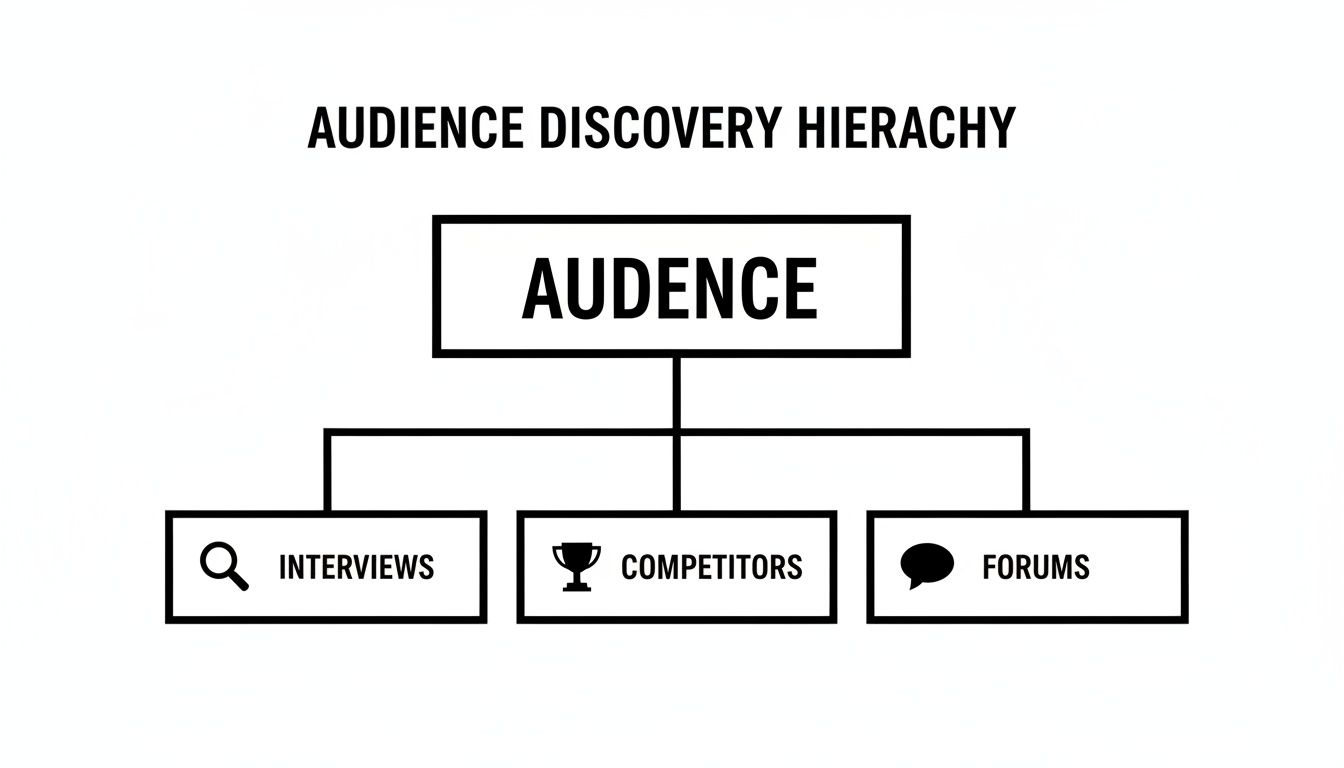
As you can see, great content isn't dreamed up in a vacuum. It’s born from listening to your audience, analyzing your competition, and tapping into community conversations.
Developing Strategic Cluster Topics
With a solid pillar in place, you can start building out your cluster topics. Think of these as the spokes on the wheel. They are more specific, long-tail subjects that dive deep into the real-world questions your audience has. Each cluster becomes a piece of content—a blog post, a video, a guide—that strategically links back to your main pillar page.
For our "HubSpot Implementation for SMEs" pillar, the cluster topics practically write themselves:
- Decision-Making Content: Help prospects who are stuck in the "which one?" phase. Think "HubSpot vs. Zoho for a Growing Sales Team" or "Is HubSpot Marketing Hub Overkill for a 10-Person Company in 2026?" This captures buyers actively comparing solutions.
- Problem-Solving Content: Use the pain points you uncovered in your interviews to create hyper-relevant articles. "How to Actually Automate Lead Nurturing in HubSpot" or "Fixing the Most Common Data Sync Errors Between HubSpot and Shopify" shows you can solve their problems before they even hire you.
- How-To & Implementation Guides: Show off your technical chops with practical, step-by-step tutorials. A piece like "The Founder's Playbook for Setting Up HubSpot Sales Hub" or "Migrating from Excel to HubSpot CRM Without a Single Data Casualty" builds immense trust.
When you create this interconnected web of content, you're building a fortress of expertise. Each cluster post bolsters the authority of your pillar page, and the pillar, in turn, passes that authority back down to every supporting piece.
Mapping Keywords to Your Content Ecosystem
Now for the final piece of the puzzle: validating these ideas with keyword research. Fire up a tool like Ahrefs or Semrush and find the exact phrases your audience is typing into Google. But don't just look at search volume; focus on the search intent. What is the user really trying to do?
Let's take our topic "Automating Lead Nurturing with HubSpot." Your research might spit out a few variations, each with a different intent:
- "hubspot lead nurturing examples" (Informational Intent): The user wants to see what's possible. This is perfect for a blog post showcasing 3-4 brilliant workflow examples.
- "hubspot automated email sequence" (Transactional Intent): The user wants to do something. This is a great fit for a step-by-step guide on setting up their first sequence, with a clear CTA for a free consultation.
- "best hubspot nurturing workflows" (Commercial Intent): The user is evaluating and close to buying. An in-depth comparison article or a downloadable template would be ideal here.
The end goal is a detailed content map that assigns a primary keyword and a clear user intent to every single article you plan to write. If you're looking to truly sharpen your execution, mastering the more technical aspects of SEO services in Dubai can give you a serious leg up on the competition. This methodical approach is what separates content that gets lost in the noise from a B2B content strategy that becomes a predictable, lead-generating machine.
Mapping Your Content to the B2B Sales Funnel

So, you’ve nailed down your core topics and are ready to build authority. Excellent. Now comes the part where a good content marketing strategy for b2b becomes a great one: mapping every single idea to a specific stage of the sales funnel.
It's a common mistake to just create "good content." The real question is, good for whom? And when? You can't hit someone with a demo request when they've only just realised they have a problem. That's the marketing equivalent of proposing on a first date.
Your content needs to meet buyers exactly where they are, guiding them from a vague awareness of a problem all the way to signing on the dotted line.
Top of the Funnel (ToFU): Your First Handshake
This is your brand’s first impression. At the top of the funnel, people aren’t looking for your product. They're not even looking for a product. They're simply aware of a challenge or pain point and are starting to look for answers. Your job is to be that helpful, expert voice they find first.
The goal here is education, not sales. You're offering value with no strings attached, building an initial layer of trust.
- Insightful Blog Posts: Think articles like, "7 Signs Your Startup Has Outgrown Spreadsheets." This grabs the attention of someone feeling the pain but doesn't shove your CRM solution down their throat. It just validates their problem.
- Engaging Social Videos: A 60-second video on LinkedIn titled "The #1 Mistake Teams Make When Adopting a New CRM" is perfect. It's snackable, shareable, and positions you as an authority in seconds.
- Informative Infographics: A visual breakdown of "The True Cost of Manual Data Entry" can land with a huge impact. It's easy to digest, highly shareable, and makes the problem tangible.
Forget about tracking leads here. Your key metrics are reach, eyeballs, and engagement. You're building an audience that trusts you.
Middle of the Funnel (MoFU): Building Real Trust
Okay, you have their attention. They know who you are, and they understand their problem more deeply. Now, they’re in the consideration phase, actively comparing different approaches and solutions. This is where you need to go deeper and prove your worth.
This is the make-or-break stage. Your content must shift from simply being helpful to being genuinely persuasive.
In the B2B space, the consideration phase is where trust is truly forged. Prospects are weighing their options, and your content must prove you are not just an expert, but a credible partner who delivers real results.
Here's how you do it:
- In-Depth Webinars: A 45-minute webinar on a specific topic like "How to Automate Your Sales Pipeline with HubSpot and n8n" is pure gold. It showcases your deep expertise, and the live Q&A lets you handle objections in real time.
- Compelling Case Studies: This is your social proof on steroids. A case study detailing how you helped a client boost their qualified leads by 40% is infinitely more powerful than any sales pitch. It turns your promises into proven results.
- Detailed Comparison Guides: Buyers are going to compare you anyway, so why not own the conversation? A guide like "HubSpot vs. Zoho: Which CRM is Right for Your SME in 2026?" positions you as a transparent advisor and captures people with high buying intent.
Building out a strong library of MoFU content is non-negotiable. You can get a better sense of how to tie these assets together by looking into proven CRM automation strategies that nurture prospects effectively.
Bottom of the Funnel (BoFU): Closing the Deal
At this point, your prospect is on the verge of making a decision. They've done the research, weighed their options, and have you on their shortlist. Now's the time to make it incredibly easy for them to choose you.
The content here should be direct, product-focused, and aimed squarely at conversion. No more coyness—just clear, compelling reasons to act.
- Product Demo Videos: A crisp, on-demand video tour of your platform or service is a must. Let them see exactly how it works and how it will solve their problem.
- High-Intent Comparison Pages: Build a page right on your site that compares your service packages or pricing tiers. This helps qualified prospects make a final decision without having to talk to anyone.
- Free Consultation or Audit Offers: The final nudge. A clear, low-friction call-to-action like "Book a Free 30-Minute Strategy Session" gives them a direct path to your sales team.
When you deliberately create assets for each stage, your content stops being a random collection of posts and becomes a finely tuned machine—one that consistently nurtures leads and drives real, measurable revenue.
Building Your B2B Content Operations Machine
Even the most brilliant strategy is just a PDF collecting dust without a real engine to power it. This is where your content marketing strategy for B2B gets its hands dirty. It’s time to build the operational machine that turns your best ideas into a steady stream of high-impact content, week after week. And no, you don't need a massive team or an enterprise-level budget. This is all about creating a lean, intelligent system that practically runs itself.
It all starts with your editorial calendar, but please, ditch the clunky spreadsheet. A tool like Notion or Asana can transform your calendar from a static to-do list into the command center for your entire content operation. This is where you’ll map out your content pillars, cluster your topics, and assign everything from publication dates to target keywords. This kind of clarity is gold—it prevents those last-minute scrambles and keeps your team aligned and moving forward.
A great content strategy rarely fails because of bad ideas. It fails because of inconsistent execution. A solid operational system is your insurance policy against that inconsistency.
With your command center in place, the next step is building a simple, repeatable workflow. Every single piece of content, whether it's a blog post, a webinar, or a short-form video, needs to follow the same predictable journey from idea to publication. This isn't about stifling creativity; it’s about creating a safety net that maintains quality and ensures nothing slips through the cracks.

A Lean Workflow From Ideation To Publication
A clearly defined workflow is your best defense against chaos and ambiguity. When everyone on the team knows their role and what’s expected at each stage, they’re empowered to work fast and with confidence. Your process should be documented and visible to everyone right inside your project management tool.
Here’s a battle-tested workflow I’ve seen work wonders for lean teams:
- Ideation & Briefing: The process kicks off when a detailed content brief is created. This isn't just a title; it’s a blueprint containing the target persona, primary keyword, funnel stage, key talking points from customer interviews, and a very clear call-to-action.
- Drafting: The writer takes the brief and runs with it, focusing on delivering genuine value and nailing the core message. This stage is about getting the ideas onto the page, not about perfection.
- Review & Editing: Next, an editor polishes the draft. They're checking for clarity, tone, and grammar, but more importantly, they’re ensuring the piece aligns perfectly with your brand voice and hits all the strategic marks from the brief.
- Design & Production: Now it's time to make it look good. The design team or a creator jumps in to source images, build custom graphics, or produce any video assets needed to bring the content to life.
- Final Approval & Scheduling: One last look. The final, complete asset is reviewed and then scheduled for publication in your CMS. At the same time, all promotional activities across your distribution channels are queued up and ready to go.
This kind of structured process guarantees quality and efficiency, transforming content creation from a messy, unpredictable art form into a reliable production line.
Your Scalable B2B Content Tech Stack
Let me be clear: you do not need dozens of expensive tools to run a powerful content operation. The secret is picking a few core platforms that solve specific problems and, crucially, play well together. For a startup or SME, a lean stack provides the most bang for your buck without bloating your budget.
Here’s a simple but incredibly effective tech stack for 2026:
- Project Management: Notion or Asana. This is your single source of truth for the editorial calendar, content briefs, and workflow tracking.
- Creation & Editing: Grammarly Business. This is about more than just catching typos. It helps enforce a consistent tone of voice and level of clarity, no matter who is writing.
- SEO: Ahrefs or Semrush. Absolutely essential for keyword research, tracking your rank, and keeping an eye on what your competitors are up to.
- Automation: n8n.io. This is the secret weapon. It’s an open-source tool that lets you connect your apps and automate repetitive tasks without needing a developer.
Automation is what truly allows a small team to punch well above its weight. Instead of manually copying and pasting information between your tools, you can build simple, powerful workflows.
For example, you could have a workflow where submitting a Google Form for a "new content idea" automatically creates a card in Asana. No more lost ideas.
Or, imagine a workflow that automatically creates a draft post in WordPress and pings your editor on Slack the moment a writer drags their task card into the "Ready for Review" column. This is how you build a hands-off, highly efficient content machine that lets you focus on strategy, not admin.
Getting Your Content Seen and Proving It Works
I've seen it happen more times than I can count: a team pours weeks into a brilliant piece of content, hits 'publish,' and then… crickets. A fantastic case study or a game-changing report that nobody sees has a return on investment of exactly zero. The hard truth is that great content is only the starting point. How you get it in front of the right people is what makes all the difference.
This isn't about blasting your work across every channel you can think of. It's about surgical precision. For any B2B company, a strong presence on LinkedIn is simply non-negotiable. When you share a new article with a personal take, you're not just posting a link; you're starting a conversation that could lead to your next big client. In the same way, targeted email campaigns let you hand-deliver a high-value asset, like a webinar recording, to a specific list of people who are already engaged with your brand.
The real purpose of distribution isn't just generating clicks or traffic. It's about sparking meaningful conversations, building your authority, and giving the right person the right resource at the exact moment they need it.
Stop Chasing Vanity Metrics and Start Tracking Revenue
Once your content is live, it’s incredibly tempting to get a rush from watching the likes, shares, and page views climb. While those numbers aren’t completely meaningless, they won’t convince your CFO. To really prove the value of your content and justify your budget, you have to connect your work directly to business goals.
This is where a tool like Google Analytics 4 (GA4) goes from being a dashboard to your most valuable ally. Forget just looking at traffic sources; you need to set up custom conversion events that track actions with real business impact.
So, what should you actually be measuring?
- Marketing Qualified Leads (MQLs): This is your bread and butter. How many people submitted a form to download your new e-book or signed up for your latest webinar? This is a direct line from your content to lead generation.
- Pipeline Influence: Dig into your CRM. Can you see which contacts read a specific blog post or case study before they became a qualified sales opportunity? This is how you prove your content is actively helping to close deals.
- Customer Acquisition Cost (CAC): Over time, you can show how content marketing is lowering the cost to bring in a new customer when compared to channels like paid advertising.
- Bottom-of-Funnel Conversion Rates: Look at your high-intent pages—like case studies or pricing. What percentage of visitors from those pages go on to request a demo? This shows your content is successfully pushing ready-to-buy prospects over the finish line.
Choosing Your Battlegrounds: Where to Distribute
Let's be realistic: you don't have unlimited time, money, or people. The trick is to pick a handful of channels where you know your audience lives and go all-in on executing them perfectly. It’s always better to dominate two channels than to be mediocre on ten. A well-oiled distribution plan is a cornerstone of any truly effective social media marketing service.
To help you decide where to focus your energy first, here’s a quick breakdown I often share with clients:
| Channel | Typical Cost | Effort Level | B2B Impact Potential |
|---|---|---|---|
| LinkedIn (Organic) | Low | Medium | High |
| Email Marketing | Low | Medium | High |
| SEO / Blog | Medium | High | Very High |
| Paid Social (LinkedIn) | High | Medium | High |
| Webinars | Medium | High | Very High |
When you master smart distribution and tie your efforts back to the KPIs that leadership actually cares about, you elevate your content from a simple marketing task to a predictable, revenue-generating machine. This is how you earn respect, secure a bigger budget, and scale your impact.
Your B2B Content Strategy Questions Answered
Even with the best-laid plans, you're going to have questions once the rubber meets the road. That's normal. Over the years, I've seen a few common sticking points trip up even the smartest B2B marketers, especially those in the startup and SME trenches.
Let's start with the big one I hear almost every day: "So, what's the budget for all this?"
While industry benchmarks suggest allocating 25-30% of your total marketing budget to content, that number can feel abstract. For a startup, I find it's far more practical to flip the question. Don't start with a budget; start with the value of a new customer. Once you know what a client is worth, you can work backward to determine a realistic and justifiable investment to win them over with your content.
Quality Over Quantity Always Wins
The next big debate is always quality versus quantity. Frankly, in the B2B world, it’s not even a debate. It's a settled fact. Your audience is made up of savvy professionals with zero time for fluff. They can spot a low-effort, rushed article from a mile away.
One deeply researched, high-impact piece of content will always do more for your brand than ten shallow blog posts ever could.
The goal isn't just to fill your editorial calendar. It's to publish content so insightful that your ideal customer would feel like they should have paid for it. That's the real benchmark for quality in B2B.
Instead of churning out content for the sake of it, pour your resources into creating one "hero" asset each month. This could be an original research report, a comprehensive guide, or a data-rich case study. Then, you can strategically break that hero piece down into dozens of smaller assets—blog articles, LinkedIn posts, video clips, and email snippets—getting maximum mileage without compromising on the quality of your core idea.
This "hero and spoke" model ensures you’re consistently building authority and publishing assets that actually influence buying decisions.
So, how long until you see the needle move? Let's be clear: B2B content marketing is a marathon, not a sprint. While you might see leads from bottom-of-funnel content in as little as three months, building genuine SEO authority and a predictable inbound engine is a 6-12 month commitment. Be patient, stay consistent, and keep a close eye on leading indicators like keyword rankings and marketing qualified leads (MQLs) to know you're on the right track.
Ready to stop guessing and start building a content engine that drives real revenue? GoDesign Technologies builds comprehensive B2B content strategies, high-converting websites, and powerful automations that turn your expertise into a lead-generation machine. Learn how we can help you scale faster at https://godesign.ae.
Enhanced by Outrank